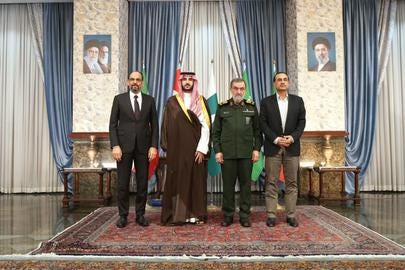
On Monday, while Donald Trump was publicly pondering whether to “make a deal” with Iran or “finish them off,” something happened in Tehran that should have set off alarms in every office of the State Department, assuming anyone is still left there to hear them.
Saudi Arabia’s defense minister, Prince Khalid bin Salman, the brother of the Crown Prince, flew to Tehran. With him came Pakistan’s Field Marshal Asim Munir and Turkey’s intelligence chief, Ibrahim Kalin. They sat down with Iran’s President Masoud Pezeshkian, Foreign Minister Abbas Araghchi and senior security official Rezaei, who hosted the talks, for about two hours. The agenda: the Houthi attacks on Saudi Arabia, the Strait of Hormuz, the American blockade of Iran’s ports and a regional non-aggression framework.
Read that list again. Those are the four biggest security problems in the Persian Gulf. The countries that actually live there just met to discuss them. The United States, which has two carrier strike groups, an amphibious ready group and a blockade in the neighborhood, was not in the room. Nobody seems to have missed it.
The pact that was supposed to protect Riyadh from Iran
Here is the delicious part. The three visitors are the signatories of the Makkah Agreement, the mutual-defense treaty that Saudi Arabia, Turkey and Pakistan signed on August 7. Article 2 says an attack on one is an attack on all. It was sold, at least in Washington’s imagination, as a Sunni shield for the Kingdom against Iran and its friends in Yemen.
Eleven weeks later, the entire shield showed up in Tehran to talk about cooperation. Iran’s ambassador to Pakistan says Tehran will “study” the agreement, “and if it is good, we will support it.” The treaty conveniently includes an accession clause allowing new members to join by consensus. My sources tell me the three formally invited Iran to join once the U.S.-Israeli war ends, and that Tehran accepted on that basis. No official readout confirms that yet. But the official readouts did agree to keep talking “among the four,” and Iran has a phrase for what it wants: “endogenous security.” Translation: security for the Gulf, by the Gulf, without the 5th Fleet.
Imagine NATO’s founding members inviting the Soviet Union to join in 1952, and you have some idea how badly this has gone for American strategy.