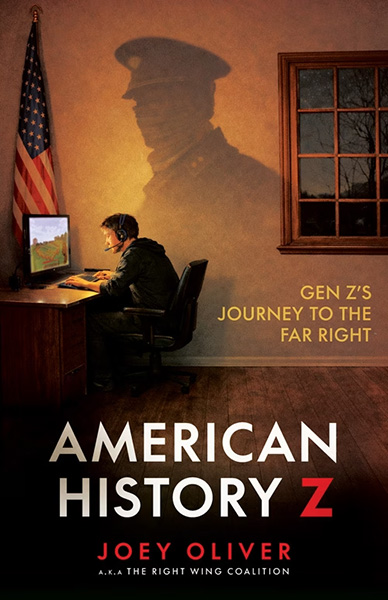
Joey Oliver, American History Z: Gen Z’s Journey to the Far Right, Arktos Media, Ltd., 2026, 224 pages, $22.95 paperback, $4.99 ebook
American History Z, with a foreword by Jared Taylor, just broke Arktos Media’s record for first-day sales and is shaping up to become a bestseller. It seeks to answer a question older loyalists of the political establishment ask almost in desperation: What could possibly be turning young men so powerfully toward “right-wing radicalism?” The generation in question, popularly termed “Gen Z” or “the Zoomers,” is commonly defined as Americans born between 1996 and 2010. Joey Oliver, born 1998, is therefore a fairly senior member of the cohort whose political education he describes in his first work of nonfiction after an earlier novel called The Grey Lion.
This generation can just about remember George W. Bush’s America: already riddled with the corrupting influence of liberalism, but outwardly still a continuation of the America of their fathers. There were still plenty of what we politely call “nice neighborhoods” with “good schools” — places where whites were free to be ourselves and raise our children. But those children are Generation Z, now coming of age or already young adults, and they see clearly that the world they glimpsed early in life is gone. They cannot, therefore, simply approach life on the same terms as their parents, but will have to fight for things their parents took for granted.
Like several generations before, they were raised on liberalism. They initially took to it so well they could hardly believe anyone had ever thought any other way:
The very idea that White, land-owning men had once been the sole demographic with a say in society was ridiculous. Women’s suffrage was heralded as another monumental victory in our battle to establish a world where everyone had an equal say. We couldn’t believe that a society that made distinctions between groups of people had previously existed at all. We’d solved the problem of government [and] were now waiting for everybody else to catch up.
Nevertheless, they learned that their more remote ancestors had somehow managed not to be liberals. In the process, they had done horrible, illiberal things such as enslaving Africans, murdering American Indians, and expecting women to be faithful wives and mothers. These crimes must never be forgotten, they were assured, and who were they to disagree?
So the young liberals-in-training cheered as a black man became President, trusting the assurances that the “post-racial era” had finally arrived. They were wholly disabused of that notion by his actual administration, however. The simple ideal of hiring the best man for the job, for example, was still a long way off due to all the injustice that had accumulated during past ages when their ancestors had inexplicably failed to be liberals:
It turned out that non-Whites still could not be evaluated based on their objective skills and achievements. Our society was so entrenched in racism that these people never had a chance to succeed. There was only one way to get them on our level: we would have to step down willingly. So, we did. It was their turn, whether or not they’d earned it. But surely, now that we’d cleared the way for these people to get a fair shot, inequality should vanish soon, right? Well, it most definitely did not.
When the promised results failed to emerge, it was explained that this was because we hadn’t tried hard enough. If something isn’t working, this proves we need more of it. Eventually it began to dawn on the young that no possible outcome could ever make the partisans of racial quotas say: “We have succeeded, and our work here is done.” Racial justice was not a result that could actually be arrived at, but an eternal struggle — more specifically, an eternal struggle against white people like themselves......
..A combination of growing radicalism and the free flow of information on the internet allowed Gen Z to learn more quickly than their elders. Mr. Oliver was arriving in his mid-twenties at ideas I did not seriously consider until nearly 40.
American History Z continues the story of Gen Z’s political education into Donald Trump’s second term in office, but I will let readers discover the rest for themselves.
In closing, I will highlight one more of the book’s strengths that distinguishes it from the work of older identitarians: Mr. Oliver is highly conscious of the distinctively womanish nature of the despotism closing in on us.
We are constantly assured that the increasingly onerous restrictions on our freedom are meant only for our own safety. Our opponents no longer try to argue that our opinions are false; only that they lack “compassion.” They don’t want to convince us; just exclude us (“cancel culture”). All this is very female. For white women in particular, “wokism” is a way of joining the winning team and achieving partial absolution for the real or alleged sins of their race — at the expense of scorning their own men, of course. When they are young, this sounds like a good trade-off; as they age and begin to ask where their husbands are hiding, their perspective will change, but for many it will be too late.
Mr. Oliver notes that, as with antiracism, feminism was initially supposed to be a reconciliation, but has become open resentment and seeks retribution.
Women now had it all — education, careers, contraception, no-fault divorce, affirmative action — you name it. But instead of contentment and success, we got the most unhappy female population in recorded history. We were doing everything we could for women, but it wasn’t enough. We tried to give them what they asked for, and they still hated us. So, after the endless efforts and concessions, lots of us young men gave up on trying to appease any of these people [meaning both women and non-whites]. We don’t have an obligation to be nice to people who hate us.
Young white women may soon have to learn even more quickly than the men of Gen Z. This is among the greatest challenges now facing our race.
