THE most momentous development in the history of the book until the invention of printing was the replacement of the roll by the codex; this we may define as a collection of sheets of any material, folded double and fastened together at the back or spine, and usually protected by covers [[ii]].
In other words, a codex is essentially the familiar bound “book” with which we are all familiar today. Between the 2nd and 4th centuries, scrolls gradually disappeared in favor of codices. Their format is little changed from the earliest surviving codices from the 4th century [[iii]]. “It could be made of either papyrus or parchment, but it was the parchment codex which eventually won the day” [[iv]].
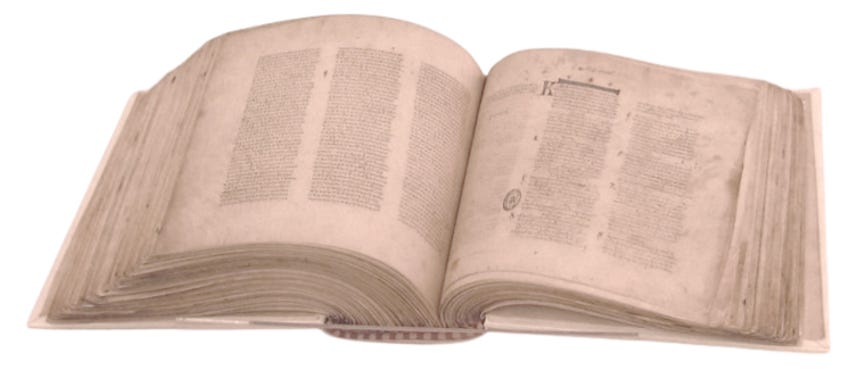
In its early centuries Christianity became a profoundly textual religion, centered on reading, teaching, comparing, and preserving Scripture. Unlike the scroll, the codex allowed readers to turn directly to specific passages, compare multiple books and prophecies side by side, assemble the Gospels and Epistles into a single compact volume, and annotate texts for study and preaching. These practical advantages made the codex ideally suited to the Church’s missionary, theological, and scholarly needs, helping to explain why Christians adopted it earlier and more consistently than the surrounding pagan world [[v]]. The details are the subject of much debate [[vi]], however it is clear that “Christians invested in the codex far more than is reflected in the larger book-culture of the time” [[vii]].
