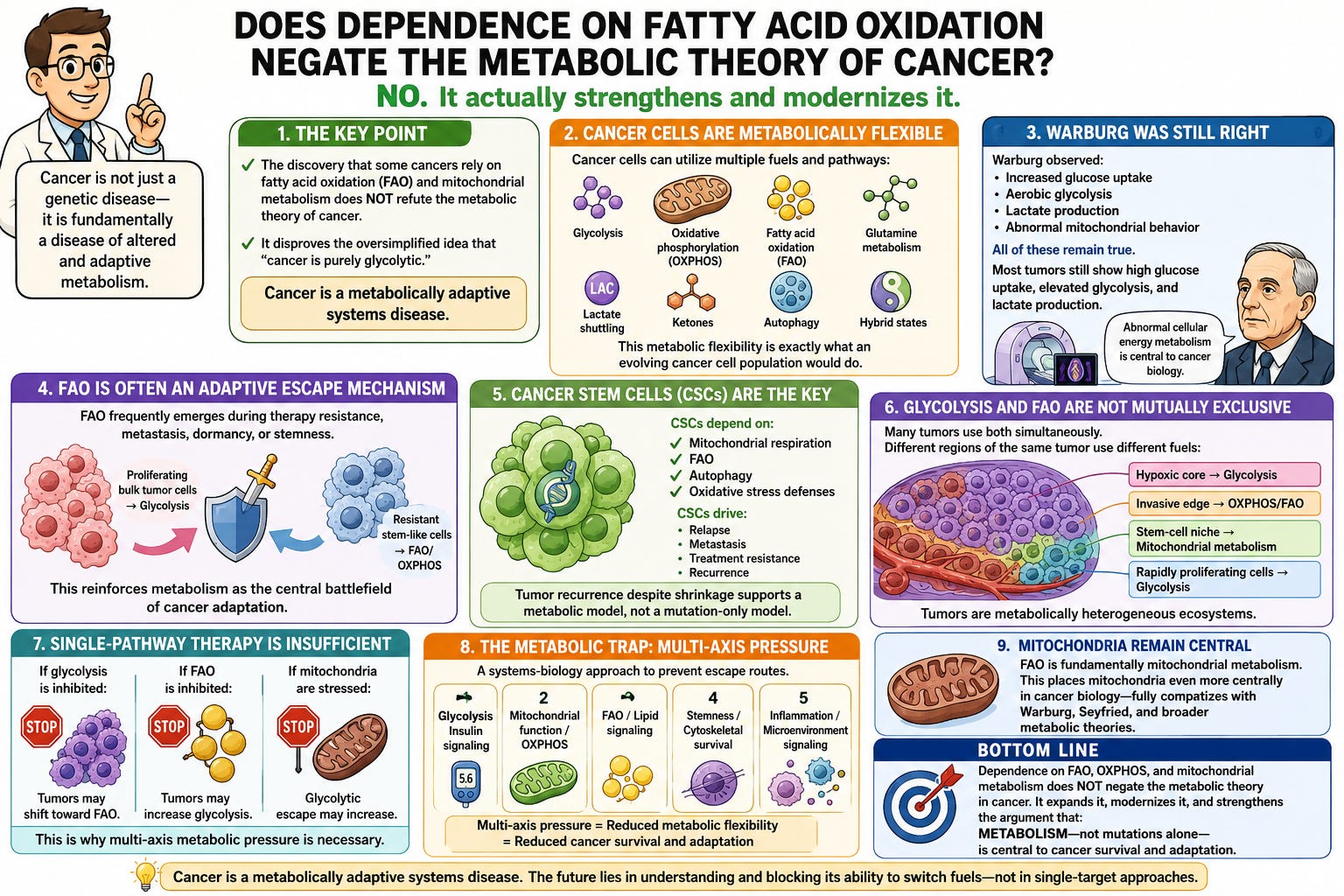
No. In many ways, the discovery that some cancers depend heavily on:
fatty acid oxidation (FAO) and mitochondrial metabolism
actually:
strengthens and modernizes the metabolic theory of cancer rather than disproving it.
What it disproves is:
an overly simplistic interpretation of the Warburg effect.
There is a major difference between:
“Cancer is purely glycolytic,”
and:“Cancer is fundamentally a disease of altered and adaptive metabolism.”
The second statement remains strongly supported.
The critical misunderstanding
Many people incorrectly equated the:
metabolic theory of cancer
with:
“all cancers only use glucose.”
That was never really Warburg’s deeper point.
Warburg’s central thesis was that:
abnormal cellular energy metabolism and mitochondrial dysfunction are central to cancer biology.
Modern research strongly supports this broader concept.
