Labels

Tuesday, March 30, 2021

Do You Believe in Magic? | Kunstler

The people pretending to run the world’s financial affairs do. The more layers of abstract game-playing they add to the existing armatures of unreality they’ve already constructed, the more certain it becomes that they will blow up all the support systems of a sunsetting hyper-tech economy that now has no safe lane to continue running in.

Virtually all the big nations are doing this now in desperation because they don’t understand that the hyper-tech economy is hostage to the deteriorating economics of energy, basically fossil fuels, and oil especially. The macro mega-system can’t grow anymore. We’re now in the de-growth phase of a dynamic that pulsates through history, as everything in the universe pulsates. We attempted to compensate for de-growth with debt, borrowing from the future.

But debt only works in the youthful growth phases of economic pulsation, when the prospect of being paid back is statistically favorable. Now in the elder de-growth phase, the prospect of paying back debts, or even servicing the interest, is statistically dismal. The amount of racked-up debt worldwide has entered the realm of the laughable. So, the roughly twenty-year experiment in Central Bank credit magic, as a replacement for true capital formation, has come to its grievous end.

Hence, America under the pretend leadership of Joe Biden ventures into the final act of this melodrama, which will end badly and probably pretty quickly. They are about to call in the financial four horsemen of apocalypse: 1) Modern Monetary Theory (MMT), 2) a command economy, 3) Universal Basic Income (UBI, “helicopter” money for the people), and 4) the “Build Back Better” infrastructure scheme.

MMT is the idea that a nation which claims a monopoly on issuing money can “create” new money ad infinitum with no negative consequences. That is, we can “lend” ourselves money (borrow it into existence) without having to worry about paying it back. The theory caught on only because that’s what we’ve done for two decades and, so far, it hasn’t destroyed the banking system — though debt turned exponential, which is to say ruinous, only recently — so we won’t have to stand by long to see how this experiment works out. Note this: MMT completes the divorce between productive activity and capital formation, that is, prosperity without wealth.

A command economy means that government increasingly attempts to take over economic enterprise, to replace x-million individual economic choices of freely-acting people in a society with bureaucratic central planning. (Have you already said ha-ha-ha, knowing how that has worked out through history?)

UBI is the primary feature of that because, in a command economy, production is mostly pretend, so you just have to give people money (for nothing). Remember the old basic operating system of the Soviet Union, stated succinctly as: We pretend to work and they pretend to pay us. Got that?

The idea behind “Build Back Better” is to renovate the infrastructure of a hyper-tech economy that actually no longer exists because we are in the contraction phase of an historic pulsation or cycle, leaving us with lots of tech and less production, tending toward zero. Nobody flogging this slogan actually knows what it ought to mean under the circumstances, which is to go with the flow of the reality of this contraction: to downsize, downscale, and re-localize all our activities to bring them back into sync with actual productivity — that is, raising food, making real stuff, and trading it. Again, it’s the energy dynamic, stupid.

To get to that point, we’re going to shed the massive over-burden of financial game-playing that has pretended to represent our economy. That means stock valuations and bond prices will vaporize along with the derivative activities concocted for trading gainfully in these now-phantom representations of capital. If that happens sooner rather than later, we won’t even be able to pretend to Build Back Better the interstate highways, the electric grid, airports, and all the other stuff in the “infrastructure” folder.

Indeed, a lot of that would be malinvestment folly now because we’re nearing the end of mass motoring and commercial aviation as we’ve known them. If we even have electricity twenty-five years from now, it will come from much-reduced grids on a much more regional basis. The bottom line for all this is that pretty soon every corner of the country will be on its own amid quite a bit of social disorder and financial wreckage. So, whatever energy you actually can marshal to Build Back Better, save it for your town or your local community. And remember, all of the attempts by a national government to control these events, and coerce its citizens in the service of that, will only lead to a more ineffectual and impotent national government that nobody has faith in, confirming the fact that you are on your own.

https://kunstler.com/clusterfuck-nation/do-you-believe-in-magic/

Undeniable fact: “Carbon Dioxide” is NOT a “pollutant” but a Giver of Life - Ice Age Now - by Robert

“Without continued reliance on carbon-energy, much of Canada’s population would simply freeze to death in the next few winters.”

– Chemist Dr. Klaus L.E. Kaiser

____

Open Letter to the Canadian Prime Minister from chemist Dr. Klaus L.E. Kaiser.

Undeniable fact: “Carbon Dioxide” is NOT a “pollutant” but a Giver of Life


March 27, 2021

Dear Prime Minister,

Presumably, you’ve welcomed the Supreme Court’s ruling on the “carbon tax”.

It never fails to amaze me how “climate change” is being equated with “carbon dioxide” (commonly referred to simply as “carbon”) or even termed “carbon pollution.”  In fact, carbon dioxide (chemical symbol “CO2”) is the substance that is absolutely vital for all life on Earth!

The ruling only mentions “carbon” and “pollution.” That’s simply more misunderstanding, confusion, and “politics.”

Yes, “climate change” has been going on (up and down) ever since this planet came into existence. Just 22,000 years ago, the whole eastern part of Canada was covered with a 1 to 3 km thick sheet of ice. Since then, over a period of around 15,000 years, it just melted away with natural “climate change.”

Does any sane person really think it was because of some camp-fires by the few earthlings then inhabiting the continents? And, why should that natural process have stopped once the ice was gone? Furthermore, analyses of deep ice core samples showed that the carbon dioxide rose well after the ice began melting, with a time lag of nearly 1000 years.

The current cult-like desire for “decarbonisation” of mankind’s energy needs is fostering severe negative consequences, especially for future generations – and has no effect on “climate change.”

Yesterday’s ruling by the Supreme Court of Canada (SCC), upholding the legitimacy of the “carbon tax,” i.e. the law of 2018, entitled “Greenhouse Gas Pollution Pricing Act”:  is a travesty.

As a chemist, I surmise that the law itself, by its title alone, is a travesty!

While the SCC may not have had any choice to rule differently, in terms of its legality, the law itself is based on misleading/faulty language and interpretation of scientific facts.

Of course, few of the learned justices have had the knowledge or training required to understand chemistry, physics, biology, ecology, geology, and related fields; nor do most of our illustrious politicians.

The ruling only mentions “carbon” and “pollution.” That’s simply more misunderstanding, confusion, and “politics.”

The undeniable fact is that “carbon dioxide” is NOT a “pollutant” but an absolutely vital trace gas in the Earth’s atmosphere, currently at around 0.04% of all its components.

Undisputed Scientific Facts

  • Without that CO2 in the atmosphere, all life on Earth would cease to exist!
  • Without that CO2 in the atmosphere, no oxygen would be produced; CO2 is/has been the sole source of molecular oxygen (that we breathe in with each breath)!
  • Without the steady supply of CO2 from the thousands of active volcanoes and fumaroles, life on Earth would have already come to a standstill.
  • Without that CO2 in the atmosphere, oceans and (most) fresh waters would become “acidified.”
  • Without the use of carbon-type resources (like coal, oil, and natural gas), the world cannot continue.
  • Without continued reliance on carbon-energy, much of Canada’s population would simply freeze to death in the next few winters.

The above statements are all undisputed scientific facts, known for decades/centuries already!

Best regards,
Dr. Klaus L.E. Kaiser

__________________________

Dr Klaus L E KaiserDr. Klaus L.E. Kaiser is a professional scientist with a Ph.D. in chemistry from the Technical University, Munich, Germany. He has worked as a research scientist and project chief at Environment Canada‘s Canada Centre for Inland Waters for over 30 years and is currently Director of Research at TerraBase Inc. He is author of nearly 300 publications in scientific journals, government and agency reports, books, computer programs, trade magazines, and newspaper articles.

Dr. Kaiser has been president of the International Association for Great Lakes Research, a peer reviewer of numerous scientific papers for several journals, Editor-in-Chief of the Water Quality Research Journal of Canada for nearly a decade, and an adjunct professor. He has contributed to a variety of scientific projects and reports and has made many presentations at national and international conferences.

Dr. Kaiser is author of CONVENIENT MYTHS, the green revolution – perceptions, politics, and facts
convenientmyths.com

Dr. Kaiser can be reached at: mail@convenientmyths.com

https://www.iceagenow.info/undeniable-fact-carbon-dioxide-is-not-a-pollutant-but-a-giver-of-life/

Monday, March 29, 2021

In essence…it always was…and still is…a War on Christ!

"What do you get when you cross a theologian with an economist and a historian?

You get Gary North!

I just finished “Moses and Pharaoh” by Gary North – published in 1985.

It’s a fascinating read in that it shows that nothing has changed over thousands of years."

The conflict between Moses and Pharaoh was a conflict between the religion of the Bible and its rival, the religion of humanism. It is not common for scholars to identify Egypt's polytheism with modern humanism, but the two theologies share their most fundamental doctrines: the irrelevance of the God of the Bible for the affairs of men; the evolution of man into God; the impossibility of an infallible word of God; the nonexistence of permanent laws of God; the impossibility of temporal judgment of God; and a belief in the power of man.

What Bible commentators have failed to understand is that the conflict between Moses and Pharaoh was at heart a conflict between the two major religions in man's history, dominion religion and power religion, with the third religion - escapist religion -represented by the Hebrew slaves. What they have also failed to point out is that there is an implicit alliance between the power religion and the escapist religion. This alliance still exists. - Moses and Pharaoh: Dominion Religion vs. Power Religion - a book review (It uniquely ties together Government/Religion/Politics/Culture)


In the foreword to his book “Millennialism and Social Theory”, Gary North makes what I considered an ironic statement. He noted that when a secular academic finds out that his book was written by a bible believing Christian, he would immediately toss it away as not credible. The Christian believer, on the other hand, has zero interest in social theory. I can personally confirm the last statement by my personal experience with various Christian churches and study groups – they’re not interested!

Therein lies the problem. The bible, especially the Old Testament, is full of social theory. Yet, the academics won’t take the time to study those theories – and the Christian believers, who have turned their faith into a personal pursuit of pietism, aren’t interested because it doesn’t fit their presupposition of end time theology.

Both parties in this alliance live in total ignorance of possible solutions to our civil societies’ problems, because they have already made up their minds as to what is truth. - The Alliance Made in Hell?


What say we expose some myths about politics?

Gary North: The vast majority of conservatives -- I would guess 80% -- are just like this woman. They are intellectually lazy. They have no respect for ideas. They have no intention of sacrificing either time or money to become better informed. They just want to feel superior. They spend their spare time ranting to other ill-informed people on the multibillionaire wokesters' social media platforms. In the great conflicts of life, they are bystanders. They do not have the strength of character to be winners. They think ranting is a substitute for thinking. They expect victory to be handed to them on a silver platter. - Why "Cultural Marxism" Isn't Marxist, and Why Anti-Communism Is Impotent in Dealing With It - by Gary North - March 27, 2021 – you can also look at other posts by him by simply entering his name in the search window. You will read for a week! You should definitely bookmark https://www.garynorth.com/


Is Conservatism Christian? Research it yourself!

And it is also why conservatism is an intrinsically non-Christian identity, for all its evangelical trappings in the USA. - Vox Popoli: All conservatives are cucks


Vox Popoli: Christianity isn't etiquette (Churchianity) - Middle Class Christianity: Quiet kindness and addressing your audience in calm smooth tones is the way to address people. Don’t use ad-hominins, stereotypes, or harsh language.

Christianity: Jesus in the gospel of Matthew: Woe to you Pharisees, you brood of vipers, you snakes, you white-washed tombs, you rotten corpses twice dead, you sons of hell (Matt 23).


“But these physical hardships were not the chief battle in which Paul was engaged. Far more trying was the battle that he fought against the enemies in his own camp. Everywhere his rear was threatened by an all-engulfing paganism or by a perverted Judaism that has missed the real purpose of the Old Testament law. Read the Epistles with care, and you see Paul always in conflict. At one time he fights paganism in life, the notion that all kinds of conduct are lawful to the Christian man, a philosophy that makes Christian liberty a mere aid to pagan license. At another time, he fights paganism in thought, the sublimation of the Christian doctrine of the resurrection of the body into the pagan doctrine of the immortality of the soul. At still another time, he fights the effort of human pride to substitute man’s merit as the means of salvation for divine grace; he fights the subtle propaganda of the Judaizers with its misleading appeal to the Word of God. Everywhere we see the great apostle in conflict for the preservation of the church. It is as though a mighty flood were seeking to engulf the church’s life; dam the break at one point in the levee, and another break appears somewhere else. Everywhere paganism was seeping through; not for one moment did Paul have peace; always he was called upon to fight.” - The Good Fight of Faith, by J. Gresham Machen (1929) (Involves conflict)


Vox Popoli: The fork in the road - (You will be forced to choose a side and there will be a price.) - This is why I pay very little attention to atheists, agnostics, and pagans who believe they are opposed to globalism. Their belief is sincere, but they simply don't understand the true nature of the war that presently engulfs Man. Despite their intentions, I expect that many, not most of them, will ultimately gravitate to the other side when push comes to shove.

Because, at the end of the day, you must either bend the knee to Jesus Christ or to the Prince of this World. You will be forced to choose a side and there will be a price. Standing proudly on your own is an illusion and it was never an option.

Do not suppose that I have come to bring peace to the earth. I did not come to bring peace, but a sword. For I have come to turn ‘a man against his father, a daughter against her mother, a daughter-in-law against her mother-in-law— a man’s enemies will be the members of his own household.’


If you are still reading – and that is a good sign - American Standard Version
But if ye are without chastening, whereof all have been made partakers, then are ye bastards, and not sons. – Hebrews 12:8………let us get to the bottom line:


Are We Governed by Humans?

Satan’s servants – both inside and outside of the church – are human actors.  They will not be convinced by the logic and purity of the non-aggression principle.  If all it took in this world was for reason to govern, libertarianism would be the accepted political regime globally.

It is not, and I have no better explanation as to why than that presented here.  We are governed not by good people with bad ideas; we are governed by servants of Satan. - bionic mosquito: Floating in the Æther?

As Americans, our lives are affected by government, politics, religion and culture. However, few of us are able to coherently explain or discuss the inter-dependence which exists among all four - http://www.crushlimbraw.com/ - as if there was none!

Within that structure are multitudes of institutions like education and media just for starters, which form our politics and culture. Can you see the problem?

See ya next time – Crush – still connecting dots!

How And Where Did The Original Holy Week Happen? - By G.W. Thielman

The days of Holy Week can be reconciled by careful accounting of events and by recognizing alternative ways that ancients used to mark time.

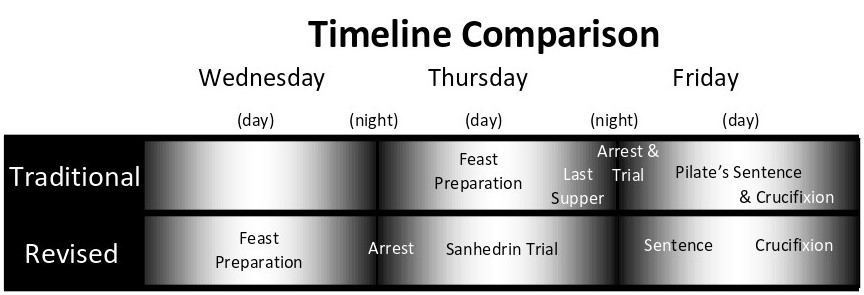
Christians around the world prepare for their Good Friday vigil by remembering the Last Supper on Holy Thursday, beginning in the late fourth century. This chronology assumes that Jesus’ trial by the Sanhedrin following his arrest at Gethsemane on the Mount of Olives commenced the night before his crucifixion.

Another debate concerns whether the Last Supper that Jesus celebrated with his disciples constituted a Passover meal. Careful aggregation of the Gospel accounts helps resolve these difficulties by linking this celebrated feast to Wednesday evening and the wee hours of Thursday morning.

Assuming the Last Supper was celebrated on Thursday evening leads to the contention that the Sanhedrin trial of Jesus occurred clandestinely that night and was thereby illegitimate. This can have misleading implications.
Elusive Target

As an itinerate healer and preacher, Jesus avoided the administrative capitals Sepphoris and Tiberius, even traveling to Phoenicia to elude Herod Antipas. (For readability, hyperlinks provide most scriptural citations.) He had no intention of being quietly slain for political exigencies, as John the Baptist had been in the Machaerus fortress as Josephus records (Antiquities §18.119).

Jewish leaders who opposed Jesus shared his objective—they sought to discredit Jesus and his ministry through a public blasphemy trial, not by a furtive Star Chamber court. They even arranged his burial as Paul related at Pisidian Antioch in c. AD 48. Hence, the traditional chronology with its nighttime forum is implausible.

Had the Sadducees merely wanted to eliminate Jesus without fuss, sicarii assassins (Ant. §20.186) could have been hired for this task, albeit at some expense. Dispatching an antagonist who frequently moved about and had worked independently as a builder—accustomed to coordinated and arduous labor—might mean an elusive and resistant target.

After a narrow escape, Jesus invited at least four fishermen as companions: Jonah’s sons Simon Peter and Andrew and Zebedee’s sons James and John, men exhibiting strength and dexterity for their vocations, able to serve as bodyguards. Nonetheless, Judas Iscariot was later paid a finder’s fee.

Paschal Sequence

Resolving this dilemma requires recognizing differences in liturgical calendars. The Johannine account identifies the “Jewish”—that is, the official—Passover, as distinct from the one celebrated by the disciples. Regarding wine, Jesus opined “the old is good,” but perhaps this also applied to the reckoning of days.

The paschal lamb is slaughtered before dusk on the 14th of the first month called “Aviv” in Cana’an, meaning between 3 p.m. and 5 p.m. at the Temple, as expounded by Josephus (War §6.423). Its carcass is roasted and consumed that evening along with unleavened bread, which would continue to be eaten over the next six days until the 21st as presented in Torah (Exodus 12:1513:623:15 and Leviticus 23:6).

After the Babylonian conquest, the feast commenced in the evening that marked the 15th of the first month called Nisan following sight of the new moon after vernal equinox, despite prophetic objection. Josephus elucidated the eating of unleavened bread as the day succeeding the communal sacrifice (Ant. §3.248-249). Several first-century Judaic worshippers followed the pre-exile calendar based on Torah instructions (Exodus 12:2-6; Leviticus 23:5 and Numbers 9:1-3).

During Josiah’s reforms in 622 BC, Passover became a national spring feast, centralized at the place of God’s choosing. Tradition ascribes this location to Solomon’s Temple on Mount Moriah in Jerusalem. That site was destroyed in 587 BC and rebuilt by Zerubbabel in 515 BC. An earthquake in 31 BC (Ant. §15.121) led to its replacement from 20 BC (Ant. §15.388-393) through 17 BC (War §1.401) by Herod.

Despite designation of Iron Age Zion for this honor, contemporary temples to YHWH were also erected elsewhere in the Levant and in Egypt. These sites included AradBethelElephantine Island (on the Nile), Mount Gerizim, and lastly Heliopolis.

Calendar Comparison

This festival change arose from a shift in marking the day. In the monarchical lunar calendar, days began and ended at sunrise, with the year starting in spring marked by end of visibility of the old lunar crescent.

After returning from exile in the sixth and fifth centuries BC, the priests employed another lunar calendar with days beginning and ending at sunset with the month’s beginning marked by first visibility of the new lunar crescent. Some communities, including the Essenes and Samaritans, retained the pre-exile calendar, while the community at Qumran adopted a solar calendar.

The occupying Romans used the solar Julian calendar with their days reckoning from midnight. Colin Humphreys explores these and many other details in his book “The Mystery of the Last Supper.”

Trial Hearing

Episodes following Jesus’ capture at Gethsemane seem too numerous and time-consuming to be comfortably compressed into a single Thursday evening. At his sumptuous residence, the emeritus high priest Ananus (Ant. §18.26questioned Jesus concurrently with Peter’s denials in all four Gospel accounts (Matthew 26:70-74; Mark 14:68-71; Luke 22:57-60; and John 18:25-27).

Afterwards, Jesus was brought to the Sanhedrin for trial presided over by high priest Caiaphas, son-in-law of Ananus, who remained the most influential. Inspiration for this sacerdotal tribunal can be found in Torah and post-exilic writings. In 47 BC, Herod purged its membership (Ant. §14.175), and in AD 66 Procurator Florus informed that council of his departure (War §2.331) following the unrest he had instigated.

The proceedings against Jesus included presentation of numerous witnessessucceeded by direct interrogation. The matter was concluded by a death sentence to be rubber-stamped shortly after by Pontius Pilate, the Roman Prefect.

Officials don’t typically operate at such breakneck expediency, even in ancient times. So when did all this happen?

Early Days of Passion Week

On Palm Sunday, Jesus arrived at Bethphage, counted as six days before the official Passover. His triumphal entry into Jerusalem through the Golden (or Eastern) gate (Ant. §15.424) adjacent the Temple Mount occurred that afternoon according to the Synoptics (Matthew 21:7-10 and Luke 19:37), although the Johannine account (John 12:12) indicates the day after. Based on dates for AD 33, that Sunday would correspond to 9 Nisan and 11 Aviv (in year 3793 AM) on the Hebrew calendar, which correspond to 29 March (AUC 786) on Rome’s Julian calendar.

The next day (Monday), Jesus cursed a fig tree and cleansed the Temple precinct, later departing that evening returning eastward. Unlike a similar altercation three years before, this market disruption sparked lethal reaction from the authorities.

The following day (Tuesday), the fig tree had withered, and Jesus entered Jerusalem. He taught the crowds by each Gospel account (Matthew 22:1 – 23:36; Mark 12:1-44; Luke 20:1 – 21:36; and John 12:34-36) and then departed towards evening.

The Upper Room

On 14 Aviv (Wednesday), Jesus instructed his disciples to find a man with a water jug and prepare the Passover feast in an upper guest room used afterward. The rendezvous likely transpired at the Siloam pool near the southern tip of the ancient City of David with a monk from the Essene community, known for their hospitality and to eschew marriage (War §2.119-121 and Pliny “Natural History” §5.73).

Such men would engage in tasks commonly relegated to women, such as carrying water. The disciples could negotiate such arrangements despite doctrinal animosity with the Herodians, so labeled from their political support of Herod (Ant. §15.377-378) c. 20 BC. That evening would mark the first day of unleavened bread that convenes the beginning of Passover.

After ritual bathing in a stepped pool called mikveh at Bethphage, Jesus and his entourage arrived at the Essene quarter in southwest Jerusalem. Before midnight, he and the disciples reclined for their communal meal for perhaps three hours while Jesus explained his Eucharistic commemoration and exhorted them at length to persevere.

Arrest and Denials

Afterward, these dozen men departed through the Essene gate (War §5.145) walking east along the Hinnom Valley, lit by the full moon as evidenced by the partial lunar eclipse in the early evening after the crucifixion some 40 hours later. Then they continued north through the Kidron Valley that flanked the ancient City of David to Gethsemane at the Mount of Olives to pray within sight of Herod’s Temple. That night Jesus was betrayed.

A crowd accompanied by Judas Iscariot approached to apprehend Jesus. They brought him to the high priest at the Antonia tower (War §5.238-241) apparently for initial questioning, probably to verify that the man seized was indeed the sought Galilean.

Peter followed into the courtyard to observe. Accused of association with the prisoner, he prevaricated. Peter’s first and third denials were succeeded first by a Roman trumpet blow at 3 a.m. of Thursday, 2 April and then according to all the Gospels, a rooster’s crowing more than an hour later (Matthew 26:74; Mark 14:72; Luke 22:60 and John 18:27) at daybreak.

Proceedings

The Sanhedrin convened at the Hall of Hewn Stones (along the Temple’s north wall) on Thursday morning of 13 Nisan (and the start of 15 Aviv) to hear testimonial attestation and then confer. The second-century judicial Midrash, Tractate Sanhedrin 4:1, requires a trial during daytime, and for a capital crime the verdict must be affirmed the following morning, procedures that probably began a century prior.

Modern confusion arises from fusing Ananus’ preliminary hearing and Caiaphas’ formal proceedings with the Gospel authors’ focus on Peter’s fear and guilt. This conflation implausibly squeezes all these incidents into only a few night-time hours.
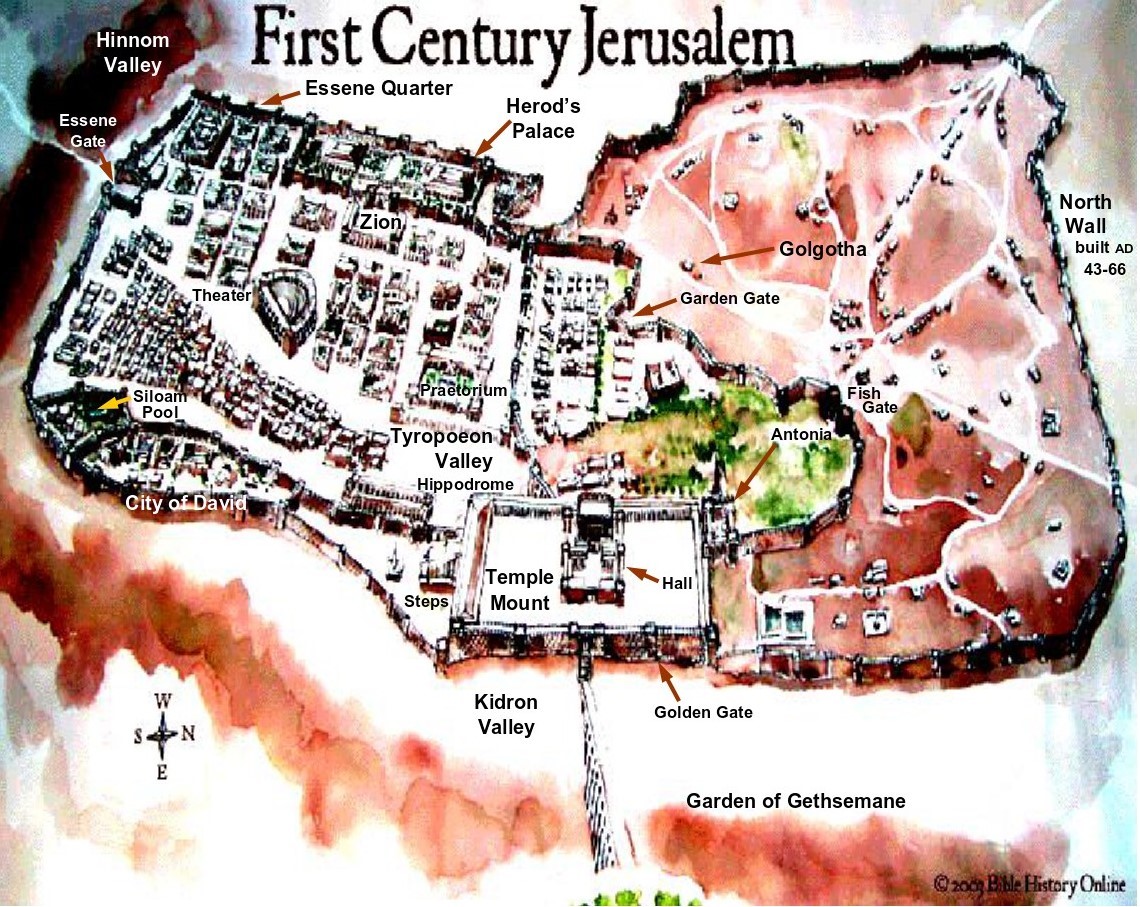
After rendering the verdict following the hearing of witnesses and direct questioning, Jesus was handed over to guards for escorting up steps (War §5.243) and incarcerated in the Antonia for the night. Meanwhile, the council would then have notified Pilate for an audience on his judgment throne (War §2.172) at the Hasmonean Praetorium in the Tyropoeon valley a few hundred feet southwest of the Temple Mount, while his family and Tetrarch Antipas stayed at Herod’s palace (War §5.176) north of the Essene quarter. His wife’s dream suggests a judicial case would be presented the next morning, which began before 6 a.m.—the sixth hour from midnight of Friday, 3 April.

Sentence

Eventually, Pilate assented to the chief priest’s demands to fulfill the execution, corresponding to 14 Nisan – the eve of official Passover (Luke 23:54 and John 19:1431 that Mark 15:42 confuses with the Sabbath). Escorted from the Praetorium (rather than Antonia, as presumed since the Crusades) through the Garden gate (War §5.146) that joined outer walls, Jesus was taken outside the city onto a small hill called Golgotha to be crucified after 9 a.m., the third hour from dawn. Hanging from his cross, Jesus expired about 3 p.m., or the ninth hour, coinciding with the slaughter of Pascal lambs.

Holy Week in Review

By this reckoning, we can account for all the days of Holy Week, from Palm Sunday’s entry (29 March), Monday’s vendor eviction from the Temple courtyard (30 March), Tuesday’s fig tree observation (31 March), Wednesday’s Passover preparation (1 April), Thursday’s trial (2 April), Good Friday’s crucifixion (3 April) and Saturday’s Sabbath on the official first day of unleavened bread (4 April) with Jesus’ body in a nearby tomb. The wave offering of first fruits would begin that Sunday.
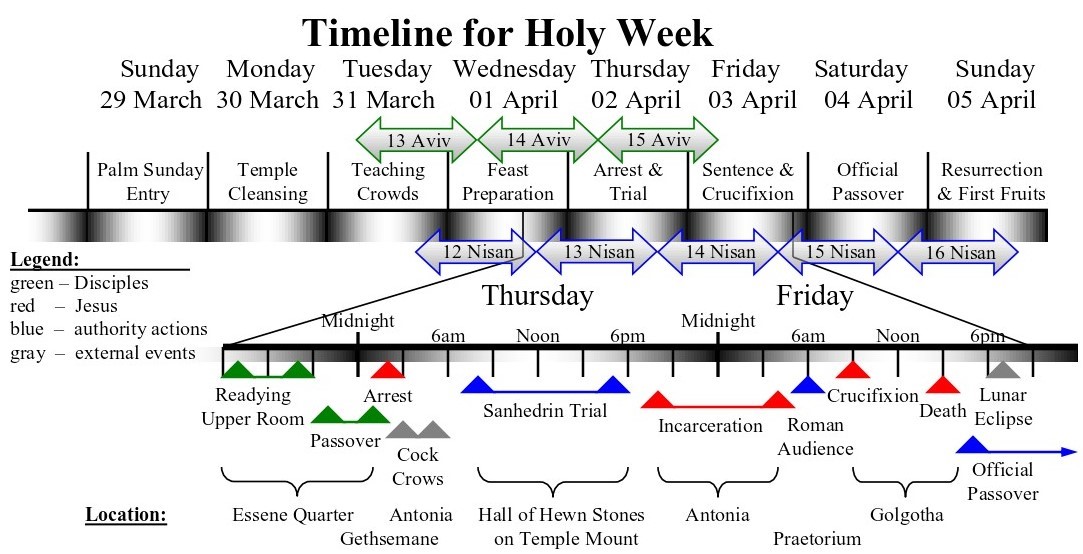
Folklore provides ritual and theological underpinnings to fill in gaps from ancient records. However, such interpretive inspirations ought not to preclude more logical and historically consistent reconstructions of transpired events. In this instance, the Last Supper can be recognized as properly belonging to Wednesday night through Thursday morning, rather than Thursday evening, whether or not religious celebrations coincide.

The Gospel accounts have been critiqued for confusing discrepancies. Despite whatever chronological deficiencies that New Testament scriveners may exhibit for their devotional emphasis in their narratives, they can’t be faulted for composing obscure fables regarding the messiah’s public ministry. Here, the times and places for the Passion narrative present a modest attempt to illuminate tradition and resolve ambiguities in sacred history from a fragmentary mosaic of secular and canonical sources.

The days of Holy Week can be reconciled by careful accounting of events and by recognizing alternative ways that ancients used to mark time. For all the superstitions ascribed to Christianity, descriptive reports such as the Passion establish its cultural context from which believers worship the God of the living. These writings thereby institutionalize the Resurrection’s historical and theological legitimacy, especially during Lent and the Easter season.

G. W. Thielman has bachelor’s and master’s degrees in engineering. He is currently employed as a patent attorney, and lives in Fredericksburg, Virginia. His opinions are his own.