Labels

Showing posts sorted by relevance for query baby boomers. Sort by date Show all posts

Friday, February 26, 2021

How Baby Boomers Ushered In Our Narcissistic Age - By Michael Morris

Helen Andrews' book, 'Boomers: The Men and Women Who Promised Freedom and Delivered Disaster,' offers a penetrating and damning look at a generation that put America on a path to ruin.

On Nov. 4, 2019, the radio host Bob Lonsberry of WHAM1180 took to Twitter to air his grievances. The host was fed up with the prevalence of “OK Boomer” memes on Twitter.

Just short of the season of Festivus, he conflated the memes with hate speech: “Boomer’ is the n-word of ageism. Being hip and flip does not make bigotry ok, nor is a derisive epithet acceptable because it is new.” Lonsberry was done listening to the internet-fueled ageism on steroids. After years of cultivating “snowflake” and “Peter Pan” as practical analogs of the word “millennial,” the baby boomers were not about to lay down and take it in return.

Then again, anyone who has survived the COVID-19 apocalypse thus far should only be surprised at the vainglory. Only a generation who has been dictating the past 50 years of cultural trends could happily raise children and grandchildren who demanded worldwide lockdowns and wave it off as the price of living in society. The Baby Boomers ushered in this narcissistic age, and the millennials will have to wrest it from their cold, dead hands.

It is against this backdrop of inter-generational warfare that an editor of The American Conservative, Helen Andrews, has released her book Boomers: The Men and Women Who Promised Freedom and Delivered Disaster. Written in the spirit of Lytton Strachey’s Eminent Victorians, Andrews chronicles the rise and dominance of this generation through the profiles of six prominent baby boomers.

To Andrews’ credit, these are not characters everyone loves to hate. She admittedly picked people with whom she feels an affinity. The chapters are broken down into several boomer mini-biographies that cover the lives of Steve Jobs, Aaron Sorkin, Jeffrey Sachs, Camille Paglia, Al Sharpton, and Sonia Sotomayor. Each symbolizes the deconstruction of his or her professional field, and together come to represent a collective boomer arc.

Destroyers of Institutions

It is hardly a secret that the Baby Boomers never quite grew out of the tendentious years of their youth. As Yuval Levin describes in “The Fractured Republic,” “The boomers’ self-image casts a giant shadow over our politics, and it means we are inclined to look backward to find our prime. More liberal-leaning boomers miss the idealism of the flower of their youth, while more conservative ones, as might be expected, are more inclined to miss the stability and confidence of early middle age—so the Left yearns for the 1960s and the Right for the 1980s.”

In both cases, as Patrick Deneen has demonstrated, this nostalgia—manifest in the social deregulation of the Sixties and the financial deregulation of the Eighties—has had a devastating effect on American civil institutions.

In the story of Al Sharpton, Andrews highlights how his contribution to civil rights undermined the truly democratic “Machine Politics” in favor of macro scale change. Functionally, this means cutting the little guy out of the process by seeking reforms through courts and corporations. The incentive, however, is pretty straightforward—in shifting the preferential option towards the powerful—channels of great personal enrichment become available.

Through Supreme Court Justice Sonya Sotomayor, Andrews paints a portrait of how the courts essentially weaponized law against the longstanding institutions of America. While the Baby Boomers, merely carrying the torch of the Warren Court to its absurd conclusions, are not singularly guilty of razing the social safety nets of Main Street via judicial activism, we can certainly see their fervor in carrying the torch. The reader encounters how the baby boomers’ seething hatred of all things remotely resembling tradition undergirds their willingness to use the levers of power to revolutionize the law.

The End of the Labor Left

In 1977, the reader is offered a visceral glimpse of the end of labor as the hinge on which left-wing politics shifts. The Sex Pistols’ single “God Save the Queen” had been released by Virgin Records, but the laborers who pressed the vinyl walked out in protest amid controversy surrounding the lyrics. For the average worker, the song was thought of as nothing short of treasonous, but it is here where we see corporate liberalism coming into its own.

“Joe Lunchbox” was cast aside and boomer chic now gyrated to the pied pipers of corporate America. Andrews summarizes, “After weeks of negotiation, Richard Branson prevailed and the workers were forced to produce the record. The fact that this is remembered as a victory for free speech and not a corporate boss quashing labor is the decline of the Left in a nutshell.“

Anecdotes of this sort, pervade the book. Andrews explains, “Instead of champions, the working class got neoliberal triangulators like Bill Clinton and Tony Blair. By the time Hillary Clinton became the presidential nominee in 2016, there was no longer much attempt to disguise the Democratic Party’s alliance with the educated and wealthy elite.

This was the year one left-leaning news outlet ran a headline, in the wake of various business boycotts in support of leftist causes, suggesting that “corporations are replacing churches as America’s conscience.” Time and again, we are able to see the same story play out, whether through Apple CEO Tim Cook’s unholy alliance with China or Jeffrey Sachs’s slash and burn brand of Harvard humanitarianism, boomers demonstrate a dogmatic eagerness to burn the bridges of the past and steal assets from the future.

Ambivalence of Apple

The character profiled in Andrews’ book about whom I remain the most ambivalent is Steve Jobs. He quite literally lived up to the hype of Boomer idealism. His unique amalgamation of hippie ideas and technological foresight manifested in a legitimate form of Platonic excellence. This unconventional recipe guided his desire to unleash the creativity of the Everyman.

Apple really was the product of the rebellious teen and the counter-cultural misfit, and Jobs was the real deal. He was an icon who marched to the beat of his own drum, both anti-political and pro-America, once bragging about never voting in a presidential election. He was also known for stubbornly keeping his business affairs state-side when outsourcing work to China was the thing to do.

But for every Jobs, there’s a mediocre boomer lurking in his shadows. Tim Cook has single-handedly engineered the worst excesses of the Apple Empire. His tenure as CEO has been one of excitedly applying the Apple logo to the most banal of leftist political causes.

He has also trailblazed lawsuits against the federal government in the push to normalize corporate use of slashing costs via Uighur labor camps. Cook has managed to take a company that uniquely reflected its founder, in his commitment to personal excellence and unleashing the creativity of everyday people, and turned it into yet another NPC meme.

Andrews closes her book with an obvious, but necessary question: How does this affect Gen X, millennials, and other forthcoming generations? Unfortunately, there’s not much room for optimism.

While millennials may be very sensitive to boomer excess, they seem to want to double down on its ugliest manifestations. We saw the chaos of the sixties play out in the Black Lives Matter riots over the summer, and the absurdity of a “free love” state of mind come home to roost in plummeting marriage and birth rates.

While the television era has given way to Twitter, we are still living a significant portion of our lives play acting through one-dimensional characters on our screens. Andrews offers a compelling book that will help readers identify these excesses and, Lord willing, maybe provide an opportunity for correction.

Mike is a husband and dad who lives in Denton, Texas. His essays have appeared in Aleteia, FEE, the Libertarian Catholic, and Church Pop. Mike has also written for the upstart cultural commentary site The Everyman. He can be followed on Twitter @laffyjaphy.

Tuesday, February 9, 2021

The Baby Boomers’ Dismal Legacy - By Chris Buskirk

In all the fields touched by the people Helen Andrews profiles—tech, entertainment, economics, academia, politics, law—what they passed on to their children was worse than what they inherited.

There is no generation about which so much has been said, written, filmed, and sung as the Baby Boomers; most of it by the Boomers themselves who have, from their youth, been absolutely enthralled with . . . themselves. 

Helen Andrews’ new book, Boomers, is a welcome corrective to the steady stream of hagiographic literature produced since the first Boomers picked up a pencil, a camera, and a guitar. It is at once beautifully written, incisive, entertaining, maddening, and flabbergasting. As she writes in the book’s introduction: “they tried to liberate us, and instead they left behind chaos.” I would add that Janis Joplin (of the Silent Generation) predicted this when she sang that freedom is just another word for nothing left to lose. But the Boomers weren’t listening.

Penguin Random House

If you want to understand the Baby Boom generation you might start with this epigram: Extremism in the defense of vice is our liberty. I don’t think anyone ever put it quite that way, but it could be a Boomer slogan. And it’s part of unlocking the secrets to their generation and to many of the problems they have inflicted on America. Never has any generation in this country—or perhaps any other—so monopolized every aspect of society, for so long, and for such selfish ends while congratulating each other on their selfless righteousness.

Tear apart the family, the churches, the charities, the schools, and everything else in your path; encourage mass drug use, promiscuous sex, and spend, spend, spend-materialism; even saddle your kids and grandkids with tens of trillions of dollars of debt to make sure you can keep the party going “Big Chill”-style, until the very last Boomers depart for the Strawberry fields where it’s always 1967

Until the past few years, not many people noticed what the Boomers were doing. It’s no surprise—they started their victory tour, celebrating themselves while they were in college in the 1960s, and haven’t stopped since. It’s only now that many of them are in their 70s that space has opened for a reassessment.

If you want to really understand the full Boomer cycle (and I suggest you do, because their long ascendancy is a big part of the story of America from about 1960 until, well, right now), there are three books you need to read—the holy trilogy of Boomer pathologies. They are The Electric Kool-Aid Acid Test, written by Tom Wolfe in 1968, The Culture of Narcissism by Christopher Lasch published in 1979, and the Götterdämmerung of this cycle, Andrews’ Boomers: The Men and Women Who Promised Freedom and Delivered Disaster, published in January.

Boomers is an astounding book. Modeled on Eminent Victorians, Lytton Strachey’s sharp 1918 reassessment of the British generation that dominated the 19th and very early 20th centuries, Andrews examines six high-profile members of the Baby Boom generation: Steve Jobs, Aaron Sorkin, Jeffrey Sachs, Camille Paglia, Al Sharpton, and Sonia Sotomayor. Each represents an element of the essential Boomer character. None of them are natural villains. Rather, each is hobbled by a fatal flaw that leaves him permanently stunted. 

The one possible exception is Jobs. When compared to the others, Jobs seems like a man out of time: in some ways, the Apple co-founder is the essential Boomer. But while he shared—and in some ways defined—the Boomer aesthetic, his soul belonged to another generation. He did, after all, insist that the Apple MacIntosh be manufactured in the United States. It was Tim Cook who later shifted manufacturing to China. And Jobs kept porn out of the App Store. “We believe we have a moral responsibility to keep porn off the iPhone” Jobs said in 2010. “Jobs had some very un-Boomerish views,” Andrews observes.

Every profile in the book is fascinating and Andrews is in her element. Her penetrating gaze leaves the subjects of these character portraits naked and vulnerable, but her elegant writing and humane style turn what could be acid takedowns of caricatures into the human, all too human, failures of the “Me” generation. 

Where Tom Wolfe described the Boomers in their rebellious, countercultural, drug-addled youth, Christopher Lasch picked up the thread as they were starting families, advancing in their careers, making some money, and taking over the institutions they had rebelled against just a few years before. But don’t worry—they didn’t sell out. No, not the Boomers. They put a deadhead sticker on their Cadillacs. And they parked the Caddy in front of a nice house in the suburbs that steadily rose in value. 

But the Boomers were the last generation that could support a middle-class family on one income. And that house they’re living in that has appreciated so nicely over the years? It’s become so expensive that their kids, the Millennials, can’t afford to buy one—let alone have kids. In fact, the Boomers had about four times the wealth the Millennials currently have as they enter their 40s.

Throughout the book, Andrews paints a picture not just of unrelenting narcissism, but of radical, lifelong immaturity. Her profile of Aaron Sorkin, creator of “The West Wing,” was striking in this regard. But the chapter on Camille Paglia is particularly jarring, mostly because it seems to hit dead center and lay her bare. She describes Paglia’s decadence as “a mauve decadence: corrupt but nonthreatening.” And her mimetic, yet one-sided, rivalry with Susan Sontag exposed a petty side to Paglia that diminishes her cultivated reputation for brassy independence.

Throughout the book, Andrews exposes these small, but revealing, tidbits about her subjects and in so doing holds a mirror up to them and to the America they created. One example is a quote she includes from Harvard Law Professor Laurence Tribe’s memo to Barack Obama (a former student) advising against nominating Sonia Sotomayor to the Supreme Court: “Bluntly put,” he told the president, “she’s not nearly as smart as she seems to think she is.”

This book is wonderful in many ways—I’ve already given it to a few friends—but there is also a melancholy undercurrent that runs throughout the story. Part of it is seeing so much potential wasted on performative narcissism. It can perhaps be tolerated in youth, but only just. Yet witnessing, through these profiles, a lifetime devoted to it is both contemptible and dispiriting. 

In the end, the Boomers didn’t build anything. As Andrews points out, Boomers claim credit for the civil rights movement, but that would require them to have been riding freedom buses and sitting in at lunch counters before most of them hit puberty. It was the generations that came before them that did the work. Instead, they just tore down everything they were born into in a lifelong tantrum that they justified as idealism. And now everyone else is left with the consequences.

Tom Wolfe wrote a fitting epitaph for the Boomers in 1968. The scene he describes in which the young woman known as “Stark Naked,” liberated by drugs and promiscuous sex from the square society of husbands and wives, parents and children, is left literally naked, broken, and screaming on Larry McMurtry’s front lawn as her former compatriots—I won’t say “friends”—on Ken Kesey’s magic bus drive on down the road without her could apply to the Baby Boom generation as they, too, are left behind: “Stark Naked had done her thing. She roared off into the void and was picked up by the cops by and by, and the doors closed in the County psychiatric ward, and that was that, for the Pranksters were long gone.”

Ultimately, Andrews concludes that “the Boomers leave behind a dismal legacy. In all the fields touched by the six Boomers profiled here—technology, entertainment, economics, academia, politics, law—what they passed on to their children was worse than what they inherited. In some cases, as with Steve Jobs and his products or Camille Paglia and her books, they left behind accomplishments that are impressive and worthy of gratitude. But the overall effect of the Boomer generation has still been essentially destructive.”

Her judgment is brutal, but it is just.

https://amgreatness.com/2021/02/07/the-baby-boomers-dismal-legacy/

Sunday, June 19, 2016

The distrustful youth - Pew Survey

The Pew Center fails to note the significant conclusions in its own poll on trust in government:
Historically, there have been only modest generational differences in trust in government. Over time, the trajectory of these attitudes has been similar across generations.

As noted, young people are slightly more trusting in the federal government than older people. Currently, 25% of Millennials (ages 18-34) say they can trust the federal government just about always or most of the time. That compares with 19% of Gen Xers (35-50), 14% of Boomers (51-69) and 16% of Silents (70-87).

In 2009 and 2010, the differences across generations were somewhat larger: In August 2009, the three-point moving average of trust in the federal government among Millennials was 36%, compared with about 20% across older generations.

In the early 1990s, Gen Xers – whose oldest members were then in their early 20s – expressed somewhat greater trust in government than did Boomers and Silents, but these differences have diminished over time. Similarly, there were, at most, small differences in trust between Boomers and Silents in the 1970s and 1980s. Most important, the steep downward slide in trust in government that occurred in the 1970s was seen among both Boomers and Silents.
Look at the chart. Notice the very steep slide that began in 1965 for the Silents and 1970 for the Baby Boomers. What is relevant is not how a very old Silent or an old Boomer's opinion compares to a young Millennial's trust in government, but rather how those opinions compare at similar ages.

The Silents' trust in government peaked at 82 percent, the Boomers' at 73 percent. The famously cynical GenXers trust peaked at 58 percent, and the supposedly naive Millennials peaked at 62 percent right in the patriotic aftermath of 9/11. The oldest Baby Boomers were 48 years old before they reached the level of cynicism about government that the Millennials have already reached.

This is particularly significant considering that the Millennials are much more racially mixed, so white Millennials are, developmentally speaking, far more suspicious of government than were white Baby Boomers.


Thursday, December 19, 2024

Locusts Confirmed - Vox Popoli - Boomers!

 Read full text: https://voxday.net/2024/12/16/locusts-confirmed/ 

It’s not just the occasional anecdote from contemptuous Gen Xer or bitter Millennial. Even the investment advisors know that the Boomers are literally Hell-bent on consuming as much of their worldly wealth as they can manage before they die.

Millionaires from the Baby Boomer generation are significantly less likely to prioritize sharing their wealth with the next generation than their Gen X and Millennial counterparts, according to a new study by Charles Schwab. The findings highlight generational differences in attitudes toward wealth, with Baby Boomers preferring to enjoy their money during their lifetimes rather than passing it on.

The study surveyed 1,000 Americans with a net worth exceeding $1 million in investable assets. When they were asked if they planned to distribute a portion of their wealth in their lifetime, wealthy Baby Boomers said they wanted to 56 percent of the time while 97 percent of both wealthy Gen X and Millennials wanted to do so.

When respondents were asked if they wanted the next generation to enjoy their money while they were still alive. While 53 percent of wealthy Millennials and 44 percent of wealthy Gen X’ers said yes, only 21 percent of wealthy Boomers agreed. Conversely, nearly half (45 percent) of Baby Boomers said they wanted to enjoy their money for themselves during their lifetimes, compared to just 15 percent of Millennials and 11 percent of Gen X.

It’s not as if we needed this confirmation; every member of the younger generations has been dealing with the reality of the Boomers for their entire lives. But it is both a condemnation and a reminder that it falls to us to do better if we wish to preserve some aspects of civilization somewhere.

DISCUSS ON SG

Friday, December 11, 2020

Charting The Growing Generational Wealth Gap | ZeroHedge

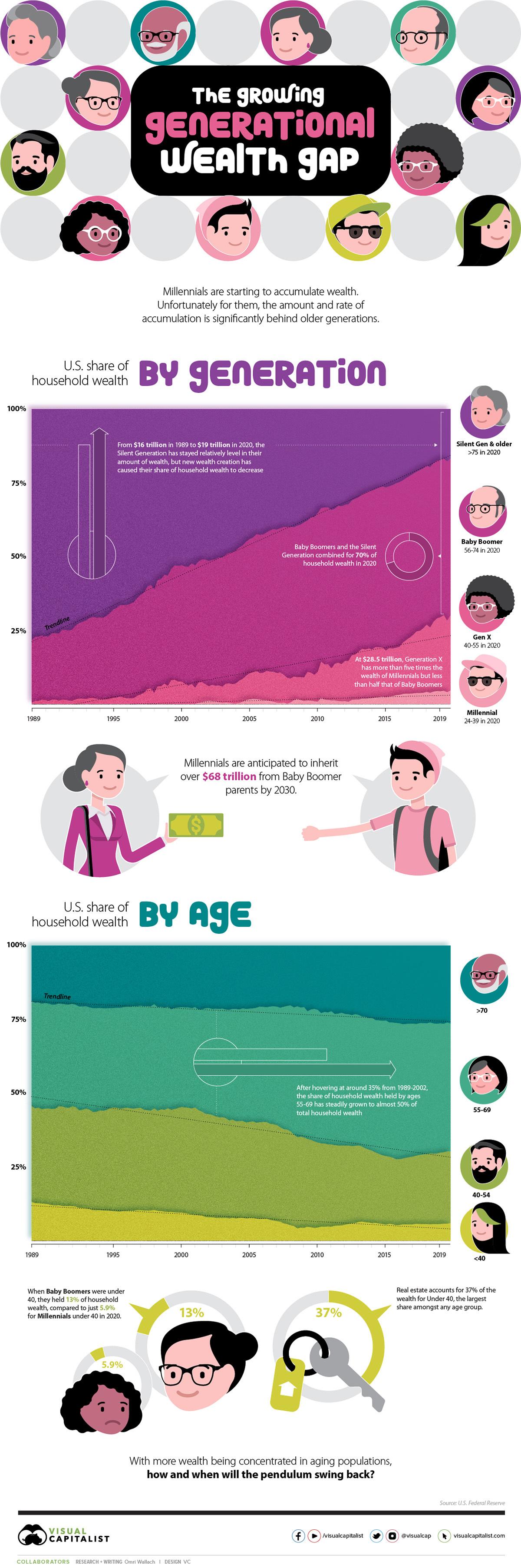
 As young generations usher into adulthood, they inevitably begin to accumulate and inherit wealth, a trend that has broadly remained consistent.

But, as Visual Capitalist's Omri Wallach explains below, what has changed recently is the rate of accumulation.

In the U.S., household wealth has traditionally seen a relatively even distribution across different age groups. However, over the last 30 years, the U.S. Federal Reserve shows that older generations have been amassing wealth at a far greater rate than their younger cohorts.

As the visual above shows, the older have been getting richer, and the younger have been starting further back than ever before.

BY GENERATION: BABY BOOMERS BENEFIT & MILLENNIALS LAG

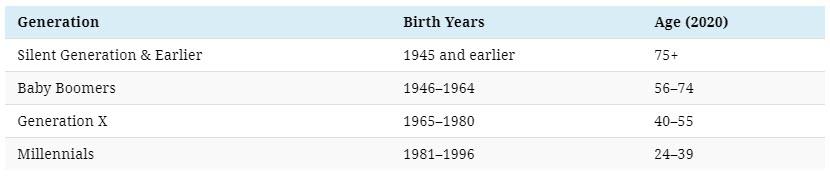
To examine the proportion of wealth each generation holds, it’s important to clearly define each age group. Though personal definitions might differ, the U.S. Federal Reserve uses a clear metric:

Relative to younger generations growing up, the Silent Generation and Greatest Generation before them have seen a decreasing share of household wealth over the last 30 years.

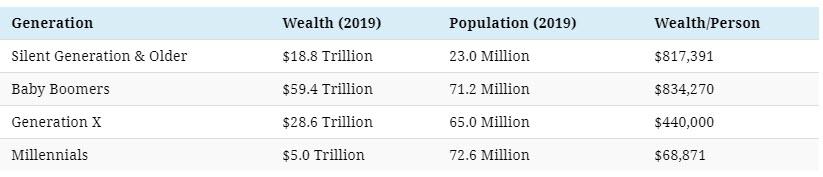
However, the numerical levels have been relatively stable. For these combined generations, total wealth has gone from $16 trillion in 1989 to $19 trillion in 2019, with a peak of $27 trillion in 2007. Considering this cohort has understandably shrunk over time—from an estimated 47 million to 23 million in 2019—their individual shares of wealth have actually increased.

Immediately following are the Baby Boomers, who held more than half of U.S. household wealth towards the end of 2020. At $59 trillion, the generation holds more than ten times the amount held by a comparative number of Millennials.

With $29 trillion held in 2019, Generation X has also been gaining in wealth over the last 30 years. It’s good enough for five times the wealth of Millennials, though at just $440k/person, they’ve fallen far behind Baby Boomers in rate of growth.

Finally, trying to catch up to their older cohorts are Millennials, who held the least amount of household wealth ($5 trillion) for the greatest population (73 million) in 2019, an average of just under $69k/person.

For a direct comparison, it took Generation X nine years to climb from their start of 0.4% of household wealth in 1989 to above 5%, while Millennials still haven’t crossed that threshold. But it’s not all doom and gloom for Millennials. Their rate of growth is starting to rise, with the generation’s level of wealth climbing from $3 trillion in 2016 to $5 trillion in 2019.

BY AGE: A GROWING SHARE FOR 55+

Though the generational picture is stark, the difference in U.S. household wealth by age makes the picture of shifting wealth even clearer.

Until 2001, the shares of household wealth held by different age groups were relatively stable. People aged 40-54 and 55-69 held around 35% each of household wealth, retirees aged 70+ hovered around 20%, and younger people aged under 40 held around 10%.

Since that time, however, the shift in wealth to older generations is clear. The 70+ age group has seen their share of wealth increase to 26%, while the share held by ages 55-69 has grown from 35% to almost half.

But not all ages are seeing an increasing slice of wealth. The 40-54 age group saw its share drop sharply from 36% to 22% between 2001 and 2016 before starting to recover towards the end of the decade, while the youngest cohort now hover around just 5%.

Breaking down that wealth by components is even more eye-opening. The 39 and under age group holds 37.9% of their assets in real estate, the largest share amongst any age group (and concentrated in the hands of fewer people) while older age groups have their wealth spread out across real estate, equities, and pensions.

But the difference is as much in assets as it is in opportunity. In 1989, Baby Boomers and Generation X under 40 accounted for 13% of household wealth, compared to just 5.9% for Millennials and Generation Z under 40 in 2020.

WILL THE TIDE TURN FOR GENERATION Z?

As new and accumulated wealth has been built up in older generations, it’s a matter of time before the pendulum starts to swing the other way.

The Millennials age group are expected to inherit $68 trillion by 2030 from Baby Boomer parents. Of course, that payout isn’t going to be even across the board, with wealthier families retaining the bulk of wealth and the majority of Millennials laden with debt.

And with Generation Z (born 1997-2012) starting to come of age, the uneven playing field is making it hard to begin accumulating wealth in the first place.

Since it is in the best interest of societies to have wealthy generations that can drive economic growth, potential solutions are being examined all over the political sphere. They include different taxation schemes, changing estate laws, and potentially cancelling student debt.

Whatever ends up happening, it’s important to track how the distribution of wealth changes over the coming decade, and begin accumulating your personal wealth as best as you can.

https://www.zerohedge.com/personal-finance/charting-growing-generational-wealth-gap


Saturday, March 30, 2024

How Inflation Hurts Our Kids, In 5 Charts - JOHN RUBINO

The real generational discord is yet to come

In 1971 the US, along with most of the rest of the world, tried something new. They ditched their previously gold-backed money in favor of “fiat” currencies backed only by citizens’ trust in central banks and politicians.

The results were profound, as the dollar lost about 90% of its purchasing power. But the real damage was generational: Eroding currencies ended up enriching the architects of the plan and their kids (i.e., the baby boomers) while impoverishing subsequent generations. Here’s a guided tour, in five charts:

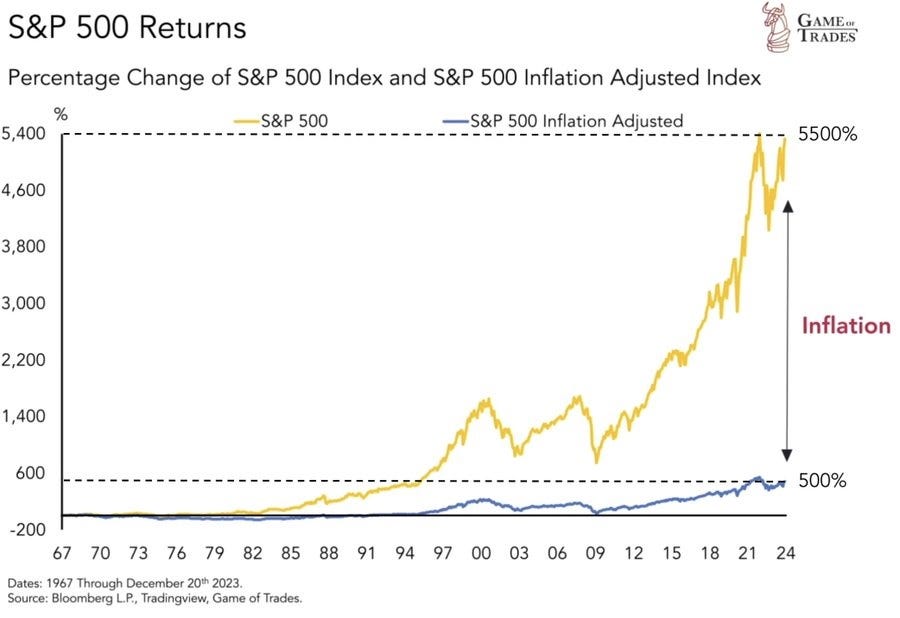
During the fiat experiment’s 53 or so years, equity prices have risen by about 500% adjusted for inflation and ten times as much in nominal terms. That’s what monetary inflation does to financial asset prices.

Now notice the timing. The blow-off part of the run came just as baby boomers (born between 1946 and 1961) were entering their big saving/investing years in the 1980s and 90s. They were able to spend 20 or so years buying stocks which then took off on a historic run.

In contrast, when the millennials (born 1981 to 1996) entered their saving and investing years in the 2000s, they were too late to the party to accumulate real financial wealth.

The result was, in effect, a wealth transfer between the people who owned rapidly inflating stocks at the beginning of the run and the vast majority of people who didn’t own stocks but had to pay for an ever-rising cost of living. Boomers (and to a lesser extent Gen X) got richer while their kids and grandkids stagnated.

Home sweet capital gain

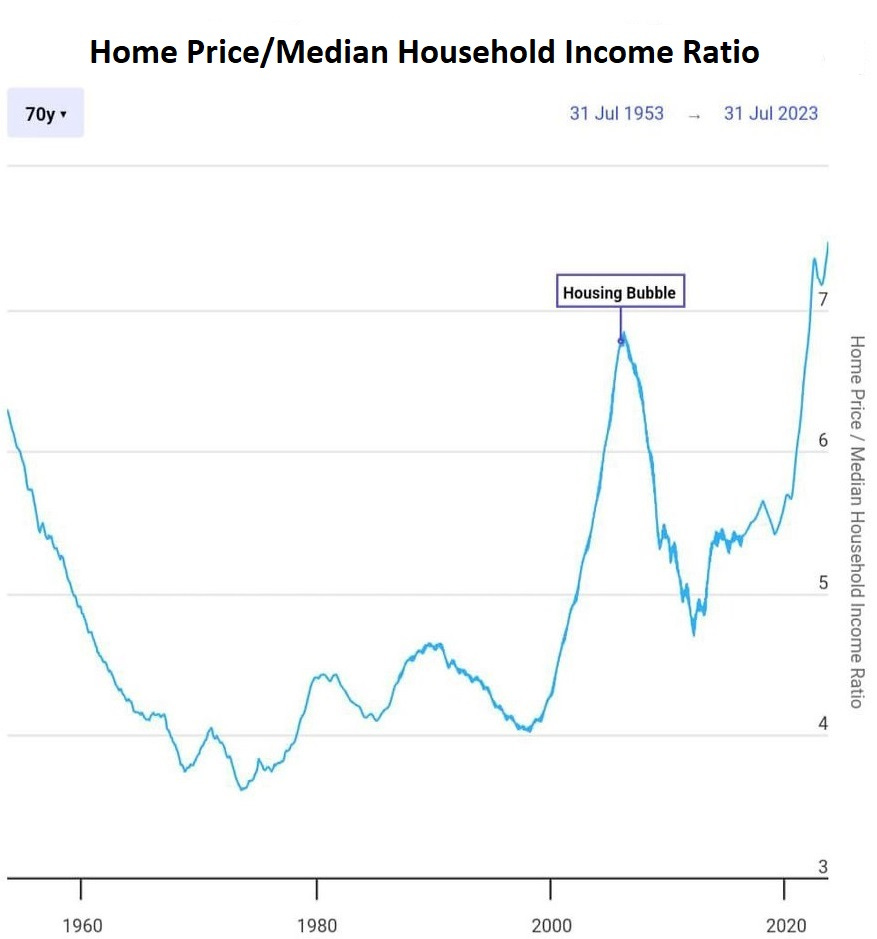
Same thing with real estate. Boomers entered the housing market early in the fiat currency experiment when prices were low, both in nominal terms and relative to wages. So their homes were swept up on the inflationary tide, rising much faster than incomes for the next four decades. Millions of boomers became “house-rich,” regardless of their subsequent career success.

Millennials, here again, came of age in an inhospitable real estate market where the typical house costs more than the typical family earns, effectively closing them out of both home ownership and real estate appreciation.

The next chart tells the same story in a slightly different way. 1980s boomers lived in a world where the average house cost 4 times the median household income, while today’s millennials are surrounded by houses that are, relative to incomes, almost twice as expensive. Which is to say mostly out of reach.

Same thing with rents

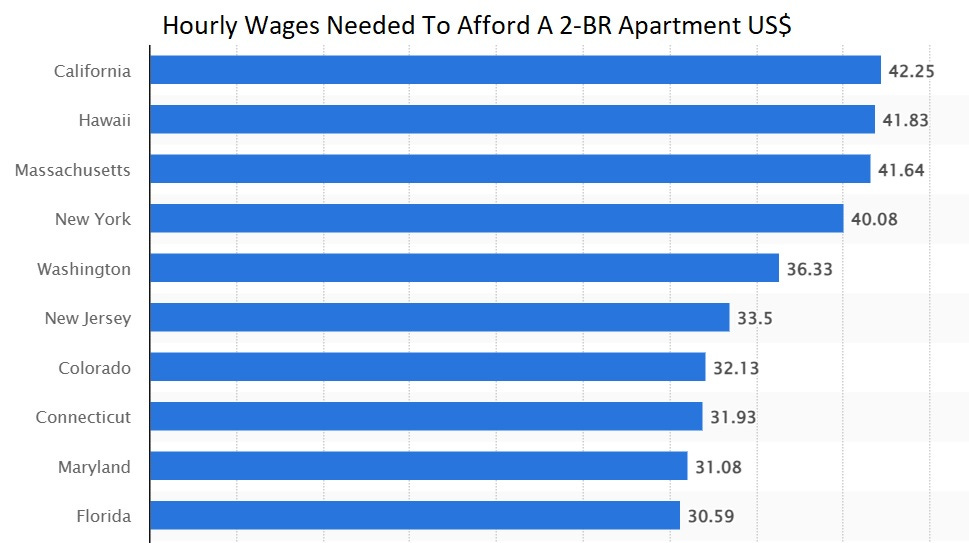
Rental apartments were cheap in the 1970s and 80s, but since then, inflation has sent them up much faster than incomes. In high-cost-of-living states, it takes an hourly wage of between $30 and $42 to afford a 2-BR apartment. $30/hour equals $60,000 per year. How many millennial or Gen-Z workers make that kind of money? Probably fewer than half.

To sum up, inflation didn’t affect the US population evenly. It enriched one group and impoverished others, tearing some very big holes in the fabric of society. When people talk about “unsound money” destroying a culture, this is part of what they mean.

Now it gets really intense

Two big trends will add a dramatic final chapter to the fiat experiment:

Big Trend #1: Governments around the world have basically given up on fiscal or monetary discipline, and have entered the blow-off stage of currency debasement. The US government’s borrowing — already dangerously aggressive pre-pandemic — has now gone almost literally off the chart. The current schedule calls for $10 trillion of new paper to be sold in 2024, raising the question of who will buy it. The answer: If China declines (as it will), the only remaining candidate is the US Fed and its printing press.

The upshot: If inflation was a dominant and divisive force in the previous few decades, we haven’t seen anything yet

Big Trend #2: The oldest boomers are now in their 70s. Many are helping their kids and grandkids with housing, tuition, and health care, while other boomers are dying and distributing their accumulated wealth to their descendants. Some might say better late than never. But others might say justice delayed is justice denied.

The problem for all concerned is that inflationary booms don’t end with a whimper in which some assets are shuffled around and everyone settles into a comfy new normal. If history is a reliable guide, millennials and Gen-Z might finally get their hands on that boomer wealth — just as it evaporates in an epic bust. That is unless Grandma and Grandpa were gold bugs.

https://rubino.substack.com/p/how-inflation-hurts-our-kids-in-5?publication_id=1166121&utm_campaign=email-post-title&r=y7h5a&utm_medium=email