Friday, September 21, 2018
Traveling note from Crush - Sept.21,2018
Tomorrow morning Ma and I will begin the third and last leg of our summer journey visiting our families - we're going home - so expect few, if any, new posts in our library in the next 12-15 days.. But remember, this is a library - not a news site - https://crushlimbraw.blogspot.com/2018/07/traveling-note-from-crush.html - I hate to repeat myself.:)

Our government makes us play with Monopoly money - by Gary DeMar
The game of Monopoly debuted in 1935
during a time of financial recovery after a steep economic downturn called the
Depression from which we’ve never really recovered since government
intervention created the Depression and every economic downturn since.
A similar game was developed by Elizabeth (Lizzie) J.
Magie Phillips in 1903. The
Landlord’s Game, as it was called, was self-published in 1906.
“Although The Landlord’s Game was patented, it was not taken
up by a manufacturer until 1910, when it was put into production in the U.S. by
the Economic Game Company of New York.
There were other board games based on the buying and selling of land leading up
to the ever-popular Monopoly.
There’s good historical evidence that Monopoly is
based on The Landlord’s Game for the simple fact that Parker
Brothers bought the patent rights for $500 in 1935 and there is an early old board game that some say bears a striking resemblance
to Monopoly.
Monopoly money is not real money, but it could be if
our government said it was and controlled its production.
Boom and bust economic cycles are made worse by
government interference. Left alone, the markets most often smooth themselves out
with fewer extreme highs and lows.
After the economic debacle of 2008, the government
once again tried to fix the mess it created and as a result extended the
economic recession.
The early developers of these games had hoped people
would learn basic economic principles from them. Some people have. They’re
called politicians and banksters. Here’s one of the rules from Monopoly:
Besides the Bank’s money, the Bank holds the Title
Deeds, and the houses and hotels prior to purchase by the players. The Bank pays
salaries and bonuses. It sells and auctions properties and hands out the proper
Title Deed cards when purchased by a player, it also sells houses and hotels to
the players and loans money when required on mortgages.
The Bank collects all taxes, fines, loans and
interest, and the price of all properties which it sells and auctions. The
Bank ‘never goes broke.’ If the Bank runs out of money, the Banker may issue as
much as needed by writing on any ordinary paper.
Don’t ever say that politicians don’t learn anything.
They’ve learned their lessons well even if we haven’t. United States currency
is different from Monopoly money in one way: Our government prints it, values
it, and forces us to use it as currency at an ever-decreasing value while
calling the result “prosperity.” In reality, it’s theft by dilution.
The Bible considers inflation, an increase of the
money supply via fiat currency, to be a violation of the law: “Your silver has
become dross, your drink diluted with water” (Isa. 11:22).
Clipping coins, adding a base metal to silver and gold, and printing money out
of thin are no different from reaching into people’s bank accounts and stealing
the assets.
The Bible requires “just weights and measures”:
“You shall have just balances, just weights, a just
ephah, and a just hin; I am the LORD your God, who brought you out from the
land of Egypt” (Lev. 19:36).
What would happen to a company that was adding water
to its wine or sawdust to its cement mix? They would be prosecuted for fraud.
And yet our government does not see a problem diluting
the value of our money by a process called “quantitative easing.” Our economy is
being propped up by fake money that in time will be worth as much as Monopoly
money.
There was a time when our coinage was silver and gold,
and government-created certificates were used that could be redeemed for the
physical metal. Today’s coins are made from base metals that have limited value
when compared to the trading prices of silver and gold.
The difference between Monopoly money and the United
States currency is that we know Monopoly money is worthless. If we continue
down the road of fiat money creation, it will be as worthless as Monopoly
money.
Christian legal theorists have understood the process
of assessing biblical laws and determining how to make contemporary
application. For example, Swiss Reformer Pierre Viret (1511–1571) “felt that
all laws affecting public morals and related to spiritual values should be
drawn directly from the moral law of God. However, he believed that these
absolute and eternal laws of God had to be geared to the times in which people
lived and the national temperament of the country to which the laws were to be
applied.”1
Viret’s use of the Eighth Commandment—“You shall not
steal” (Ex.
20)—and its application to the civil sphere is instructive. He applies it
to “those who clip coins2
and . . . those who consciously use false money and particularly of
those responsible for the public treasury.”3
Modern-day monetary theory and practices are clear violations of
the Eighth Commandment. Removing the silver from our nation’s coins in 1963,
printing money with nothing to back it other than the government mandating its
worth, and deficit spending are just three examples.
Israel was judged by the way it failed to keep God’s
commandments. This included economic laws that adversely affected widows and
orphans and the general population: “Your silver has become dross, your drink
diluted with water. Your rulers are rebels and companions of thieves; everyone
loves a bribe and chases after rewards. They do not defend the orphan, nor does
the widow’s plea come before them” (Isa.
1:22–23).
This indictment is based on laws set forth in the
Mosaic legislation, in particular, Deuteronomy
25:13–16. These verses may not say anything in particular about debasing
precious metals and passing them off as unadulterated and diluting wine and
advertising and selling it as the real thing, but the application to monetary
policy and consumer issues is clearly evident in the way it is applied in
Isaiah (also see Lev. 19:35–37; Prov. 11:1;
20:23; Ezek. 45:10;
Mic. 6:11).
Notes:
1.
Robert D.
Linder, The Political Ideas of Pierre Viret (Geneva,
Switzerland: Droz, 1964), 29, note.( )
)
)
2.
Originally, gold
coins had smooth edges, and it wasn’t noticeable if just a little gold was
clipped from the edges using a sharp knife or a file. If this was done to
several coins, the coin clipper would have enough raw gold to exchange for an
additional small denomination coin while still holding onto his original larger
denomination coins. The same could be done with silver. In time, the perimeter
of coins were milled to have reeded (grooved) edges. The dollar, half-dollar,
quarter, and dime were originally produced with about 90 percent silver. If you
got a smooth-edged coin, you knew it had been clipped. Today, no one bothers
with clipping circulated, government-issued coins since they are no longer made
of gold and silver. You will notice that the penny and nickel do not have
reeded edges since their value is minor compared to silver and gold.()
)
3.
Quoted in
Jean-Marc Berthoud, Pierre Viret: A Forgotten Giant of the
Reformation—The Apologetics, Ethics, and Economics of the Bible
(Tallahassee, FL: Zurich Publishing, 20010), 40.()
)
Embracing Reality - by Robert Ringer
As the lying, corruption, and craziness continue unabated in
Washington, it’s a reminder of just how important it is to one’s sanity to
embrace reality. Reality is synonymous with truth, but, as Baltasar
Gracian, the insightful and pragmatic 17thcentury Jesuit priest,
cautioned, “Truth is abhorred by the masses.”
Instead of
loving truth, most people try to make true that which they love, which is a
self-delusive practice that virtually guarantees frustration and failure.
Thus, most people live in an unreal world, a world they create in their own
minds based on the way they would like it to be rather than the way it actually
is. They seem to have adopted the philosophy of Ashleigh Brilliant, who
once remarked, “I have abandoned my search for truth and am now looking for a
good fantasy.”
It is
absolutely essential that a person intellectually and emotionally recognizes
that reality isn’t the way he wishes things to be or the way they appear to be,
but the way they
actually are. The individual who is not able to make this
distinction finds it virtually impossible to make decisions that lead to
positive results.
Which brings me
to principles. A principle is synonymous with a law of nature, as opposed
to a law of man. Most manmade laws are nothing more than legalized
aggression against the sovereignty of peaceful individuals and rarely bear any
relationship to Natural Law, reality, or morality.
A true
principle of nature cannot be created or altered in any way. Consider the
principle of gravity. Isaac Newton didn’t wake up one morning and decide
to create a principle whereby if he dropped an apple from a tree twenty times,
it would fall to the ground nineteen times and rise upward the twentieth time.
Instead,
through experimentation, he found that if you drop an apple from a tree twenty
times, it will fall to the ground twenty times. What he did was discover
the principle, or law, of gravity. A principle, then, is the essence of
reality.
To try to
create our own reality is both futile and destructive. You certainly have
the right to go on believing whatever you want to believe, but reality doesn’t
care about your wants or beliefs. Reality will deliver negative
consequences to the well-meaning, ignorant individual as surely as it will to
the most malevolent, stubborn person. Not once has reality excused anyone
for good motives, so consistency is essential when it comes to an accurate
perception of reality.
In physics, we
learn that for every action there is an equal and opposite reaction. The
longer I live, however, the more convinced I am that in the daily process of
living (as opposed to the science of physics), reactions tend to be far greater than the
actions that provoke them.
In other words,
whenever we make a decision or take an action that we know, in our heart of
hearts, is wrong, the punishment seems to be way out of proportion to the
“crime.” My experience has been that I almost always end up paying for an
irresponsible action multiple times, with each payment seeming to take the form
of a balloon note carrying onerous, compounded interest.
The consequence
may take a long time, and it may be indirect or subtle in nature, but
there is always
a consequence. Symbolically speaking, everything you do goes into your
book of life. This doesn’t necessarily hold a religious connotation, but
I do firmly believe that universal forces are at work that pull us inexorably
toward the deserving results of our actions. Kindness begets kindness;
cruelty begets cruelty.
Where many
people allow themselves to be misled is that the payback for their actions is
not always immediate, which results in their failing to make the connection
when it finally arrives. And even when the consequence is immediate, they
may miss the subtlety of the connection between the result and the action that
caused it.
Though most
people know, deep down inside, that all actions have consequences, I am
convinced that very few of them give it more than a passing thought as they go
about their daily affairs. The question is, why would people ignore such
an all-powerful, immutable principle?
I believe it’s
because man inhabits a world of delusions, which obscures reality and creates
dangers for himself and others. He rarely understands what he is doing or
why he is doing it. His actions and beliefs indicate that he lives in a
state of waking dreams.
I further
believe that one of the most important steps in a person’s personal growth is
to become adept at transcending his world of delusions. This is not an
easy task, due in no small part to the fact that we are surrounded by delusions
each and every day.
The nice thing
about it, however, is that you can overcome these delusions, provided you are
committed to truth. This means being willing to subordinate your desires
and wishes — your dreams, as it were — to reality.
This is not to
say that you should not have dreams. On the contrary, dreams can be
healthy for the psyche. What it does mean, however, is that you should
not allow your dreams and desires to override reality. Put simply, your
love of truth must be greater than your desire to make your dreams come true.
The more often,
and more quickly, you are able to recognize truth in your daily life, the more
likely it is that you will become part of that small minority of the human race
that lives in the real world rather than inhabiting a state of waking dreams.
The challenge
is to learn to correctly perceive reality, because when you accurately and
consistently perceive reality, delusions begin to disappear. And as
delusions vanish from your life, you are able to deal with problems on a more
rational basis, which in turn leads to success in all areas of your life.
The Constitution of Unlimited Federal Authority - By Gary D. Barnett
“Sometimes people don’t want to
hear the truth because they don’t want their illusions destroyed.”
― Friedrich Nietzsche
― Friedrich Nietzsche
Once again I have been reminded that
September 17th was Constitution Day, the federal observance of the ratification
of that power giving political document. How unwarranted to honor this piece of
parchment that was used to vastly increase federal power. In fact, it was
prepared in complete secrecy behind locked doors, with armed guards for
security during the process. Given that the members of the constitutional
convention were drafting what is now referred to as the “law of the land,” a
completely new governing system, the total secrecy and reasons given for that
secrecy have never proved valid in my opinion. In addition, the claim that this
document protected liberty, while at the same time politicians plotted in secret
to overthrow the current system for one of their choosing, one that created a
much more powerful central federal system, is a contradiction impossible to
ignore.
It is no secret that I do not worship the Constitution as so many seem
to do. Most hold it sacred, and a few hold it in contempt. I am in the latter
camp. When I take a pragmatic approach in analyzing this loose set of rules
constructed by a small group of politicians, I find holes that are difficult if
not impossible to repair. This leads me to understand that there is more to
this document than meets the eye. In other words, it is not something to be
sanctified; it deserves much scrutiny. This is the opposite approach from the
norm, but one that allows open investigation of those who drafted it and their
true motives, instead of shrouding them under a protective halo.
Can
anyone even imagine today a few politicians on their own and in secret,
Democrats or Republicans, or any combination of the two, overhauling the
government, creating a new set of rules replacing the current government, and
drafting those rules by secret ballot?
“If
only we could get back to the Constitution.” I have heard this phrase uttered
an untold number of times, but what does it mean? It means nothing to me, for
it is not a worthwhile argument or for that matter, any argument at all. It
places reverence on a political document, and any thinking person should be
able to understand that if the protection of individual rights is due to a
constitution drafted by politicians, then he has no rights at all.
Politicians,
legal scholars, professors, academics, and any number of others are fond of
claiming that the U.S. Constitution severely limits government, and protects
the individual from tyranny. They claim that all federal powers are explicitly
limited due to the written restrictions contained in that “founding” document.
This is simply not true. Where are these so-called restrictions? There
are none as far as I see in Article 1, Section 8, and this is the one article
that outlines all the powers of Congress. In part, it authorizes the power to
tax, to provide for the common defense, to provide for general welfare, to
borrow money at will, to regulate all commerce, to coin (control) money, among
many other powers. In addition, the final power authorized in the powers
clauses allows government to make any laws necessary for carrying out these
powers. Reading this section of the Constitution, regardless of the rest of
this document, and believing that government power is restricted is an exercise
in futility. The government certainly has never viewed its power as restricted,
and for good reason.
There are those who choose to
defend the Constitution by isolating the different powers mentioned, especially
by using what the Founders said in non-binding papers, private letters, and
after its drafting to support their argument. This is usually a defense based
upon the “intent” of the signers. This is not only an empty argument, but is an
impossible claim. Pretending to understand the intent of a politician in the 18th century
is ludicrous when considering how written law should be interpreted. Even if
particular individuals responsible for drafting the Constitution spoke out
later to clarify what they actually meant, how is this useful given that the
document had already been implemented and made law with only the original
language evident?
One
example worth mentioning is the continual argument about the general welfare
clause. This was mentioned twice in the body of the Constitution. The first was
in the preamble, which is irrelevant, due to the fact that no power was given,
and could not be given in that section of the Constitution. But it was
mentioned again in the powers given to Congress in Article 1, Section 8. There,
explicit power was given for Congress to provide for the general welfare.
Because nothing specific is outlined concerning this power, no restriction is
evident. That is why Congress from the very beginning, due to this non-specific
language, abused its power concerning the general welfare clause.
Yes, Madison and others
claimed that the general welfare provision in the Constitution was never meant
to be an unlimited power for spending or for any number of other abuses by
Congress. Do his words mean anything given that the language granting those
powers was never changed? Why were all the powers given in Article 1 of the
Constitution so broad in nature in the first place if they were intended to be
restrictive? Open-ended language granting power to government is never able to
restrict, it is only an allowance for abuse. Whether accidental or by design,
it has been a nightmare, and if the original language was unclear, why has it
never been amended?
Due
to the language used in Article 1, Section 8, it is much more evident that this
spending can be justified more easily than it cannot. Words mean things, and
the words in the Constitution, especially in the powers clauses, are not meant
to restrict, but to allow for unlimited interpretation. The drafters of the
Constitution were some of the most brilliant minds of the time, but those
defending the Constitution and its framers must assume they were idiots. Why
would they allow such loose language, language that obviously would be
misconstrued and abused? If they wanted to put into law clear restrictions on
government, why would they be so careless by not being specific in their
demands? Why would they leave open to doubt the powers of government if liberty
is what they sought?
If
freedom and liberty are to be evident in this society, government must be held
down. No constitution can save us, nor can it provide liberty for the
individual. No constitution written by politicians should be revered. It should
instead be shunned. The enemy of freedom is government, and if any government
is to exist, it should have only one mission and only enough power to protect
that singular mission. That is to protect the natural rights of the individual,
nothing more. Consider these words of wisdom by Ludwig von Mises:
“Government is in the last
resort the employment of armed men, of policemen, gendarmes, soldiers, prison
guards, and hangmen. The essential feature of government is the enforcement of
its decrees by beating, killing, and imprisoning. Those who are asking for more
government interference are asking ultimately for more compulsion and less
freedom.”
No
truer words have ever been spoken. The only way to have government by the
people is to have little or no government at all.
Gary D.
Barnett [send
him mail] is a retired investment professional living and writing in
Lewistown, Montana. Visit his website.
Previous
article by Gary D. Barnett: Lies Cannot Hide the Dark Side of
Reality
Has Russia Given Up on the West? - By Patrick J. Buchanan
By the end of his second
term, President Ronald Reagan, who had called the Soviet Union an “evil
empire,” was strolling through Red Square with Russians slapping him on the
back.
Bliss was it in that dawn to be alive.
And how have we husbanded the fruits of our Cold War triumph?
This month, China’s leader-for-life Xi Jinping stood beside
Vladimir Putin as 3,000 Chinese troops maneuvered with 300,000 Russians, 1,000
planes and 900 tanks in Moscow’s largest military exercise in 40 years.
An uncoded message to the West from the East.
Richard Nixon’s great achievement in bringing Peking in from the
cold, and Reagan’s great achievement of ending the Cold War, are history.
Bolshevism may be dead, but Russian nationalism, awakened by
NATO’s quick march to Russia’s ancient frontiers, is alive and well.
Russia appears to have given up on the West and accepted that
its hopes for better times with President Donald Trump are not to be.
U.N. Ambassador Nikki Haley is berating Russia for secretly
trading with North Korea in violation of U.N. sanctions, saying, “Lying,
cheating, and rogue behavior have become the new norm of the Russian culture.”
Cold wars don’t get much colder than defaming another country’s
culture as morally debased.
Have something to
say about this column?
Visit Pat’s FaceBook page and post your comments….
Visit Pat’s FaceBook page and post your comments….
The U.S. has also signaled that it may start supplying naval and
anti-aircraft weaponry to Ukraine, as Russia is being warned to cease its
inspections of ships passing from the Black Sea through the Kerch Strait into
the Sea of Azov.
The three-mile-wide strait lies between Crimea and Kerch
Peninsula. In Russia’s eyes, both banks of the strait are Russian national
territory.
With U.S. backing, Ukraine has decided to build a naval base on
the Sea of Azov to “create conditions for rebuffing the aggressive actions of
the Russian Federation in this region.”
Kiev has several patrol boats in the Sea of Azov, with a few
more to be transferred there in coming months. Russia’s navy could sink those
boats and wipe out that base in minutes.
Are we going to send our Navy across the Black Sea to protect
Ukraine’s naval rights inside a sea that has been as historically Russian as
the Chesapeake Bay is historically American?
Poland this week invited the U.S. to establish a major base on
its soil, for which Poland would pay two billion dollars, to be called “Fort
Trump.”
Trump seemed to like the idea, and the name.
Yet, the Bush II decision to install a missile defense system in
Poland brought a Kremlin counter-move: the installation of nuclear-capable
Iskander cruise missiles in Kaliningrad, the former German territory on
Poland’s northern border annexed by Stalin at the end of World War II.
In the Balkans, over Russian protests, the U.S. is moving to
bring Macedonia into NATO. But before Macedonia can join, half its voters have
to come out on Sept. 30 to approve a change in the nation’s name to North
Macedonia. This is to mollify Greece, which claims the birthplace of Alexander
the Great as it own.
Where are we going with all this?
With U.S. warships making regular visits into the Eastern Baltic
and Black Sea, the possibility of a new base in Poland, and growing lethal aid
to Ukraine to fight pro-Russian rebels in the Donbass and the Russian navy on the
Sea of Azov, are we not crowding the Russians a bit?
Are we confident the Russians will always back down?
When Georgia, believing it could kick Russian peacekeepers out
and re-annex its seceded province of South Ossetia, attacked in August 2008,
the Russian Army came crashing in and ran the Georgians out in 48 hours.
George W. Bush wisely decided not to issue an ultimatum or send
troops. He ignored the hawks in his own party who had helped goad him into the
great debacle of his presidency: Iraq.
So, what exactly is the U.S. grand strategy with regard to
Russia?
What might be called the McCain wing of the Republican Party has
sought to bring Ukraine and Georgia into NATO, which would make the containment
of Russia America’s policy in perpetuity.
Are the American people aware of the costs and risks inherent in
such a policy? What are the prospects of Russia yielding always to U.S.
demands? And are we not today stretched awfully thin?
Our share of the global economy is much shrunken from Reagan’s
time. Our deficit is approaching $1 trillion. Our debt is surging toward 100
percent of GDP. Entitlements are consuming our national wealth.
We are committed to containing the two other greatest powers,
Russia and China. We are tied down militarily in Afghanistan, Iraq, Syria and
Yemen, with the War Party beating the drums for another and larger war — with
Iran. And we are sanctioning adversaries and allies for not following our
leadership of the West and the world.
In looking at America’s global commitments, greatly expanded
since our Cold War victory, one word come to mind: unsustainable.
Do You Appreciate
Reading Our Emails and Website? Let us know how we are doing – Send us a
Thank You Via Paypal!
Thursday, September 20, 2018
Of Two Minds - We're All Speculators Now
When the herd thunders off the cliff, most participants are trapped in the stampede..
One of the most perverse consequences of the central banks "saving the world" (i.e. saving banks and the super-wealthy) is the destruction of low-risk investments: we're all speculators now, whether we know it or acknowledge it.
The problem is very few of us have the expertise and experience to be successful speculators, i.e. successfully manage treacherously high-risk markets. Here's the choice facing money managers of pension funds and individuals alike: either invest in a safe low-risk asset such as Treasury bonds and lose money every year, as the yield doesn't even match inflation, or accept the extraordinarily high risks of boom-bust bubble assets such as junk bonds, stocks, real estate, etc.
The core middle-class asset is the family home. Back in the pre-financialization era (pre-1982), buying a house and paying down the mortgage to build home equity was the equivalent of a savings account, with the added bonus of the potential for modest appreciation if you happened to buy in a desirable region.
In the late 1990s, the stable, boring market for mortgages was fully financialized and globalized, turning a relatively safe investment and debt market into a speculative commodity. We all know the results: with the explosion of easy access to unlimited credit via HELOCs (home equity lines of credit), liar loans (no-document mortgages), re-financing, etc., the hot credit-money pouring into housing inflated a stupendous bubble that subsequently popped, as all credit-asset bubbles eventually do, with devastating consequences for everyone who reckoned their success in a rising market was a permanent feature of the era and / or evidence of their financial genius.
Highly volatile speculative bubbles are notoriously humbling, even for experienced traders. Buy low and sell high sound easy, but when the herd is running and animal spirits are euphoric, only the most disciplined speculators and the lucky few who have to sell exit near the top of the bubble.
The "safety" of investments in housing, commercial real estate, stocks, corporate bonds, emerging markets, etc., is illusory: these are now inherently risky markets, and it's difficult to hedge these risks. (Not many participants knpw how to hedge housing, commercial real estate, etc.)
In an environment in which participants have been richly rewarded for believing that "the Fed has our backs," i.e. central banks will never let risk-assets drop because they understand pension funds, insurers, banks, etc. will implode if the risk-asset bubbles pop, few see the need to bother with hedges, as hedges cost money and reduce yields.
As a result, few participants are fully hedged. Most participants are buck-naked in terms of exposure to risk, and once the tide goes out we'll find out how few are hedged against bubbles popping.
Financial markets are not linear by nature, so predictably rising markets are atypical. Financial markets are intrinsically non-linear, meaning that the dynamics are inter-connected and prone to asymmetric events in which a small input triggers an outsized output such as a crash.
In the fantasy world conjured by central bank stimulus, markets never go down and economies never slide into recession. Financial engineering has eradicated risk. But the dynamics interact in ways that can't be controlled. As inflation heats up globally, central banks are being forced to "normalize" interest rates and yields, and political pressure to stop saving banks and the super-wealthy is mounting.
All speculative markets deflate, slowly or suddenly, depending on the marginal buyers and sellers. The shakier the marginal participants, the greater the likelihood that the speculative bubble will pop with a suddenness that surprises the vast majority of participants.
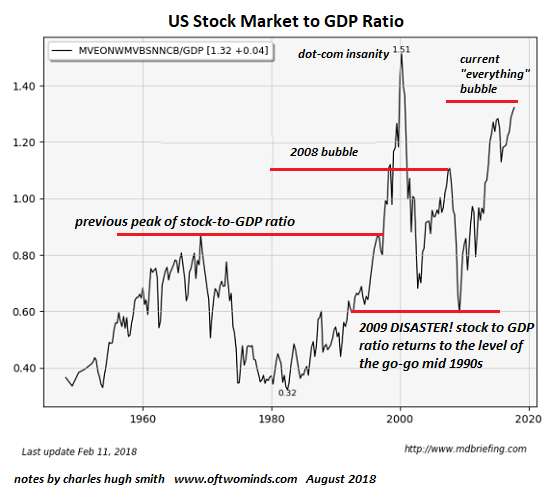
Take a look at stock valuations as a percentage of GDP, i.e. the real economy: stocks are clearly in a bubble.
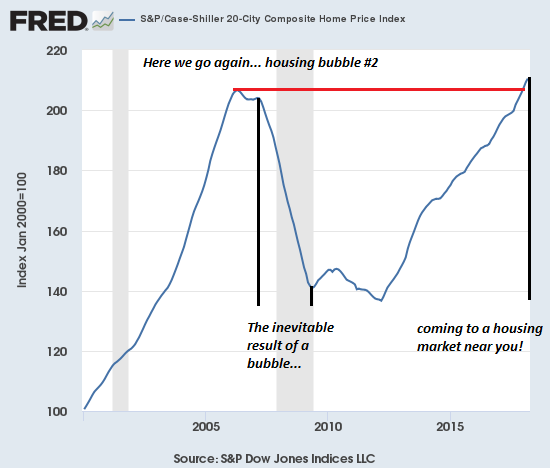
The national Case-Shiller housing price index: bubble.
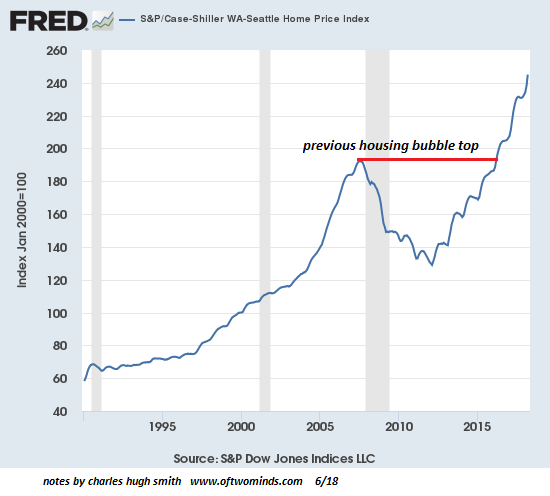
The Seattle Case-Shiller housing price index: super-bubble.
The Dallas Case-Shiller housing price index: super-duper-bubble.
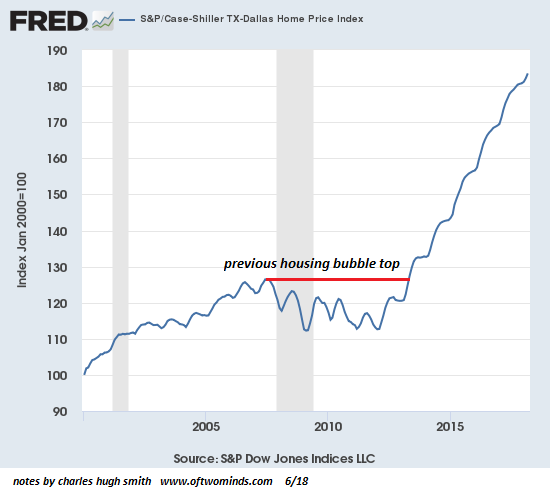
You get the point: virtually every supposedly low-risk asset class is actually a super-risky, super-dangerous bubble. Speculation drives valuations far beyond financial rationality because we're herd animals and unearned gains supercharge our greed, especially when we see all sorts of undeserving people making fortunes for doing nothing but running with the herd.
So when the herd thunders off the cliff, most participants are trapped in the stampede. Very few exited far from the cliff, and even fewer will wait patiently for the dust to settle before moving cash into assets.
Risk has a knack for hiding in plain sight. Few people look for it, and even fewer recognize it. Only a handful act on it.
My new mystery The Adventures of the Consulting Philosopher: The Disappearance of Drake is a ridiculously affordable $1.29 (Kindle) or $8.95 (print); read the first chapters for free in PDF format.
My new mystery The Adventures of the Consulting Philosopher: The Disappearance of Drake is a ridiculously affordable $1.29 (Kindle) or $8.95 (print); read the first chapters for free in PDF format.
My new book Money and Work Unchained is now $6.95 for the Kindle ebook and $15 for the print edition.
Read the first section for free in PDF format.
If you found value in this content, please join me in seeking solutions by becoming a $1/month patron of my work via patreon.com.
If you found value in this content, please join me in seeking solutions by becoming a $1/month patron of my work via patreon.com.
https://www.oftwominds.com/blogsept18/speculators9-18.html
Vox Popoli: UN backs Soros
The UN and the EU are desperately trying to get nationalist Hungary to back down
and accept foreign invasion before more countries are inspired to defend
themselves against the globalist evil:
Hungary’s Foreign Minister Peter Szijjarto has accused the UN human rights
watchdog of “spreading lies” about his country, saying that immigration was not
a “fundamental human right.”
The official took aim at the “independent experts” with the UN Human Rights Council, stating they “should not be independent from the truth.”
“Recently, unfortunately, some UN officials started to spread lies against and about my country,” Szijjarto told the UN body’s meeting on Wednesday.
Such officials would like to “force on us impossible things,” namely allowing illegal migrants into the country, Szijjarto stated. “They say that migration is a fundamental human right, which is a lie,” he stressed.
The harsh statement of the foreign minister came as a response to criticism against Hungarian anti-immigration policies. Last week, the UN rights body blasted the so-called ‘Stop Soros’ law, adopted by the country’s government back in July. The UN paper said Hungary “attacks against civil society, migrants, refugees and asylum seekers” with the law, adding that it’s against the international human rights law and poses a threat to the “values” of the whole European Union.
It added that it targets the critical “civil society” and fuels “hostility, xenophobia and … discrimination against migrants, asylum seekers, refugees and all those trying to provide them support.”
The ‘Stop Soros’ law has imposed restrictions on foreign NGOs, which work with migrants, obliging them to seek licenses from the government. It also criminalized aiding migrants, namely “providing financial or property benefit” to them or simply informing them about the asylum-seeking procedures. Those who do so could now face 12 months in jail.
The official took aim at the “independent experts” with the UN Human Rights Council, stating they “should not be independent from the truth.”
“Recently, unfortunately, some UN officials started to spread lies against and about my country,” Szijjarto told the UN body’s meeting on Wednesday.
Such officials would like to “force on us impossible things,” namely allowing illegal migrants into the country, Szijjarto stated. “They say that migration is a fundamental human right, which is a lie,” he stressed.
The harsh statement of the foreign minister came as a response to criticism against Hungarian anti-immigration policies. Last week, the UN rights body blasted the so-called ‘Stop Soros’ law, adopted by the country’s government back in July. The UN paper said Hungary “attacks against civil society, migrants, refugees and asylum seekers” with the law, adding that it’s against the international human rights law and poses a threat to the “values” of the whole European Union.
It added that it targets the critical “civil society” and fuels “hostility, xenophobia and … discrimination against migrants, asylum seekers, refugees and all those trying to provide them support.”
The ‘Stop Soros’ law has imposed restrictions on foreign NGOs, which work with migrants, obliging them to seek licenses from the government. It also criminalized aiding migrants, namely “providing financial or property benefit” to them or simply informing them about the asylum-seeking procedures. Those who do so could now face 12 months in jail.
Hungary is nationalist because Hungary
understands the long-term costs of being invaded much better than most nations
do. The Hungarian
leadership is doing what the Right far too often fails to do, which is go on
the offensive against its enemies. If all you do is play defense, you will
lose. It's guaranteed. Every party of the Right, from Myanmar to the USA,
would be well advised to start aggressively pushing for laws banning the
principles, funding, activities, and organizations of the Left.
So-called "freedom of speech" was always a trap. As others have noted, they simply define your speech as violence even as they define their violence as speech.
So-called "freedom of speech" was always a trap. As others have noted, they simply define your speech as violence even as they define their violence as speech.
Subscribe to:
Posts (Atom)