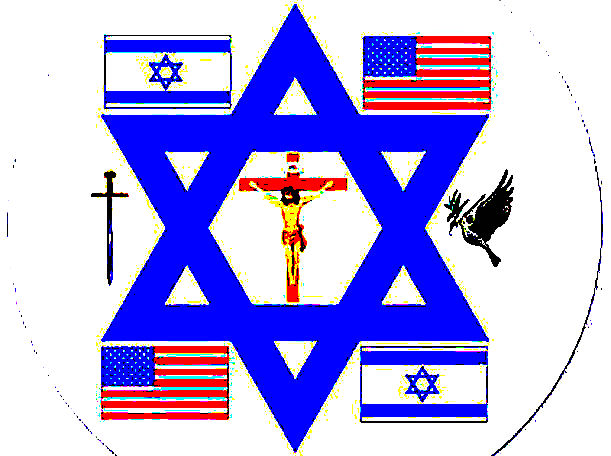
We can see mainstream Christianity become more and more Jewish with each passing day — and that transformation is progressing because Christians have been duped into believing that Christianity is fundamentally based on “Judaism” and “Jewish values” — while Jews concede no such thing, and rightfully see Christianity as completely antithetical to Judaism. This inter-faith dynamic is a one-way street — where Christians compromise and concede any aspect of their faith that Jews perceive as anti-Jewish — which ultimately means all of it.
The following essay, “The Myth Of A ‘Judeo-Christian’ Tradition,” was first published in New Dawn Magazine in 1994, but it is more relevant today than it was almost 30 years ago, as we can clearly see so much of it coming to fruition. If nothing else, the direct quotes from Jewish sources provide invaluable, prima facie evidence that Christians are indeed being profoundly deceived — and how Jewry benefits from this deception.
“The Myth Of A ‘Judeo-Christian’ Tradition”
This is an age in which news has been superseded by propaganda, and education by brain-washing and indoctrination. From the advertising used to sell poor quality goods, to the classes in schools designed to make children into conditioned robots of the State, the art of persuasion has displaced the simple virtue of truth.
Since the end of the Second World War we have been bombarded from all sides with references to the Western world’s “Judeo-Christian religion,” and “our Judeo-Christian heritage.” We are told by both church leaders and scholars that our society is based on a supposed “Judeo-Christian tradition.”
The notion of “Judeo-Christian religion” is an unquestioned—almost sacrosanct—part of both secular and church thinking. American Christian leader Prof. Franklin H. Littel, a vocal supporter of the Zionist state, frankly declared that “to be Christian is to be Jewish,” and that consequently it was the duty of a Christian to put support for the “land of Israel” above all else. Pat Boone, the North American singer and evangelist, said there are two kinds of Judaism, one Orthodox and the other Christian.
Yet such a decidedly Christian Zionist outlook is to say the least, wildly simplistic and profoundly ahistorical. As the astute Jewish writer, Joshua J. Adler, points out, “The differences between Christianity and Judaism are much more than merely believing in whether the messiah already appeared or is still expected, as some like to say.”
The comments of Jewish author Mr. S. Levin may well explain the Christian’s need for the Judeo-Christian myth. Writing in the Israeli journal Biblical Polemics, Levin concludes: “‘After all, we worship the same God’, the Christian always says to the Jew and the Jew never to the Christian. The Jew knows that he does not worship the Christ-God but the Christian orphan needs to worship the God of Israel and so, his standard gambit rolls easily and thoughtlessly from his lips. It is a strictly unilateral affirmation, limited to making a claim on the God of Israel but never invoked with reference to other gods. A Christian never confronts a Moslem or a Hindu with ‘After all, we worship the same God’.”
Back in 1992 both Newsweek magazine and the Israeli Jerusalem Post newspaper simultaneously printed extensive articles scrutinising the roots of the sacrosanct Judeo-Christian honeymoon.
The statement heading the Newsweek article read: “Politicians appeal to a Judeo-Christian tradition, but religious scholars say it no longer exists.” The Jerusalem Post article’s pull quote announced: “Antisemitism is a direct result of the Church’s teachings, which Christians perhaps need to re-examine”.
“For scholars of American religion,” Newsweek states, “the idea of a single Judeo-Christian tradition is a made-in-America myth that many of them no longer regard as valid.” It quotes eminent Talmudic scholar Jacob Neusner: “Theologically and historically, there is no such thing as the Judeo-Christian tradition. It’s a secular myth favoured by people who are not really believers themselves.”
Newsweek cites authorities who indicate that “the idea of a common Judeo-Christian tradition first surfaced at the end of the 19th century but did not gain popular support until the 1940s, as part of an American reaction to Nazism . . ,” and concludes that “Since then, both Jewish and Christian scholars have come to recognize that—geopolitics apart—Judaism and Christianity are different, even rival religions.”
The Jerusalem Post accused the Christian Church of being responsible for the Holocaust. The French Jewish scholar Jules Isaac was quoted as saying: “Without centuries of Christian catechism, preaching, and vituperation, the Hitlerian teachings, propaganda and vituperation would not have been possible.”
“The problem,” concludes the Jerusalem Post, “is not, as some assert, that certain Christian leaders deviated from Christian teachings and behaved in an un-Christian manner; it is the teachings themselves that are bent.”
Joshua Jehouda, a prominent French Jewish leader, observed in the late 1950s: “The current expression ‘Judaeo-Christian’ is an error which has altered the course of universal history by the confusion it has sown in men’s minds, if by it one is meant to understand the Jewish origin of Christianity . . . If the term ‘Judaeo-Christian’ does point to a common origin, there is no doubt that it is a most dangerous idea. It is based on a ‘contradictio in abjecto‘ which has set the path of history on the wrong track. It links in one breath two ideas which are completely irreconcilable, it seeks to demonstrate that there is no difference between day and night or hot and cold or black and white, and thus introduces a fatal element of confusion to a basis on which some, nevertheless, are endeavouring to construct a civilisation.” (L’Antisemitisme Miroir du Monde pp. 135-6).
What is the Truth?
Is there then any truth in this term, “Judeo-Christian”? Is Christianity derived from Judaism? Does Christianity have anything in common with Judaism?
Reviewing the last two thousand years of Western Christian history there is really no evidence of a Judeo-Christian tradition and this has not escaped the attention of honest Christian and Jewish commentators.
The Jewish scholar Dr. Joseph Klausner in his book Jesus of Nazareth expressed the Judaic viewpoint that “there was something contrary to the world outlook of Israel” in Christ’s teachings, “a new teaching so irreconcilable with the spirit of Judaism,” containing “within it the germs from which there could and must develop in course of time a non-Jewish and even anti-Jewish teaching.”
Dr. Klausner quotes the outstanding Christian theologian, Adolf Harnack, who in his last work rejected the hypothesis of the Jewish origin of Christ’s doctrine: “Virtually every word He taught is made to be of permanent and universal humanitarian interest. The Messianic features are abolished entirely, and virtually no importance is attached to Judaism in its capacity of Jesus’ environment.”
Gershon Mamlak, an award-winning Jewish Zionist intellectual, recently claimed that the “Jesus tradition” is essentially the ultimate extension of ancient Greek Hellenism and is in direct conflict to Judaism’s “role as the Chosen people”.
Dr. Mamlak, writing in the Theodor Herzl Foundation’s magazine of Jewish thought, Midstream, maintains that the prevailing theory that Christianity originated in the spiritual realm of Judaism “is anchored in a twofold misconception: 1) the uniqueness of Judaism is confined to its monotheistic God-concept; 2) the ‘parting of the ways’ between the Jesus coterie and Judaism is seen as the result of the former’s adaptation of the doctrines of Christology.”
The first misconception means: “When the affinity of the Jesus coterie with Judaism is evaluated by common faith in the One, severed from the believer’s duty to execute the Law of the One and to acknowledge the Chosen Nation of Israel as His instrument-faith in the One becomes anti-Judaism par excellence!”
In Gershon Mamlak’s view, “The conflict between Judaism and the Jesus tradition goes beyond the confines of theology. [The Jesus tradition] was the cosmopolitan renunciation of the national phenomenon in general and extreme hostility to Israel’s idea of a Chosen Nation as the divine instrument for the perfection of the world.”
Evidently the concept of a common Judeo-Christian tradition has more to do with post 1945 politics and a certain amount of ‘public relations’ than it does with historical and Biblical reality. Never the less a number of modern Christian polemicists have managed to rest certain New Testament verses in the drive to give a Scriptural basis to their argument.
Confusion over the origin of Rabbinic Judaism and Christianity is the root of the Judeo-Christian myth.
Biblical scholars Robert and Mary Coote clearly show in their book Power, Politics and the Making of the Bible that neither is Christianity a patched up Judaism, nor is Rabbinic Judaism automatically synonymous with the religion of Moses and the old Hebrews.
The Cootes’ illustrate the religious climate in Judea two millennia ago: “The cults, practices, and scriptures of both groups, rabbis and bishops, differed from those of the temple; thus we reserve the terms Jew, Jewish, and Judaism for the rabbis and those under their rule and use Judean, contrary to custom, for the common source of Judaism and Christianity….”
“Despite the ostensible merging of Judean and Jew even in certain New Testament passages and by the rabbis who became rulers of Palestine in the third century and continued to use Hebrew and Aramaic more than Greek, the roots of Christianity were not Jewish. Christianity did not derive from the Judaism of the pharisees, but emerged like Judaism from the wider Judean milieu of the first century. Both Christians and Jews stemmed from pre-70 Judean-ism as heirs of groups that were to take on the role of primary guardians or interpreters of scripture as they developed on parallel tracks in relation to each other.” (Power, Politics, and the Making of the Bible).
The few New Testament ‘proof texts’ utilized by Christian Zionists and secular proponents of the modern Judeo-Christian myth are the product of poor translation. Messianic Jewish writer Malcolm Lowe in his paper “Who Are the Ioudaioi?” concludes, like Robert and Mary Coote, that the Greek word “Ioudaioi” in the New Testament should be translated as “Judeans”, rather than the more usual “Jews.” The Israeli scholar David Stern also came to the same conclusion when translating the Jewish New Testament.
Few Christians are aware that the translators of Scripture often mistranslated the word “Jew” from such words as “Ioudaioi” (meaning from, or being of: as a geographic area, Judean). The word Judean, mistranslated as “Jew” in the New Testament, never possessed a valid religious connotation, but was simply used to identify members of the native population of the geographic area known as Judea.
Also it is important to understand that in the Scriptures, the terms “Israel,” “Judah” and “Jew” are not synonymous, nor is the House of Israel synonymous with the House of Judah. The course of history is widely divergent for the peoples properly classified under each of these titles. Accordingly, the authoritative 1980 Jewish Almanac says, “Strictly speaking it is incorrect to call an ancient Israelite a Jew or to call a contemporary Jew an Israelite or a Hebrew.”
A writer for The Dearborn Independent, published in Michigan back in 1922, summarized the problem thus: “The pulpit has also the mission of liberating the Church from the error that Judah and Israel are synonymous. The reading of the Scriptures which confuse the tribe of Judah with Israel, and which interpret every mention of Israel as signifying the Jews, is at the root of more than one-half the confusion and division traceable in Christian doctrinal statements.”
Jesus Christ and the Pharisees
The New Testament Gospels reveal an intense conflict between Jesus and the Pharisees, one of the two principal Judean religious sects (see Matthew chapter 3, verse 7; Matthew chapter 5, verse 20; Matthew chapter 23, verses 13-15, 23-29; Mark chapter 8, verse 15; Luke chapter 11, verse 39). Much of this controversy was centered on what was later to become the foundation and highest authority of Judaism, the Talmud. In the time of Jesus Christ, this bore the name of “The Tradition of the Elders” (see Matthew chapter 15, verses 1-9).
The Judean historian Josephus wrote: “What I would now explain is this, that the Pharisees have delivered to the people a great many observances by succession from their fathers, which are not written in the laws of Moses . . .”
While the Pharisees recognized the Laws of Moses, they also claimed that there was a great body of oral tradition which was of at least equal authority with the written Law—and many claimed that the Tradition was of greater authority. By their tradition, they undertook to explain and elaborate upon the Law. This was the “Tradition of the Elders,” to which the name of Talmud was later given. It had its beginning in Babylon, during the Babylon captivity of the people of Judah, where it developed in the form of the commentaries of various rabbis, undertaking to explain and apply the Law. This was the foundation of Rabbinic Judaism.
This Judaism was very different from the religion of the ancient Israelites. The late Rabbi Stephen S. Wise, who was the Chief Rabbi of the United States, expressed this conclusively when he said: “The return from Babylon, and the adoption of the Babylonian Talmud, marks the end of Hebrewism, and the beginning of Judaism.” The Jewish Encyclopedia tells us that the Talmud is actually “the product of the Palestinian and Babylonian schools” and is generally referred to as “the Babylonian Talmud”.
Dr. Boaz Cohen in Everyman’s Talmud states the Talmud is the work of “numerous Jewish scholars over a period of some 700 years, roughly speaking, between 200 [B.C.] and 500 [A.D.].”
Rabbi Louis Finkelstein in Volume 1 of The Pharisees, the Sociological Background of their Faith says, “Pharisaism became Talmudism, Talmudism became Medieval Rabbinism, and Medieval Rabbinism became Modern Rabbinism. But throughout these changes of name, inevitable adaption of custom, and adjustment of Law, the spirit of the ancient Pharisee survives unaltered.”
According to The Universal Jewish Encyclopedia, Vol. VIII, (1942) p.474 : “The Jewish religion as it is today traces its descent, without a break, through all the centuries, from the Pharisees. Their leading ideas and methods found expression in a literature of enormous extent, of which a very great deal is still in existence. The Talmud is the largest and most important single member of that literature.”
Moshe Menuhim explains that the Babylonian Talmud embodied all the laws and legends, all the history and ‘science,’ all the theology and folklore, of all the past ages in Jewish life—a monumental work of consolidation. In the Talmud, Jewish scholarship and idealism found their exclusive outlet and preoccupation all through the ages, all the way up to the era of Enlightenment. It became the principal guide to life and object of study, and it gave Judaism unity, cohesion and resilience throughout the dark ages.
The Talmud, more than any other literature, so defined Judaism that Rabbi Ben Zion Bokser admitted, “Judaism is not the religion of the Bible.” (Judaism and the Christian Predicament, 1966, p.159) It is the Talmud that guides the life and spirit of the Jewish people.
“The Talmud is to this day the circulating heart’s blood of the Jewish religion. Whatever laws, customs, or ceremonies we [Jews] observe—whether we are Orthodox, Conservative, Reform or merely spasmodic sentimentalists—we follow the Talmud. It is our common law.” (A History of the Jews, Solomon Grayzel).
Both Jewish and Christian scholars agree that it was Jesus Christ’s flagrant rejection of this “Tradition of the Elders” and his open confrontation with the powerful Pharisees that created the climate that led to his death. Historically, Christian thinkers argued that the Talmud was directly responsible for the rejection of Christ.
In their view these “traditions” blinded the eyes of the people to a true understanding of the prophecies which related to the coming of the Messiah.
Defining Christianity
If, as we have seen, the Pharisees and the Talmud forever defined Judaism, then most certainly the writings of the post-Apostolic Christian church leaders help us in understanding the relationship of the early Christian faith to both paganism and Judaism.
Justin Martyr (c100-165 A.D.) was indeed the earliest and most significant of these post-Apostolic church apologists. Following in the theological footsteps of Paul, who taught that the Gospel was the fulfilment of Moses and the Prophets, Justin argued that the Gospel was in the mind of God from the beginning and it was given to Abraham and the righteous Patriarches long before Judaism existed. This is in keeping with the Gospel teaching that the Hebrew Scriptures find their ‘flowering’ in the life, purpose, and accomplishments of Jesus the Christ.
Hence, the Christian faithful have traditionally understood the Old Testament through the New Testament.
In his Dialogue with Trypho Justin seeks to persuade a Jew of the truth of Christianity. Unlike the other apologists, he focuses mainly on the nature and meaning of Christ. Christ was the Logos who inspired the Greek philosophers and is present in all men as the Logos spermatikos (seminal reason or word). Through Him, the best of the philosophers were able to produce significant works of theology and philosophy. Their ideas could serve as beacons of truth just as much as could the inspired writings of the Old Testament Hebrews. Those who lived according to the Logos, even before Christ, were Christians. In the Old Testament it was the Logos who was revealed as God, because the transcendent Heavenly Father could not thus speak to man.
Justin wrote in Apology:
“We have been taught that Christ is the first-born of God, and we have declared above that He is the Word [or reason] of whom all mankind partakes. Those who lived reasonably [with the Word] are Christians, even though they have been called atheists. For example: among the Greeks, Socrates, Heraclitus and men like them; among the barbarians [non-Greeks], Abraham . . . and many others whose actions and names we now decline to recount, because we know it would be tedious.”
Christianity, seen through Justin Martyr’s writings, takes on a ‘cosmic’ breadth:
“I both boast and strive with all my strength to be found a Christian . . . Whatever things were rightly said by any man, belong to us Christians. For next to God we worship and love the Word, who is from the unbegotten and ineffable God, since He also became man for our sakes, that by sharing in our sufferings He might also bring us healing. For all those writers were able to see reality darkly, through the seed of the implanted Word within them.” (2 Apology).
Jesus Christ had come, argued Justin, to restore true religion and to denounce the hypocrisy of the religion of Judea. For that crime Jesus had been crucified. Consequently, Christianity is not a form of Judaism or simply Jewish prophecies fulfilled but ‘the true philosophy’.
Justin’s Christianity was eventually reducible to three major principles: (1) worship of God, mostly through private prayer and communication of being; (2) belief in an after-life with rewards and punishments for one’s actions in this world; and (3) the importance of leading a virtuous life in imitation of Christ and in obedience to His commandments.
The Romans killed Justin for his religion. He was ever known as Justin Martyr, and not as St. Justin. His works defined Christianity as a culminating religion and a “universal” faith incorporating the essential and perennial truth of the pre-Christian religious tradition. Christianity was the restatement of a very old doctrine encompassing the Old Testament and the grand verities of the ancients. Two centuries later Augustine again clarified the Christian faith in these terms when he wrote:
“That which is now called the Christian religion existed among the ancients, and never did not exist from the planting of the human race until Christ came in the flesh, at which time the true religion which already existed began to be called Christianity.”
Justin not only showed that Christ is the culmination and completion of all the partial knowledge of truth in Greek philosophy, He is also the culmination of the history of ancient Israel. According to Justin Jesus Christ is Israel and because of Him the church now bears the name of Israel.
This is to say, therefore, that the central message of the Old Testament has been fulfilled in the New Testament. It must be understood that this was the position of Christendom for at least 1900 years. It was the position, not only of Justin Martyr, but of such Stalwart saints as Irenaeus and Hippolytus; a position embraced by Martin Luther and John Calvin, the two towering figures of the Protestant Reformation.
Here we have not only a clear separation of Christianity and Judaism, but a direct challenge to Judaism’s core dogma of a Chosen Nation. A point which has not been lost by Jewish writers.
We read in Zionist author Uri Zimmer’s Torah-Judaism and the State of Israel: “The Jewish people, Rabbi Judah Halevy (the famous medieval poet and philosopher) explains in his ‘Kuzari’, constitutes a separate entity, a species unique in Creation, differing from nations in the same manner as man differs from the beast or the beast from the plant . . . although Jews are physically similar to all other men, yet they are endowed with a ‘second soul’ that renders them a separate species.”
Fraud
Traditionally Jewish scholars, as we have shown, were highly critical of the Judeo-Christian myth. There are many others, under the influence of modernism and secular Zionism, who do see some advantage in it.
Rabbi Martin Siegel, reflecting a Messianic zeal, was quoted in the 18 January 1972 edition of New York Magazine as declaring: “I am devoting my lecture in this seminar to a discussion of the possibility that we are now entering a Jewish century, a time when the spirit of the community, the non-ideological blend of the emotional and rational and the resistance to categories and forms will emerge through the forces of anti-nationalism to provide us with a new kind of society. I call this process the Judaization of Christianity because Christianity will be the vehicle through which this society becomes Jewish.”
While historic Christianity has looked to the eventual triumph of the Kingdom of God throughout the earth, according to the Zionist leaders Talmudic Judaism is zealous in the “drive to perfect man’s earthly habitat” (Gershon Mamlak, Midstream, Jan., 1989, p.31).
Dr. Mamlak admits that “many Jews have filled the ranks of the various revolutionary movements “(op. cit., p.32) in order to satisfy this urge. [But who can agree on the terms of the social contract? Were the Zionist Irgun and Stern gangs who terrorised and massacred the Palestinian Arabs in the campaign to establish the Israeli state, shining role models for young Jews? What about the immorality of “the end justifies the means”?]
Rabbi Michael Higger, renowned Talmudic scholar, in his book The Jewish Utopia, discusses the reshaping of the world into a Jewish Eden. The victory of this Utopia is inexorably tied to the coming of the Jewish Messiah.
“And the Messianic Age,” argues the eloquent Jewish Zionist author Leon Simon, “means for the Jew not merely the establishment of peace on earth and good will to men, but the universal recognition of the Jew and his God. . . For Judaism has no message of salvation for the individual soul, as Christianity has; all its ideas are bound up with the existence of the Jewish nation.” (Studies in Jewish Nationalism).
Driven by political agendas compromising Jews and compromising Christians began, only in this century, to disseminate the theretofore unheard of doctrine that Christianity originated from Judaism and that the two share a common worldview.
Dr. Gordon Ginn, an American Christian scholar, made a very valid point when he noted: “It is most interesting, indeed, that rabbis as well as Jewish scholars such as Mamlak and White agree with orthodox, historical Christianity that ‘Judeo-Christian’ is a contradiction in terms, even though that truth is yet to be discovered by contemporary evangelical and fundamentalist Christians” (Smyrna, August, 1993).
Christianity and Judaism are two distinct religious inheritances, despite all the superficial attempts by modern scholars to manufacture a naive “Judeo-Christianity.” The very term “Judeo-Christian” is a mischievous misnomer without historical or Scriptural validity.
The religions of the world are the product of progressive revelation to a diverse humanity, separately expressing as they do the great metaphysical realities of life. Attempts to distort or eliminate these unique, ancient and divinely ordained patterns, through non-divine syncretism and politically-motivated concoctions, is both anti-traditional and truly diabolical.
Appeals to a nonexistent historical unity and calls for a banal, modernist theology do nothing for religious understanding and mutual respect. “Judeo-Christianity” should be seen for what it is—another secular twentieth century fraud, manufactured for narrow political ends, that is supremely disrespectful to all true believers.
Any fundamental unity that does exist between world religions cannot be appreciated by ignorant and secular scholarship, but only through knowledge of the great primordial and universal truths.
As Luc Benoist aptly wrote, “Our age is seeking a universal understanding which men of vision can already foresee and which is the longing of all great souls. There is ample evidence that the world’s economic problems can be solved without the different religions having to abandon their unique spiritual insights; after all, brotherly agreement does not prevent the individual growth of each member of the family, bodily separate, but united in heart and mind.” (The Esoteric Path).
https://christiansfortruth.com/the-myth-of-a-judeo-christian-tradition/


