Labels

Sunday, December 30, 2018

Of Two Minds - How Many of Your Local Taxes and Fees Are Rocketing Higher?


While wages have supposedly gone up 3.4% in 2018, taxes and fees are rising at much higher rates.

Here's a list of tax and fee increases hitting residents of one of the counties I call home; the list includes taxes/fees raised in 2017 and 2018:
1. Property taxes: between 6.5% and 10%, depending on the property class
2. Gasoline tax (county), from 8.8 cents to 23 cents, phased in over 3 years
3. General excise tax, up 6.3%
4. Garbage fee (commercial): up 27%
5. Sewer fees: up 44%
6. Electricity (base rate): up 7.4%
7. Annual vehicle safety inspection fee (state): up $5.81
8. County water service: up 8%
9. Accommodation fee (a.k.a. hotel tax) (state): up 10%

I may have missed a few, but you get the idea: while wages have supposedly gone up 3.4% in 2018, taxes and fees are rising at much higher rates. (Given that the Consumer Price Index underweights increases in big-ticket costs such as healthcare and college, the 3.4% gain is suspect; those households exposed to giant leaps in expenses likely lost ground).

I understand local governments are caught in a vise: wages and benefits to their employees make up the majority of their expenses, and those costs are mandated by union contracts and/or state-level agreements.
Many local governments cut services in the Great Recession rather than raise fees and taxes, and so now that the economy has "recovered," they're rushing to raise revenues to restore services or deal with the backlog of projects set aside during the lean years.

But none of that makes it easier for households and enterprises getting hit by fast-rising fees and taxes. The above list is just the tip of the iceberg: how much does a simple parking ticket cost you now? In many locales, what once cost $15 is now north of $60.
How about the cost for a copy of an official document at the County Records office? In many locales, what was once a nominal fee is no longer nominal.
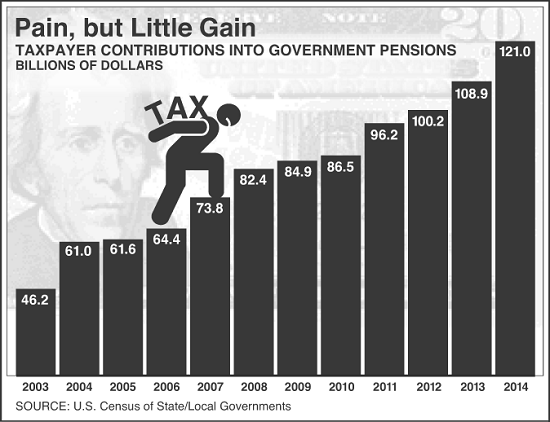
We all know public pensions are often underfunded, or dependent on outsized stock market gains, which means the increases in local government taxes and fees are just getting started.
My book Money and Work Unchained is now $6.95 for the Kindle ebook and $15 for the print edition. Read the first section for free in PDF format. 


Saturday, December 29, 2018

Systemic Anti-Americanism - By Jack Kerwick (And how the Big Con is guilty too!)


Living in 21st America, it’s impossible to go a single day without hearing multiple mentions of “racism.” It seems to be the lifeblood of our political-cultural life.
Because of the ever-increasing rarity of overt instances of white-on-black “racism” (and make no mistakes about it, “racism” is used to refer only to white-on-nonwhite transgressions), the architects and agents of the Racism-Industrial-Complex (RIC) have had to appeal to what they call “institutional” or “systemic” or “structural” racism.
The idea here is that even the best-intentioned of whites are either subconsciously racist or, at the very least, they subconsciously purvey American institutions which embed “racist” assumptions that impede black success.  Eduardo Bonilla, a loyal RIC agent, sums up the gist of this notion in the title of his book on this subject: Racism without Racists: Color-Blind Racism and the Persistence of Racial Inequality in America.
Racism without Racists...Eduardo Bonilla-SilvaBest Price: $4.25Buy New $35.96(as of 03:57 EST - Details)https://www.lewrockwell.com/wp-content/mu-plugins/amazon-ad-link-lr/img/buy-from-tan.gif

Very rarely, though, do we hear much about patriotism.  It’s true, of course, that we’ll not infrequently hear politicians refer to the policy proposals of their opponents as “un-American.” Yet it’s supposed to be bad form to question another person’s patriotism. Given the ease with which people, particularly leftists, hurl the R-word (as well as many other derogatory terms) at their opponents, the conspicuous paucity of charges of anti-Americanism is more than a bit curious.
Well, it’s curious on its face. But once we scratch the surface, it’s not hard at all to see why those on the left prefer for the topic of patriotism to go the way of the dinosaur: Given its unequivocal commitment to the fundamental transformation of the Western world, the left has always derived its identity in large measure from its vehement opposition to the national identities that compose that world.
Thus, the left in America is practically by definition anti-American.  Except for when appeals to them prove rhetorically effective and ideologically useful, for the culturally and historically-specific particularities and contingencies that constitute America the left has nothing but contempt.  This is not hyperbole. Logically, it’s impossible to draw any other conclusion from the left’s relentless campaign against the allegedly “racist,” “sexist,” “classist,” “homophobic,” and “xenophobic” character of the country.  How, we must ask ourselves, can those who tirelessly characterize America in these terms have anything but disdain for an entity that they (supposedly) think is so ugly, so evil?
Let’s be frank: America was founded by white people, white Protestant Christians, to be exact, and for white people of (mostly) the same description. As early on as 1790, just a short while after the United States Constitution was ratified, the Naturalization Act was passed.  This law expressly limited citizenship in the new Republic to “free white persons of good character.” Until as recently as the 1960s, America remained nearly 90% white.  Today, at about 63% of the population, America is still majority white.
Considering that it is the white, heterosexual, Christian male on whose shoulders the contemporary left lays the burden of all of the world’s problems, there is no way that leftists can, without being blatantly inconsistent, not seethe with disgust and hatred for this bastion of White Supremacy that they have long referred to as “AmeriKKKa.”
Still, there are indeed individual Americans of a leftist bent who will take offense at the charge of anti-Americanism, individuals who insist upon their love for the United States.  Such folks are doubtless sincere.  Their sincerity, however, goes no distance toward undercutting the anti-American logic of their ideology.
Nor does their intellectual confusion exculpate them from their responsibility for purveying anti-Americanism.
The illogic of the leftist who genuinely proclaims his love for America no more defeats the allegation of anti-Americanism than does the genuineness of the white person who insists on his commitment to racial equality relieve him of responsibility for (supposedly) promoting “racism.”
Now, “institutional racism” is a fiction invented by RIC whose staying power owes to its enormous profitability: RIC needs to perpetuate this Big Lie.
Yet institutional anti-Americanism is all too real.
The ideas constitutive of leftist ideology are indeed anti-American: The cardinal leftist principle or ideal of Equality, i.e. the ideal of a more or less equal distribution of substantive or material satisfactions, leftists labor inexhaustibly to make a reality.  Yet it is precisely a condition of this sort that the decentralized, Constitutional character of American government precludes.  To put it more exactly, the American government, with its wide diffusion of power and authority, is antithetical to the sort of government whose existence is necessary to realize the Egalitarian fantasies of the left.
And, of course, the racial obsessions of the current left also render impossible any love for a country that the left insists is and has always been a bastion of White Supremacy.
But anti-Americanism is also promoted by way of other particularly popular terms and expressions that have become associated with “patriotism” and that are typically used by the conservative movement, what I call Big Conservatism, or the Big Con.
Discrimination and Dis...Thomas SowellBest Price: $14.11Buy New $18.60(as of 11:40 EST - Details)https://www.lewrockwell.com/wp-content/mu-plugins/amazon-ad-link-lr/img/buy-from-tan.gif

What all of these expressions share in common, and what makes them anti-American, is that they unequivocally deny the historical character of the country.
For example, Big Conservatives are at least as given, and, truth be told, probably much more prone than are their Democrat liberal counterparts, to characterize America as a “Nation of Immigrants.”  Yet if this was a historically accurate characterization, then one would have expected for earlier generations of Americans, and certainly those members of the Founding generation, to have viewed it as such.  They did no such thing.
In fact, anyone remotely familiar with American history can recognize the Nation of Immigrants line for the whopper of a Lie that it is.
Only if there is already an existent social order is it possible for anyone to immigrate to it. To put it another way, the logic of the concept of “immigrant” logically presupposes both an established society to which the immigrant immigrates and, importantly, the concept of “native” or “indigenous,” i.e. of the non-immigrant.
America was established by those who settled it.  There was no America before specific people at a specific time decided to tame the vast wilderness that would become the territorial jurisdiction of the United States.  Those people were all white, all British, and, at the time of the War of Independence—about 170 years after the first settlers made a home for themselves in Virginia—they were at least 80 percent English and 98% Protestant Christian.
To repeat, there was no America until white, British Protestants created it.
Thus, the term of “Native-American,” designed to refer to those who were formerly described as “Indian,” are patent misnomers. Yet the movers and shakers of the Big Con use it just as frequently as do “Politically Correct” liberal leftist Democrats.
And Big Cons also have long endorsed the notions of “the Melting Pot” and “E Pluribus Unum,” both variations of the Nation of Immigrants Lie.  Yet America was never meant to be a melting pot with ingredients from all over the globe, and “E Pluribus Unum,” every American from more honest generations would’ve insisted, refers, not to a single nation composed of immigrants, but the formation of the 13 original colonies into a single country.
According to another anti-American fiction promoted by the Big Con, America was founded upon “Judeo-Christian” principles or values.  It’s true, of course, that Christianity spun out of Judaism, and that some of the fundamental metaphysical assumptions of the latter were transmitted to the former.  This, however, does not justify, at least not from any remotely historical perspective, the nomenclature of “Judeo-Christian” when referencing the founding of America.  To repeat what has already been repeated more than once above, America was founded almost exclusively by Christians.  That in some abstract sense the “principles” that are read from the founding are embodied by both Judaism and Christianity no more warrants describing it as “Judeo-Christian” than does the fact that some of these same principles are affirmed by Muslims warrants characterizing America as having been founded upon Judeo-Christian-Islamic principles.
This, though, gets us to the heart of the problem, to that which is the most anti-American of all Big Lies purveyed by the Big Con.
This is the Big Lie of “American Exceptionalism.”  Given the ease with which the language of American Exceptionalism flies from the lips of Big Conservatives, one would think that this terminology lends itself to more than one meaning.  This being said, American Exceptionalists always imply that America is exceptional inasmuch as it is the only country in all of human history to have ever been founded upon principles or ideals or values.
This, though, is anti-American because it is radically ahistorical.
Principles, ideals, values, comprehensively, propositions—this is the stuff of thin gruel.  Propositions are inherently abstract and general, i.e. they easily conceal the demographic-specific contingencies constitutive of America as it historically existed while conveying an air of plausibility. The 18th century Scottish philosopher David Hume puts the point well:
Race & Economics: How ...Walter E. WilliamsBest Price: $9.76Buy New $5.00(as of 02:55 EST - Details)https://www.lewrockwell.com/wp-content/mu-plugins/amazon-ad-link-lr/img/buy-from-tan.gif

“It is easy for a false hypothesis to maintain some appearance of truth,” Hume said, as long as “it keeps wholly in generals” and “makes use of undefined terms [.]”  He added that “ideas, especially abstract ones, are naturally faint and obscure: the mind has but a slender hold of them: they are apt to be confounded with other resembling ideas; and when we have often employed any term, though without a distinct meaning, we are apt to imagine it has a determinate idea annexed to it.”
Big Conservatives, in employing the terminology of American Exceptionalism, terminology with unmistakably positive connotations, mean to suggest that they are doing nothing more or less than affirming the singular greatness of the country. American Exceptionalism is meant to imply that anyone who doesn’t affirm the “exceptional” nature of America is less than fully patriotic.
The reality, though, is that this doctrine—and it is an ideological doctrine—is designed to obscure the ethnic, racial, and religious particularities of the American founding. It is designed to veil the founding’s historically and culturally-specific character.
As such, it is anti-American.
Note, I do not mean to ascribe malevolent or unpatriotic motives to those who belong to the Big Con.  Some may very well know what they are doing.  Others, particularly those in the rank and file of the conservative movement, doubtless do not. The point that I’ve been trying to make here is that intentions aside, this sort of anti-Americanism is systemic. It’s anti-Americanism without anti-Americans, to paraphrase Bonilla.
Yet it’s precisely because ideas do indeed have consequences and that Big Conservatism, relying as it does upon key terms and phrases that are, functionally, of a piece with those of the left in facilitating the fundamental transformation of America, that it’s imperative for those of us on the right to call out the Big Con at every available opportunity.
Jack Kerwick [send him mail] received his doctoral degree in philosophy from Temple University. His area of specialization is ethics and political philosophy. He is a professor of philosophy at several colleges and universities in New Jersey and Pennsylvania. Jack blogs at Beliefnet.com: At the Intersection of Faith & Culture.

Friday, December 28, 2018

The Self-Genocide of the West - PaulCraigRoberts.org (In other words - are we insane? - CL)


Do Russiagate Promoters Prefer Impeaching Trump to Avoiding War With Russia?
The new Cold War is not a mere replica of its 40-year predecessor, which the world survived. In vital ways, it is more dangerous, more fraught with actual war, as illustrated by events in 2018, among them:
Stephen Cohen and I are branded “Russian dupes” and “Putin agents,” because we object to the highly orchestrated and false portrayal of Russia as a threat to the West, a portrayal that is leading to war. The purpose of this orchestration is to prevent President Trump or any future president from reducing the dangerous tensions between nuclear powers that have accumulated since the Clinton regime. The military/security complex has resurrected its Cold War enemy so necessary for its outsized budget and power and intends to keep Russia as The Enemy. The Democrats have an interest in the villification of Russia as “Russiagate” explains Hillary’s loss of the 2016 Presidential election and gives Democrats hope of removing President Trump from office. The media lacks independence, knowledge, and integrity and is the tool used by the military/security complex to control explanations, a prostitution of the media that has made the term “presstitutes” an accurate description. As strategic and Russian studies are largely funded by the military/security complex, the universities are also complicit in the march toward nuclear war. Republicans are as dependent as Democrats on funding from the military/security complex and the Israel Lobby.
All of this self-serving is driving America and its vassals to war with Russia, which might also mean with China. The war would be nuclear and be the end of the West, an act of self-genocide. The US national security establishment is so crazed that Trump’s efforts to get off the war track and onto a peace track are characterized as treason and a threat to US national security. See for example:https://www.nytimes.com/2018/12/23/opinion/trump-mattis-syria-afghanistan.html?rref=collection%2Fsectioncollection%2Fopinion
The Russians are aware that the accusations and demonization that they experience are fabrications. They no longer see the problem as one of misunderstandings that diplomacy can overcome. What they see now is the West preparing its populations for war. It is this perception for which the West is solely responsible that makes the situation today far more dangerous than it ever was during the long Cold War.
In his just published book, War With Russia? (reviewed here:https://www.paulcraigroberts.org/2018/12/22/if-truth-cannot-prevail-over-material-agendas-we-are-doomed/ ), Stephen Cohen documents the creation of the “Russian threat” that serves a few material interests at the expense of life on earth.
In the article below, Cohen asks if it is more important to impeach Trump than to avoid nuclear war.
Do Russiagate Promoters Prefer Impeaching Trump to Avoiding War With Russia?
The new Cold War is not a mere replica of its 40-year predecessor, which the world survived. In vital ways, it is more dangerous, more fraught with actual war, as illustrated by events in 2018, among them:
The militarization of the new Cold War intensified, with direct or proxy US-Russian military confrontations in the Baltic region, Ukraine, and Syria; the onset of another nuclear arms race with both sides in quest of more “usable” weapons; mounting, but entirely unsubstantiated, claims by influential Cold War lobbies, such as the Atlantic Council, that Moscow is contemplating an invasion of Europe; and the growing influence of Moscow’s own “hawks.” The previous Cold War was also highly militarized, but never directly on Russia’s own borders, as is this one, from the small nations of Eastern Europe to Ukraine, a process that continued to unfold in 2018.
Russiagate—allegations that President Trump is strongly influenced by or even under the sway of the Kremlin, for which there remains no actual evidence—continued to escalate as a dangerous and unprecedented factor in the new Cold War. What began as suggestions that the Kremlin had “meddled” in the 2016 US presidential election grew into mainstream insinuations, even assertions, that the Kremlin put Trump in the White House. The result has been to all but shackle Trump as a crisis-negotiator with Russian President Putin. Thus, for attending a July summit meeting with Putin in Helsinki—during which Trump defended the legitimacy of his own presidency—he was widely denounced by mainstream US media and politicians as having committed “treason.” And twice subsequently Trump was compelled to cancel scheduled meetings with Putin. Americans may reasonably ask whether the politicians, journalists, and organizations that assail Trump for the same kind of summit diplomacy practiced by every president since Eisenhower actually prefer trying to impeach Trump to avoiding war with Russia.
The same question can be asked of major mainstream media outlets that have virtually abandoned the reasonably balanced and fact-based reporting and commentary they practiced during the latter stages of the preceding Cold War. In 2018, for example, their nonfactual, surreal allegation that “Putin’s Russia attacked American democracy” in 2016 became an orthodox dogma and the pivot of their Russiagate and new Cold War narrative. Also unlike during the preceding Cold War, they continued to exclude dissenting, alternative reporting, perspectives, and opinions. Still more, these media outlets persist in relying heavily on former intelligence chiefs as sources and commentators, even though the role of these intel officials in the origins of the Russiagate narrative now seems clear. A striking example of media malpractice was coverage of the maritime conflict between Ukrainian and Russian gunboats on November 25, in the Kerch straits between the Sea of Azov and the Black Sea. All empirical evidence available, as well as Ukrainian President Poroshenko’s desperate need to bolster his chances for reelection in March 2019, strongly indicated that this was a deliberate provocation by Kiev. But the US mainstream media portrayed it instead as yet another instance of “Putin’s aggression.” Thus was a dangerous US-Russian proxy war fundamentally misrepresented to the American public.
In large part due to such media malpractice, and despite the escalating dangers in US-Russian relations, in 2018 there continued to be no significant anti–Cold War opposition anywhere in mainstream American political life—not in Congress, the major political parties, think tanks, or on college campuses, only a very few individual dissenters. Accordingly, the policy of dΓ©tente with Russia, or what Trump has repeatedly called “cooperation with Russia,” still found no significant supporters in mainstream politics, even though it was the policy of other Republican presidents, notably Eisenhower, Nixon, and Reagan. Trump has tried, but he has been thwarted, repeatedly again in 2018.
Meanwhile, the charge that Russia “attacked American democracy” and continues to do so might best be applied to Russiagate promoters themselves. Their allegations have undermined the America presidency as an institution and cast doubt on US elections. By criminalizing both “contacts with Russia” and proposals for “better relations,” and by threatening to weed out a capacious and nebulous body of “disinformation” in US media, they have considerably diminished the vaunted American marketplace of free speech and ideas. Also under growing assault are traditional concepts of US political justice, which, at least based on what is known in regard to Russia, have been abused in the cases of Gen. Michael Flynn and, in Soviet-like fashion, of Maria Butina. At worst, this young Russian woman seems to have been an undeclared (but candidly open) advocate of “better relations” and an ardent proponent of her own country. For this, something long pursued by young Americans in Russia as well, she was held for months in solitary confinement until she confessed—that is, entered a plea. And this in a nation that has long officially “promoted” democracy abroad.
Finally, while US political and media elites remained obsessed with the fictions of Russiagate—which increasingly appears to be Russiagate without Russia and instead mostly tax-fraud-gate and sex-gate—post–Soviet Russia continued its remarkable rise as a diplomatic great power, primarily, though not only, in the East, as documented recently in three highly
informed publications far from and scarcely noted by the US political-media establishment. Meanwhile, Washington’s primary base of allies in world affairs, the European Union, continued its slide into self-inflicted, ever-deepening crisis.


A Manifoldly Unconstitutional Bill - By James Wesley, Rawles


I have a legislative alert for SurvivalBlog readers: H.R. 7115, the “3D Firearms Prohibitions Act” is on its face perhaps one of the most unconstitutional laws ever written. It is sponsored by Congressman Frank Pallone, Jr., Democrat, of New Jersey. It will most likely be reintroduced in the 116th Congress. This proposed law, introduced on November 2, 2018, is purported to ban 3D printed guns. But it is actually about milling (subtractive) technology rather than 3D printing (additive) technology. I have news for Mr. Pallone: All guns are “3D”, once they are off the drawing board!
Pallone’s bill goes far beyond milling machine processes. It would ban firearms parts kits, ban electronic publishing about 80% receivers offered for sale, require the owners of receiver blanks to beg the issuance of a serial number before then can be milled, and even retroactively bans unserialized receivers that have been made since 1968. It also arbitrarily sets a 90 day limit for number stamping/engraving and completion of the receiver. You can read the full text of the bill, here.
The summary preamble to H.R. 7115 reads: “To prohibit the sale, acquisition, distribution in commerce, or import into the United States of certain firearm receiver castings or blanks, assault weapon parts kits, and machinegun parts kits and the marketing or advertising of such castings or blanks and kits on any medium of electronic communications, to require homemade firearms to have serial numbers, and for other purposes.” But even a cursory reading of Pallone’s bill shows that it is blatantly unconstitutional, in many ways. Here are a few:
Amazon.com $150 Gift C...Buy New $150.00(as of 03:15 EST - Details)https://www.lewrockwell.com/wp-content/mu-plugins/amazon-ad-link-lr/img/buy-from-tan.gif
  •  
  • The proposed law violates the 1st Amendment by making it illegal to communicate to others about the availability of certain gun parts.
  • The proposed law violates the 2nd Amendment. If anything, battle rifles deserve the strongest protection of the 2nd Amendment, since those are the guns most suitable for use by the citizen militia. But Pallone’s law focuses on them and their component parts as a supposed “banned hazardous products”.
  • The proposed law violates the 4th Amendment because it eliminates the inherent privacy of citizens in assembling guns from parts of their own manufacture or that have no bearing on interstate commerce. It also violates our privacy by forcing us to beg for serial number assignments for already legally-possessed guns from Federal Firearms License holders.
  • The proposed law violates the 5th Amendment by requiring the owners of post-1968 unserialized privately-made guns (or receivers, or receiver blanks, or parts sets) to report themselves to Federal authorities, possibly incriminating themselves.
  • The proposed law also violates the 5th Amendment’s “Takings” clause, because it bans “certain firearm receiver castings or blanks, assault weapon parts kits, and machinegun parts kits” without leaving any viable  market. It is a ban without compensation.
  • The proposed law exceeds the mandate of the Commerce Clause (Article 1, Section 8, Clause 3 of the U.S. Constitution) by creating new over-reaching Federal authority on 50-year-old gun receivers and other gun parts that can date back more than 100 years. These parts clearly have long been out of Interstate Commerce and thus have no Federal nexus whatsoever. (That is private intrastate commerce.)
  • The proposed law violates the Ex Post Facto Law Clause by retroactively creating the crime of owning a post-1968 unserailized firearm receiver. This is a gross violation of Article I, Section 10, Clause 1, of the U.S. Constitution. That clause prohibits the enactment of ex post facto laws.
  • Amazon.com Gift Card i...Buy New $25.00(as of 05:30 EST - Details)https://www.lewrockwell.com/wp-content/mu-plugins/amazon-ad-link-lr/img/buy-from-tan.gif
  •  
  • The proposed law is also void for vagueness. According the Cornell Law School web site, this is “a constitutional rule that requires criminal laws to state explicitly and definitely what conduct is punishable.  Criminal laws that violate this requirement are said to be void for vagueness.  Vagueness doctrine rests on the due process clauses of the Fifth and Fourteenth Amendments of the U.S. Constitution.  By requiring fair notice of what is punishable and what is not, vagueness doctrine also helps prevent arbitrary enforcement of the laws.”  In this instance the law bans “parts sets” without properly defining how many parts constitutes a “set”. The law is also horribly vague in that it does not define what percentage of completion constitutes a “receiver blank”.  It is 80%? It doesn’t say. Not does it define what percentage constitutes a completed “receiver”. Is that 81%? Or 90%? Or 99%? Or 100%?  Again, it is quite vaguely written.
All in all, this proposed law is grossly unconstitutional on several levels and in several respects.  Under the traditions and standards of American Jurisprudence, we are not bound to obey this law, and it cannot be enforced. (Lex Mala, Lex Nulla.) It is null and void, even before passage.
This bill will get a new number when it is re-introduced. Be forewarned that it may be slipped into a large legislative package, such as an omnibus funding bill. Please contact your Congesscritter and Senator to mention this particular legislation. While you are at it, remind them that “universal background checks” is a gun-grabbers’ code phrase for “banning private party sales.” Also, be sure to mention: I oppose any and all new gun laws and Red Flag laws!  – JWR

James Wesley, Rawles (JWR) is Founder and Senior Editor of SurvivalBlog, the original prepping /survival blog for when the Schumer Hits The Fan (SHTF). He began SurvivalBlog in 2005. It now reaches more than 320,000 unique visitors weekly. JWR is a journalist, technical writer, and novelist. His survivalist novel Patriots: Surviving the Coming Collapse, is a modern classic that reached #3 on the New York Times bestsellers list. Two of his other novels have also been best New York Times bestsellers. Jim is the originator of the American Redoubt movement and a frequent talk show guest on shows such as Alex Jones. He is also a retreat consultant specializing in off-grid living, rural relocation, and survival preparedness.
Note: Permission is granted for re-posting of this entire article, but only if done so in full, with proper attribution to James Wesley, Rawles and SurvivalBlog, and only if the included links are preserved.)

Copyright © 2018 SurvivalBlog.com

Thursday, December 27, 2018

Why Even Non-Christians Lose From Growing Ignorance About The Bible - By Colin Chan Redemer


This is a loss not only of the Bible or Christian faith but a severing of his connection to all the other aspects of a culture that ought to have been ours.

One short conversation from graduate school stands out above all the others. It was during a cigarette break. (This was back when Californians could still have a cigarette break, having not yet been legally turned into the less-social smartphone break.)
The class had been discussing a modern novel and I had perked up with a comment about how the author had put an unattributed quote from the Psalms in a character’s mouth. It wasn’t the first time I had offered this sort of insight in class, but I tended to keep these observations casual so as not to draw too much attention.
During the break, my oh-so-hip San Francisco-dwelling classmate turned to me and asked, “How did you know that about the Psalms?” I explained that I was a Christian and sheepishly confessed that I read the Bible pretty regularly. He looked at me with longing and confessed in turn, “I wish I knew the Bible.”
Knowing the Bible
I didn’t know how to respond. I had spent most of my young life avoiding letting people know just how well I knew the Bible. In thousands of veiled and unveiled ways, it had been clear to me that having spent evenings and weekends reading, studying, and memorizing the Bible made me odd. Yet here was the secular cool kid I’d envied my whole life, having reached the logical end point of his educational career, looking longingly back at me.
I was odd, yes, but odd in a way that was needed. A colleague of mine studied for his Ph.D. under renowned deconstructionist scholar Jacques Derrida. He recalled that each year when Derrida taught, he spent lots of time covering the biblical literature. When asked why, Derrida’s response echoed my cigarette break revelation: If they don’t know the Bible, they won’t know much.
The lack of biblical literacy has been catalogued by various polling firms and lamented from countless pulpits (or at least at pastor support groups), but no one is cataloguing the emptiness of a culture without a sacred rock at its foundation. It isn’t catalogued because it isn’t quantifiable.
I’m not talking here about the value of religious belief, although I’d be interested in discussing that on wholly other grounds. I’m talking solely about about education and culture. My graduate school friend desired a particular educational experience of being formed as a child by a tradition that included the biblical authors, plus Dante, Shakespeare, Milton, Fielding, Dostoevsky, Melville, Faulkner, and so many more. My friend was sad that he, being now older and done with his education, couldn’t go back and be formed the way these and countless other authors and artists were formed.
The Tradition of the Bible
This formation is a tradition that he, not possessing, cannot pass on. This is a loss not only of the Bible or Christian faith but a severing of his connection to all the other aspects of a culture that ought to have been his. Studying the liberal arts without any knowledge of the Bible is to dine without salt. Having become a reader, my friend knew he would prefer my oddness.
I am sure that this oddness-envy is being experienced right now by the writer at NPR who wrote this spring that Easter is “the day celebrating the idea that Jesus did not die and go to hell or purgatory or anywhere at all, but rather arose into heaven.” That is what I imagine California Buddhists sound like to monks in southeast Asia when they describe the Four Noble Truths: in the ballpark but still basically wrong. This is self-anthropology, American style.
The Wall Street Journal corrected a similar error when their reporter misunderstood Israeli Prime Minister Netanyahu as saying that “Moses brought water from Iraq.” Oddness isn’t just about our enjoyment of the flavor of culture; it can also spare us from embarrassment. These journalists can write clean copy, but like my graduate student friend who can’t pick up an author’s biblical hint, they’re poorly educated. Unlike my graduate student friend, they’re probably too dumb to know it.
An End to Biblical Knowledge Through Osmosis
Where in the past we could hope that the general population would pick up a good bit of biblical teaching from a book, film, or at least a department store, we now live in a world where that’s all in the past. Google will gladly doodle out about Hannah Glasse’s 310th birthday or the 30th anniversary of Pi day but, come Christmas time, it will merely say “Holidays 2018.” Come Easter, and it will celebrate nothing at all.
Thankfully, however, with just a little bit of intentionality, most people can enter into this tradition of learning. My kids, for example, really get a kick out of the “What’s in the Bible” DVDs, which are instructive and entertaining, even for adults. But the real McCoy is to dig into the Good Book itself.
For that I recommend finding a local organization that runs Bible-reading groups like Bible Study Fellowship or Intervarsity Christian Fellowship. These groups tend to have plenty of non-Christians in attendance and are often led by enthusiasts who make for better teachers than your average theology professor. The Good Book is also a pretty good book.
For me, the paradigm has shifted. I’m glad for all the sword drills I did as a youth and for all the Scripture I was forced to memorize. I am glad not only because I’m a Christian and because in Jesus’ death and resurrection I live, move, and have my being. I am also glad because as I continue to study and teach literature, art, philosophy, music, and history, I do not have to do so as a stranger in a strange land. Rather, I am an insider to a conversation that’s been taking place for thousands of years.
I look at my college students now and think about that cigarette break. If you want your kids to thrive in graduate school, send them to Bible study.
Colin Chan Redemer is a professor at Saint Mary’s College of California and a fellow of the Davenant Institute. His writing has appeared in the Englewood Review of Books, Evansville Review, Sojourners Magazine​, and​ the Tampa Review​​.