Guest post by Ola Hössjer, Professor of Mathematical Statistics, Stockholm University
Introductory Remarks by Bill Dembski
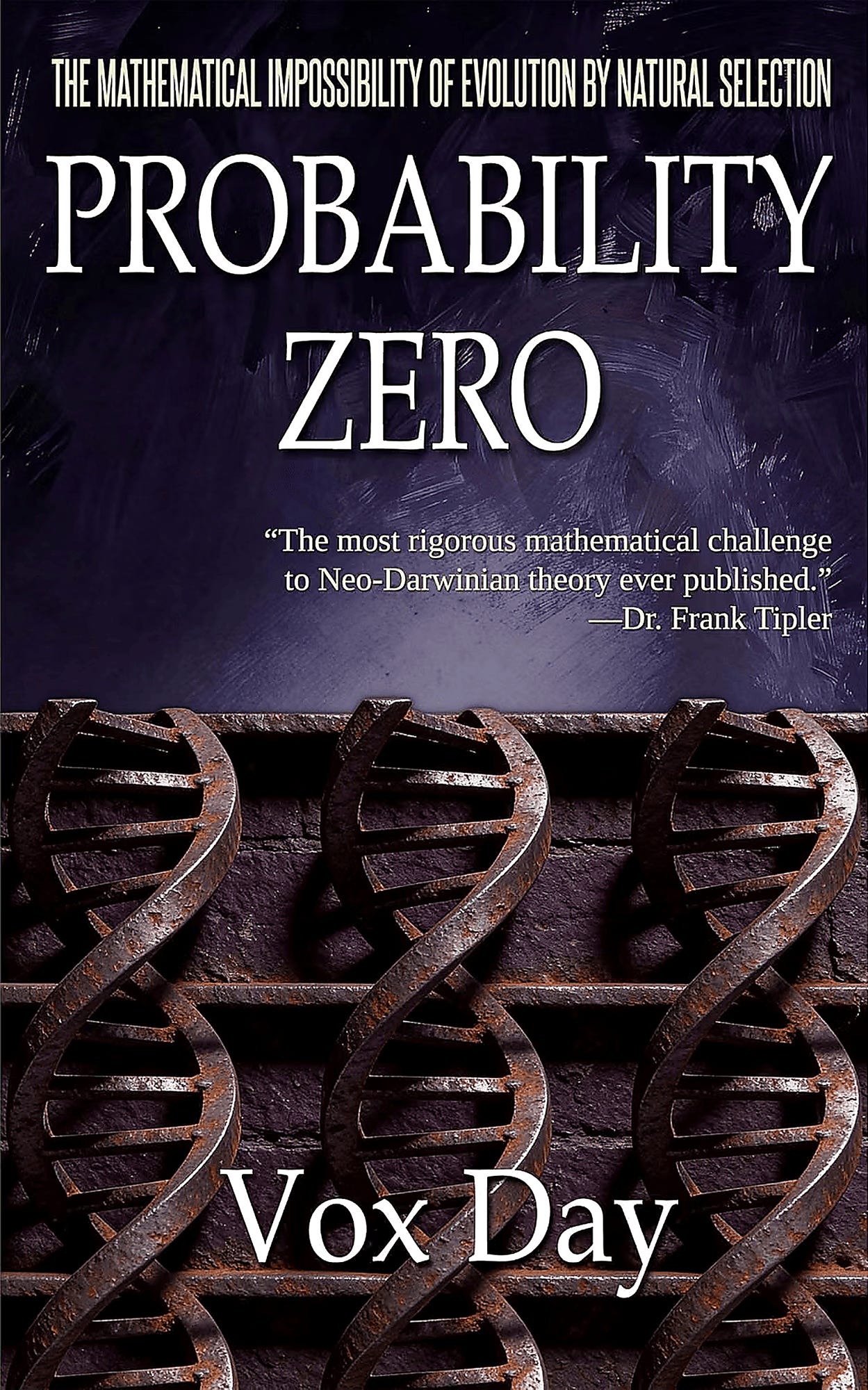
Some months back, my friend and colleague at Tulane University, Frank Tipler (of Anthropic Cosmological Principle fame), alerted me to a book by Vox Day titled Probability Zero and subtitled The Mathematical Impossibility of Evolution by Natural Selection (published January 2026). Tipler gave it a glowing endorsement and also contributed an appendix to the book.
Vox Day (aka Theodore Robert Beale) is a controversialist and contrarian, and thus not to everybody’s taste. Working outside the intelligent design community, he has nonetheless come to many of the same conclusions about the inability of Darwinian natural selection to drive any sort of meaningful evolutionary process. This book is hardly his first entry as a critic of Darwinism. He has been writing on this topic for years. I’ve read some of his work in this area, but just now I asked Grok to produce a reasonably complete list of it predating 2026 (it’s clear from this list that Probability Zero draws much from it):
With all that I’ve just written, it would be easy to dismiss Vox Day as unserious and thus deserving to be ignored. But when he is not engaged in rhetorical flourishes, he can be insightful, as with his discussion in chapter 6 of the 1966 Wistar meeting featuring Murray Eden, Stan Ulam, and Marcel Schützenberger (Mathematical Challenges to the Neo-Darwinian Interpretation of Evolution). Also, he seems to have a large following that does not intersect the ID community.
In any case, Probability Zero hinges on a core argument that, given known mutation and fixation rates for genes, there’s no way humans could have evolved from a common human-chimp ancestor in the 10 or fewer million years since chimps and humans presumably evolved on separate lineages. Given that others in the ID community were better equipped to assess Vox Day’s argument, I decided to approach my friend and colleague Ola Hössjer, Professor of Mathematical Statistics at Stockholm University.
I asked Ola to write up a review of Vox Day’s main argument as a guest post for this Substack column. He kindly agreed to do so. Note that his positive remarks apply to Vox Day’s main argument, not to the book as a whole. As it is, Ola needed some mathematical notation to do the review up right. Substack, however, is not great handling mathematical notation. Moreover, it seemed that most readers would profit from reading a version of his review that summarized the underlying mathematics in plain English.
I therefore decided to do the following. I would make the full review with its mathematics available here for download as a pdf:
