Labels

Friday, February 28, 2020

Vox Popoli: Socialism is the better option


That isn't to say that it is a GOOD option or the best option available. But it is a better option than continuing the post-1965 trajectory of driving the price of labor ever downward in order to keep the usury pumps going:
Every single economic policy change since about 1990 has had two primary effects:

a) lowered real wages through increased labor market participation and/or lowered demand for labor
b) increased the value of fixed assets or investment instruments

In other words, if you were “holding” in 1987, when the oldest Boomers were forty and the youngest were twenty-five, you’re golden now. If you were just starting your career in 1987, you were racing against time. If you’re starting today, the deck has been stacked against you higher than you’ll ever clear. Want to live the middle-class life of 1975? Better hope your IPO nets you ten million bucks. The wealthiest of the Baby Boomers deliberately created a world in which they’d pay less for the things they wanted (employees, labor, televisions) while being paid more for the things they owned (real estate, index funds, 1959 Les Pauls, 1985 Porsche 911s). It was a hell of a trick, wasn’t it?

Eric Chester looks at the hellscape generated by his generation and what he sees is that there aren’t any more paperboys. I look at it and I have serious concerns. I note that support for explicitly socialist government is growing by leaps and bounds. Some of my friends think this is because the Millennials are stupid. “Don’t they know that they won’t be the people who benefit from a communist government?” This is what I think the proto-socialists have figured out:

a) In the event of a Red Revolution in this country, they have a very slim chance of becoming part of the nomenklatura who have power, real estate, and freedom to determine their own lives.
b) If there is no Red Revolution, they have precisely zero chance of ever owning a home, saving for retirement, or starting a traditional family.

This is why the Nationalist Right is inevitable. This is why the globalist world order will fail, either in Nationalist ice or Socialist fire. And the painful economic reality is that either course will be more viable than the status quo. This explains the otherwise inexplicable appeal of Bernie Sanders. As awful as he is, the jewish socialist is legitimately a less horrific candidate than the jewish corpocrat.


Boomer-Os Killed The Summer Job Star - by Jack Baruth


Nostalgia is a wonderful thing; it allows us to look back fondly at times in our lives which were often difficult and unrewarding. It can produce joy in the present moment and assist us in feeling optimistic about the future. I assume that it evolved in us as some sort of defense against suicide or despair; people who felt nostalgia were less likely to just walk into the ocean and not come back.
Of course, nostalgia can also be harmful. It can cause us to hold onto people, possessions, and situations which would be better left behind. Worse yet, it can cause us to drastically misinterpret the past, which in turn causes us to make mistakes in the present day. Such is the case with business-book-huckster Eric Chester’s lament regarding the elimination of teenaged paperboys and other forms of youth labor. Chester notes with disdain that today’s paper is “will be thrown from the window of a hail-damaged 2006 Saturn Ion by a 30-something woman, and it will land at the edge of the curb at least 35 yards from my front porch.” Things were different when Eric Chester delivered the newspaper in 1970, yesireebob.
To his credit, Chester doesn’t necessarily blame the Millennials for not having been paperboys, which is very generous of him. He’s identified another enemy — and since he’s a Baby Boomer, you can probably guess what it is.
Like so many jobs of the 20th century, the job of paperboy has been eliminated, and with it, the work ethic of generations past.
.
Teen employment in virtually every industry has dropped dramatically over the past 20 years.
.
And yet, when young people take their first job – or enter their first career position, employers expect them to not only have the required technical skills, they expect them to already know how to work. And regardless of what they’ve learned in a classroom, the vast majority simply don’t.

All of this is true. Wonder why that is?
The job(s) that would have given them those skills have been eliminated, given to a more experienced worker who is worth the $15 per hour the government has mandated, and/or handed over to a robot.
The fellow who sent this article to me noticed this comment and pointed out that many states and municipalities are raising their minimum wages. Could this be the reason? Is the minimum wage now so high that it puts adults into the jobs that kids used to do?
Before we get to that, I want to address Chester’s story. I, too, was a paperboy as a kid, first for the Columbus Citizen-Journaland then for the Suburban News Publications. Those newspapers relied on an army of grossly underpaid kids who were indirectly subsidized in many ways by parents who paid for bikes, helped their children in the winter, and delivered the papers themselves when the kids had chicken pox. I doubt that Chester actually delivered the 158 newspapers by himself every single day of the week, rain or shine, without fail. I bet his parents recall his job quite differently.
My mom stayed at home when I was a kid. Chester’s mom probably stayed at home, too. Those stay-at-home moms served as the glue to hold communities together. They cleaned their own homes, helped their kids, and served as an informal network through which social connections were made, careers were determined, and emergencies were solved. We don’t live like that now. We decided, as a society, to more or less double the size of our workforce by making women get involved. But we didn’t double the amount of available work. So everybody was paid less. This gradual evisceration of the middle-class wage went unnoticed because you couldn’t see it happen from day to day — but it happened.
At the age of 38, my father was basically where I am at forty-eight, career-wise. He drove a new Town Car and put two kids through private school. He had a much more valuable home than I do — about twice as valuable in today’s market. And my mom stayed at home. It’s true that Dad was frugal in ways that I am not; they didn’t have carbon-fiber mountain bikes or Paul Reed Smith guitars back then. But there is no level of frugality that would allow me to live the way he lived at the time. I’d need to earn four hundred grand a year, and we’d feel pinched still.
Oh, and he was also setting himself up to retire to a plantation in South Carolina.
Today’s kids don’t have moms to help them do the paper route. Their moms are out there trying to have careers of their own. So the kids go to school and then to aftercare. We used to call that being a “latchkey kid”. Nowadays it’s rare for a child to go home after school until he’s old enough to be at home by himself. Given how our society winks at violent pedophilia nowadays, I’d define that age as sixteen for boys and 42 for girls. If Eric Chester were thirteen in 2020 instead of 1970, he’d be eating a pre-packaged snack while waiting for a schoolbus instead of delivering papers and then returning home for a hot breakfast, because his mom would be busy making PowerPoints for a living and Amazon shopping on her company laptop while planning her next business trip to see her excitingly demanding boss.
There’s also the fact that you could ride a bicycle around an 85-paper territory in about 45 minutes back in 1970 when everyone took a paper. I used to walk mine and it rarely took more than an hour. Today, with maybe one in ten or twenty households taking a paper, you need a Saturn with hail damage to make it work time-wise.
You get the idea. We won’t have paperboys until we restore the America which needed them: a country where people were literate, interested in the news, and willing to pay for en masse, while also making sure we had moms at home to look after the paperboys. What about the rest of Chester’s assertion? Are teenagers no longer working because the minimum wage is high enough to attract “experienced workers”?
This chart answers that question. The minimum wage, in real dollars, hasn’t been this low in the Boomers’ lifetimes. It was half again as much back when Chester&Company were working their summer jobs. But I think that the real story is even more frightening, because that light blue line which shows “productivity” is really a measure of what people are paying for fixed assets now. The minimum wage was $3.35 when I worked at Rax as a 15-year-old; it’s $7.25 now. I lived with my mom in a townhome which now rents for almost four times what she paid; two years prior, she had sold our house for — wait for it — one-ninth of its current price. She’d just bought a new Honda Civic S for $6,495; that’s a $26,000 Civic Si today. So the minimum wage would really need to be ten or eleven bucks just to keep pace with that — and that’s before you consider the fact that certain costs, like healthcare and education, have done far more than triple in the thirty-three years since then. I could have gone to Ohio State for $380 a quarter; that would be $2,810 now.
I can make a pretty strong argument that the “Fight For $15” minimum wage doesn’t buy what my Rax wage of $3.35 used to buy. And yet Eric Chester is right: even at $7.25 an hour, you can find plenty of full-time adults to do the work that used to be done by kids and part-time workers. What happened?
You know what happened. The “Greatest Generation” decided in 1965 to open the floodgates for immigration. Their Boomer successors voted again and again to remove even the most nominal of limits to incoming labor. We’ve had more than thirty million new legal immigrants since the turn of the century, which sounds insane but is, in fact, the case. There are about 45 million legal immigrants and another 11 million “undocumented” immigrants in this country.
Adding 56 million people to the American economy, more than half of which are considered “low-skilled” workers, did exactly what you’d expect to wages. We are told that “the economy benefits” from this additional labor, which is a nice way of saying that the stock market benefits. What happened to human beings? Read for yourself:
·         Real wages rose at the top of the distribution, whereas wages stagnated or fell at the middle and bottom. Real (inflation-adjusted) wages at the 90thpercentile increased over 1979 to 2018 for the workforce as a whole and across sex, race, and Hispanic ethnicity. However, at the 90th percentile, wage growth was much higher for white worker sand lower for black and Hispanic workers. By contrast, middle (50thpercentile) and bottom (10thpercentile) wages grew to a lesser degree (e.g., women) or declined in real terms (e.g.,men).
·         The gender wage gap narrowed, but other gaps did not.From 1979 to 2018, the gap between the women’s median wage and men’s median wage became smaller. Gaps expanded between the median wages for black and white workers and for Hispanic and non-Hispanic workers over the same period.
·         Real wages fell for workers with lower levels of educational attainment and rose for highly educated workers.Wages for workers with a high school diploma or less education declined in real terms at the top, middle, and bottom of the wage distribution, whereas wages rose for workers with at least a college degree. The wage value of a college degree (relative to a high school education) increased markedly over 1979-2000. The college wage premium has leveled since that time, but it remains high.High-wage workers, as a group, benefited more from the increased payoff to a college degree because they are the best educated and had the highest gains in educational attainment over the 1979 to 2018 period.
Let me put this in unkind but forthright terms: In the post-1965 America, the harder you work the less you’ll be paid, and the more your wages will sink over time. And I should remind the reader that these “real” wages are adjusted to CPI, which is great if you’re shopping for a hamburger but absolutely useless if you’d like to own a home, get a college degree, or enjoy some life-saving medical treatment. Even the “high-wage” workers who saw pay increases on paper aren’t necessarily seeing an increase in their standard of living. This is true in Ohio, where homes in nice neighborhoods are only priced at ten times what they were forty years ago. Imagine how true it is on the coasts. Remember The Brady Bunch? Six kids, a stay-at-home mom, and full-time help. Dad was an architect. Glassdoor says that a top-rate architect in California can earn $150,000 a year, which is about $8,000 a month after taxes in California. Living in that neighborhood now would cost you a minimum of $1.6 million dollars, so that’s about $12k a month in principal and interest. If you really wanted the Brady Bunch lifestyle now, with six kids in school, two cars, and a maid, you’d have to
a) earn $750,000 a year;
b) forget about taking vacations or buying new clothes for anyone but Marcia.
“Okay, Jack, I get it,” you’re saying. “Everything sucks now. But surely things got better for some people?” Well, yes. Take a look at Eric Chester. He was thirty years old in 1987. Let’s say he bought an index fund. It’s worth ten times what it was then. Let’s say he bought real estate in Ohio. It’s worth as much as ten times what he paid. If he bought real estate in Calfornia — or Denver, where he lives — perhaps it’s worth twenty times what it was then. Every single economic policy change since about 1990 has had two primary effects:
a) lowered real wages through increased labor market participation and/or lowered demand for labor;
b) increased the value of fixed assets or investment instruments
In other words, if you were “holding” in 1987, when the oldest Boomers were forty and the youngest were twenty-five, you’re golden now. If you were just starting your career in 1987, you were racing against time. If you’re starting today, the deck has been stacked against you higher than you’ll ever clear. Want to live the middle-class life of 1975? Better hope your IPO nets you ten million bucks. The wealthiest of the Baby Boomers deliberately created a world in which they’d pay less for the things they wanted (employees, labor, televisions) while being paid more for the things they owned (real estate, index funds, 1959 Les Pauls, 1985 Porsche 911s). It was a hell of a trick, wasn’t it?
Eric Chester looks at the hellscape generated by his generation and what he sees is that there aren’t any more paperboys. I look at it and I have serious concerns. I note that support for explicitly socialist government is growing by leaps and bounds. Some of my friends think this is because the Millennials are stupid. “Don’t they know that they won’t be the people who benefit from a communist government?” This is what I think the proto-socialists have figured out:
* In the event of a Red Revolution in this country, they have a very slim chance of becoming part of the nomenklatura who have power, real estate, and freedom to determine their own lives.
* If there is no Red Revolution, they have precisely zero chance of ever owning a home, saving for retirement, or starting a traditional family.
This is where the situation in our country becomes dangerous. As long as there is some chance of succeeding in the current state of affairs, people will generally play along. If you take away all of their hope, they have nothing to lose. Talk about bread lines and mending old clothes doesn’t frighten people who have already internalized the fact that they will be earning close to starvation wages for their entire lives. This is particularly true if they have no children who would be at risk. It’s a roll of the dice for them and things can only come up better.
Very few people in my generation grew up screaming “EAT THE RICH” and stuff like that. We figured we had a chance to be the rich, even if things might not be as easy for us as they’d been for our parents. The twenty-five-year-olds of today no longer think they have any chance — and they live in an echo chamber of $25-per-article bloggers who screech night and day about the potential benefits of violent economic redistribution.
Now here’s the good news: This situation could right itself. Within twenty years, there will be a massive redistribution of wealth in this country through the simple mechanism of probate courts and inheritance. The price of many things will go down, from 1959 Les Pauls to warehouse space. I suspect a lot of Millennials will leave their microliving apartments and head back to suburban enclaves made affordable by the death of their existing occupants and the unwillingness of various inheritors to live in Florida or Phoenix. The stocks will be given to people who would rather sell than hold.
We might also see some societal changes as a result of today’s coronavirus and its many pandemic successors to come. Tommy Friedman’s flat world doesn’t look so attractive when the container ships can’t enter port and every Eat, Pray, Love trip is a chance to wind up isolated on a Navy base for a year. We’re going to have to start making things again. And we might find that we no longer need to own or consume as much as we thought. When most of the available jobs are in manufacturing and not in the creation of PowerPoints, perhaps some people will decide that staying home is a better alternative. Which means they’ll have time for children, and cheap homes in which to raise them. Those new parents will want something to read, and someone to deliver it. In other words: Ask not for whom the paperboy throws; he might be throwing for you.


Thursday, February 27, 2020

Vox Popoli: When a pandemic isn't a pandemic


It's when the globalists are modifying the meaning of a clearly defined term in order to protect their financial interests:
A little known specialized bond created in 2017 by the World Bank may hold the answer as to why U.S. and global health authorities have declined to label the global spread of the novel coronavirus a “pandemic.” Those bonds, now often referred to as “pandemic bonds,” were ostensibly intended to transfer the risk of potential pandemics in low-income nations to financial markets.

Yet, in light of the growing coronavirus outbreak, the investors who purchased those products could lose millions if global health authorities were to use that label in relation to the surge in global coronavirus cases.

On Tuesday, federal health officials at the Center for Disease Control and Prevention (CDC) announced that they are preparing for a “potential pandemic” of the novel coronavirus that first appeared in China late last year. The World Health Organization (WHO) has stated that an estimated 80,000 worldwide have contracted the disease, most of them in China, while more than 2,700 have died.

However, some have argued that the CDC’s concerns about a likely pandemic have come too late and that action should have been taken much earlier. For instance, in early February, Dr. Anthony Fauci, director of the US National Institute of Allergy and Infectious Disease, had told the New York Times that the novel coronavirus is “very, very transmissible, and it almost certainly is going to be a pandemic,” while former CDC director Dr. Thomas R. Frieden had echoed those concerns at the time, stating that it is “increasingly unlikely that the virus can be contained.”

Despite those warnings, among many others, the CDC waited to announce its concerns that the virus could spread throughout the United States. Their Tuesday announcement riled markets, wiping out $1.7 trillion in stock market value in just two days. The CDC’s warning has reportedly angered President Trump, who accused the agency of needlessly spooking financial markets.

Notably, WHO officials have taken an even more cautious approach than the CDC in their recent comments, stating that it is still “too early” to declare the coronavirus outbreak a “pandemic” while also asserting that “it is time to do everything you would do in preparing for a pandemic.”

The refusal to label the outbreak a pandemic is odd, since it refers to an epidemic or actively spreading disease that affects two or more regions worldwide. This currently describes the geographical spread of the highly contagious novel coronavirus, which has now resulted in significant clusters of cases far from China, namely in Italy and Iran. Countries closer to China, like South Korea, have also recently experienced an explosion in novel coronavirus infections.

Given that the disease is actively spreading in at least FOUR different regions, the term "pandemic" is obviously the correct one. It doesn't appear to be a particularly lethal pandemic, fortunately, but the term is entirely appropriate at this juncture.


Wednesday, February 26, 2020

Black History Month Sidelines African-American Triumphs For Politics - By Mary Grabar


It’s time to restore real black history: recognition of achievement and overcoming obstacles as citizens integral to this great nation.

The first black studies department opened at San Francisco State University in 1968, much to the chagrin of conservative black columnist George Schuyler, who had advocated teaching black history since he began his journalism career in 1923 at the black socialist monthly magazine The Messenger.
His objection had to do with the radicalization, politicization, and attendant distortion of black history. Schuyler fearlessly mocked patronizing white liberals and attacked exploitative white communists. During his extended travels to the South in 1925-1926 for the Pittsburgh Courier, Schuyler reported on the accomplishments of black areas of towns and cities and came to admire people like “Mr. James,” who built up a profitable produce wholesale company in Charleston, West Virginia.
In the 1920s, despite segregation and Ku Klux Klan resurgence, most black Americans took great pride in economic independence and their performance as soldiers in all the country’s wars. Black leaders such as James Weldon Johnson, Kelly Miller, and William Pickens staked their claim as Americans and distinguished themselves from black Africans. In 1922, they took part in the bipartisan “[Marcus] Garvey Must Go!” campaign against the black nationalist who had ludicrously declared himself the president of Africa. In the 1950s, Schuyler began championing Booker T. Washington and his belief in black economic self-empowerment.
This is a far cry from Democrats’ disrespectful reaction to President Donald Trump’s public honoring of 100-year-old Tuskegee Airman Brig. Gen. Charles McGee during the State of the Union address. It reveals the influence of white socialists and communists who radicalized young blacks, primarily on college campuses in the 1960s. In Schuyler’s April 23, 1955, column, he reported on the “bore from within” strategy discussed in a Political Affairs article and warned readers to expect “a mass invasion of Reds, crypto-Communists and fellow travelers into the NAACP, Urban League, churches, fraternities, societies, etc.”
Teaching the Wrong Version of Black History
This strategy included education. White socialist Tom Kahn enrolled in 1960 at Howard University to radicalize black students while pretending to fight for civil rights. In 1956, Spelman College hired Howard Zinn, who had been a card-carrying Communist Party USA member from about 1948 to 1953. In 1963, he was fired for insubordination by the college’s first black and first male president.
Zinn used the cover of civil rights to radicalize students. He turned them against the administration — as well as their parents and church leaders — by encouraging them to defy rules about chapel attendance and curfews. In the Aug. 6, 1960, issue of The Nation, Zinn bragged about transforming a Christian women’s college from what he denigrated as a “finishing school” to a “school for protest.”
The evidence of Zinn’s disdain for the United States, which he called a “myth” and a “pretense,” is abundant. For example, he told students that under our system of government, voting made no difference, and in the 1960s, he advocated on behalf of the North Vietnamese enemy as he led anti-draft protests. In his magnum opus, “A People’s History of the United States,” first published in 1980, Zinn grossly distorted American history through selective and misleading quotations, critical omissions, plagiarism of dubious sources, and invention of facts to present a racist country, irredeemable because of capitalism and nationalism.
Sadly, the Zinn version of black history is the one almost always taught to students during Black History Month. As I point out in my book, “Debunking Howard Zinn,” Zinn studiously ignored the achievements of the anti-communist NAACP, praised black communists who often sacrificed fellow blacks to the party, and valorized the Black Panthers and black Muslim separatists such as Malcolm X. Zinn also left out key critical facts about Frederick Douglass, making him appear, as Zinn did with all other blacks, a helpless victim of the American system — wherein blacks’ only hope lay with white communists, a fact unnoticed by today’s critics of “white saviorism.”
Changing the Celebration of Black History
The Zinn push has unfortunately tainted the celebration of black history. Even the U.S. Department of Education newsletter linked to suggested readings including Malcolm X’s autobiography and James Baldwin’s “The Fire Next Time.” Time Magazine recommended six movies, all about anger, sexuality, or the Black Panthers.
It did not recommend “Created Equal,” the stunning new movie about Supreme Court Justice Clarence Thomas. In fact, Time gave most space to a group inspiring riots and police assassinations, Black Lives Matter. During the first week of February, teachers in the country’s three largest school districts — New York, Chicago, and Los Angeles — wore Black Lives Matter T-shirts to school.
Time cited Ursula Wolfe-Rocca, a white teacher from Portland, Oregon, and lead curriculum writer at the Zinn Education Project. Although enjoying nonprofit status as an educational organization, ZEP is overtly political, offering Zinn-inspired downloadable lessons, videos, and books that weave in Trump attacks, conduct smear campaigns against educational organizations, such as the Bill of Rights Institute, and offer materials for the Boston Teachers Union to participate in the Black Lives Matter Week of Action and “Abolish Columbus Day” classroom kits for lobbying on the state, city, and school level.
Time presents ZEP as meeting “the rising demand for resources.” As evidence of the success of teaching black history, the article offers the 80 percent success rate of students, including in underperforming schools, in passing a pilot Advanced Placement African diaspora pilot program. The Columbia Teachers College’s Institute for Urban and Minority Education website, where it was developed, reveals an ideological focus on “common experiences across the diaspora such as imperialism, resistance to oppression and cultural practices.”
After also delving into “music, dance, cuisine, customs and other foundational chapters in the black experience,” students are encouraged to “engage in an inner dialogue with themselves” — part of what one teacher called a “healing process.” “Success” is measured by testimonials from students such as Thalias Henry, who said “he is now able to draw a direct line from the African continent to ‘events in the real world’ such as Ferguson and Black Lives Matter.”
Kayla Sergeant came to appreciate the connection of a “special food … to a specific tribe or people.” According to an article published in the last days of the Obama administration by the American Historical Association’s then-President Patrick Manning, the program was intended “to reach beyond the existing AP constituency.” But the 100 percent nonwhite participation rate indicates a reverse bias. The focus on the diaspora continues the focus on African and not American identity.
The ‘1619 Project’ Injects Racism into America’s DNA
Similarly, The New York Times’ “1619 Project” attempts to de-mythologize the 1776 founding date by presenting the arrival of a ship bearing about 20 Africans in 1619 as the beginning of an exploitation legacy. The Atlanta Journal-Constitution also takes that time, “400 years ago,” as the launch for its series on Black History Month, interviewing Morehouse College professor Frederick Knight, who “specializes in the African Diaspora.” (Yet the linked black history quiz concerns mostly black celebrities and sports stars.)
Under the “1619 Project,” even the old Marxist slogan of “black and white, unite and fight” is abandoned, as the project’s critics find a home at the World Socialist. The charge of racism being in the DNA of this country recalls Zinn’s claim that American racism was not limited to prejudiced individuals but baked into the structure of the country. The “1619 Project” delivers a false toxic narrative of universal black victimization and universal white oppression, spurring racial animus.
It’s time to restore real black history: recognition of achievement and overcoming obstacles as citizens integral to this great nation. The examples of George Schuyler, Booker T. Washington, Charles McGee, Clarence Thomas, and Mr. James offer good places to start during Black History Month.
Mary Grabar, the author of "Debunking Howard Zinn," earned her PhD from the University of Georgia and taught college English for 20 years. She is now a resident fellow at the Alexander Hamilton Institute for the Study of Western Civilization in Clinton, New York. Her writing can be found at DissidentProf.com and at marygrabar.com.


Stop, Question, and Frisk - By Sir Walter E. Williams


Before former New York City Mayor Michael Bloomberg threw his hat into the 2020 presidential race, he defended the New York Police Department’s use of “stop, question and frisk” policing. At a United States Naval Academy’s 2019 Leadership Conference, Bloomberg said, “We focused on keeping kids from going through the correctional system … kids who walked around looking like they might have a gun, remove the gun from their pockets and stop it.” He claimed that as a result of his policy, New York’s murder rate fell from 650 a year to 300 the year he left office.
In the cases of Terry v. Ohio, Sibron v. New York, and Peters v. New York, the U.S. Supreme Court, in 1968, granted limited approval to officers to stop, question and frisk, even though they lacked probable cause for an arrest, if the officer believed the subject to be dangerous. The Court’s decision made suspicion of danger to an officer grounds for a “reasonable search.”
The stop, question and frisk policy has taken on racial overtones because most of the people stopped are black men. Let’s look at the numbers. Last year, NYPD data showed that 93% of suspects arrested for murder were black or Hispanic. Ninety-six percent of those nabbed in shootings were also minorities. Eighty-eight percent of New York City’s homicide victims were black or Hispanic as were 96% of shooting victims. While these percentages have been roughly the same for decades, New York police have brought the absolute number of crimes, including homicides, way down from its 1990 peak at 2,245 to 289 homicides in 2018. Since blacks and Hispanics are the major victims of homicide, as a result of the NYPD’s proactive response to crime, possibly tens of thousands of blacks are living today who would otherwise be dead.
American Contempt for ...Walter E. WilliamsBest Price: $5.90Buy New $13.13(as of 08:30 EST - Details)https://www.lewrockwell.com/wp-content/mu-plugins/amazon-ad-link-lr/img/buy-from-tan.gif

For a law-abiding black person to be stopped, questioned and frisked — in a word or two, be racially profiled — is truly insulting. However, to analyze the policy, let’s look at the origins of racial profiling or any other kind of profiling. First of all, policemen are neither mind readers nor are they equipped with X-ray vision. That means good policing requires learning how to use an easily observed physical characteristic as a guess or proxy for some other difficult-to-observe characteristic. Thus, the reason people profile is that information is costly and they seek methods to economize on information costs. One way to do that is through profiling.
The reality is that race and other behavioral characteristics are correlated, including criminal behavior. That fact does not dispel the insult, embarrassment, anger and hurt a law-abiding black person might feel when being stopped by police, being watched in stores, being passed by taxi drivers, standing at traffic lights and hearing car door locks activated or being refused delivery by merchants who fear for their safety in his neighborhood.
Former New York Mayor Michael Bloomberg is a politician in pursuit of his own agenda. President Donald Trump is also a politician in pursuit of his own agenda. Both will deny their support for and talk down the policy of stop, question and frisk in an effort to curry favor with black voters. Most Bloomberg and Trump supporters don’t live under the horrible conditions that so many blacks live under in high crime cities like Baltimore, St. Louis, Chicago and Detroit. Black people must ask what needs to be done to stop criminals from preying on them and making so many of their communities economic wastelands. If stop, question and frisk can contribute to that goal, so be it. They need not listen to politicians, academics, talking heads on the news and others.
I’ll add that even if the police, intimidated by leftists, are not doing their job to safeguard black residents in high crime communities, that doesn’t mean that black people should not organize to take independent measures to protect themselves.
Walter E. Williams is the John M. Olin distinguished professor of economics at George Mason University, and a nationally syndicated columnist. To find out more about Walter E. Williams and read features by other Creators Syndicate columnists and cartoonists, visit the Creators Syndicate web page.
Copyright © 2019 Creators.com

The Rich v Oligarchs - By Martin Armstrong


QUESTION: Hello Martin, You have said ‘the rich get richer by investing’; and as well, you’ve said ‘governments are always corrupted’. What history shows (and many of us have learned) is that ‘big money’ is especially adept at manipulating government for its own advantage. Currently, we call this ‘regulatory capture’. (This includes ‘judicial’ capture). The revolving door between corporate and government executive offices is obvious and historical. So I suggest that ‘the rich get richer by investing in corruption’ and suborning every possible corner of the body politic.
You have also said ‘ human nature never changes’. I could dispute that selectively from a religious point of view, but generally, I concur. However, since ‘big money’ understands human nature this is why it bankrolls/sponsors all manner of destructive lusty covetousness among the peoples of the world, (especially including borrowing to speculate) enabling it by easy credit-debt, using force of law, under threat of ‘assassination’, in one form or another, to collect.
You’ve also noted that Moses said “thou shalt not covet” your neighbor’s assets, though, particularly in relation to the principle of ‘socialism/Marxism’. However Moses also renounced, in the name of God, the practice of usury among people of the land, that is, in the body politic.
Against the Left: A Ro...Llewellyn H Rockwell JrBest Price: $13.57Buy New $8.00(as of 10:15 EST - Details)https://www.lewrockwell.com/wp-content/mu-plugins/amazon-ad-link-lr/img/buy-from-tan.gif

Also, you’ve mentioned the Mosaic law of the generational debt jubilee for all other kinds of debt in kind. Martin, to my mind, the first way of covetously accumulating capital is through pure force, theft and plunder by conquest, (yet wars must be ‘bankrolled’ too). In times of relative peace the debt-equity swap appears to be the fundamental and intentional principle of accumulation of capital, and, thus, ‘the business cycle’, the inner machinations of which are controlled, as much as possible, by lenders and their ‘legal’ contractual leverage. (Recall, for example, the Jewish ‘Shetar laws’ introduced into England after the conquest by William the Conqueror).
These things being said, and given the prospect of the ‘bankruptcy’ of the current political/economic ‘system’, I am particularly interested if you have any comment upon the super-priority of derivative contracts in business bankruptcy, not to mention, bail-in provisions of bank ‘reconciliation’, as established in various statutes. (Your recent posting of ‘1984 is Here’, and Orwell’s illumination of ‘oligarchical collectivism’ is apropos in exposing the historical link between financial/corporate oligarchy and ‘socialism’, the plantation mentality of mercantilism, etc..
It seems to me the ‘private wave’ is not necessarily something to be looking forward to, either, actually.) Many regards for your work, and thanks for holding fast to a humane heart. FCB, a Socrates subscriber. (By the way, the date of Jesus’ birth has been remarkably addressed in E.L. Martin’s 1991 work “The Star that Astonished the World”)
FB
ANSWER: I think sometimes I am not always specific in what I say because in my mind I have drawn a distinction that I have not articulated in words. As Einstein said, he thought in concepts, not words. That is a very true statement that has been largely ignored by most programmers who try to mimic the brain with neural networks. That is why IBM’s Watson was unable to find cures. As a programmer, I should know better. You really have to break down every single step in an action to be able to code it. How do you move your arm? It begins with a thought which then moves all the various elements for you to raise your hand up in a classroom.
That confession aside, when I speak of the “rich” who do not make money from wages but investments, I am not referring to the corporate organizations that are not single individuals but are honestly bureaucratic private replicas of government. I have attended board meetings of some of the largest public corporations in the world. I find them to be the same in structure as governments. I was called into a major auto company to resolve a $1 billion loss in hedging. They then referred me to a parent company that held stock in their corporation, for they had the same trade. The parent company had made hedging decisions at the board level and because they lost money by second-guessing their hedging decisions, they passed a resolution that once they took a hedging position, they would let it expire. By the end of the fiscal year, the two were merged to hide the $1 billion loss in the parent company.
There is a substantial difference between an individual who runs a small business and a major public corporation which has become bureaucratic. That is why Apple first removed Steve Jobs because he did not comply with bureaucratic procedures. When they then lost all creativity, they begged him to return.
Insofar as “human nature never changes,” once again I am not speaking of an individual but collectively as a society. We each have our own cycle in this journey for knowledge. If we are not complete fools who blame everyone else for their own mistakes (like Hillary), then we mature and learn from our mistakes. As children, parents inevitably warn their child not to place their finger in the flame of a candle. We all still do because we simply must experience that pain before we understand the power of fire and what it does.
I have also explained that there are no degrees you can get in trading. We all must be self-taught. The very concept of supply and demand was born in the mind of John Law (1671-1729). Since he was charged with murder for killing another man in a fair duel that was declared illegal, everyone else took advantage and plagiarized his discovery including Adam Smith. John Law gave birth to the concept of supply and demand because he was a trader on the floor of the first exchange in Amsterdam. There are some things you will NEVER discover unless you actually are involved in the experience.
Therefore, my statement that “human nature never changes” does not refer to an individual, for most intelligent people do not believe what they may have believed when they were a teenager. Mark Twain’s famous quote is spot-on: “When I was a boy of 14, my father was so ignorant I could hardly stand to have the old man around. But when I got to be 21, I was astonished at how much the old man had learned in seven years.” There is even the quote of King Oscar II on how we are all socialists before 25 and become realists after 25 when we have to pay taxes.
You also mention that Moses renounced, in the name of God, as well the practice of usury. I have stated that we had usury laws up until Paul Volcker wanted to raise interest rates using Keynesian Economics to enable him to raise the discount rate to 14% in March 1981. Congress was eliminating usury laws by March 31, 1980. In order to fight inflation using Keynesianism, they never restored usury rates and thus they transferred a huge amount of wealth to bankers as they were now able to charge 20% on credit cards with no problem.
Private waves are inherently more volatile but the usury laws were all abandoned going into the peak of the Public Wave as the government was fighting for control. The government becomes much more aggressive and totalitarian during a Private Wave as they are losing power. But as they lose power, they ultimately turn against the very oligarchs who fed them to rise from the outset. The next financial crisis may not see Goldman Sachs walking on water. Politicians will turn against their benefactors to survive. This is typical during the final stages of the last 8.6-year wave within a Private Wave formation.
Reprinted with permission from Armstrong Economics.
Copyright © Armstrong Economics


Selma, Alabama’s First Black Church Is Still Going Strong. Take A Look At Its Amazing Legacy - By Christine Weerts

First Baptist has always had strong members whose faith, tested and tried with slavery, Jim Crow segregation, intimidation, violence, and even a devastating tornado, triumphed over all.

Now let us have a little talk with Jesus
Let us tell Him all about our troubles
He will hear our faintest cry, He will answer by and by
Now when you feel a little prayer wheel turnin’
And you know a little fire is burnin’
You will find a little talk with Jesus makes it right.
Warren William “Billy” Young can still hear his father Woodrow’s deep bass voice whenever his home church sings his dad’s favorite hymn, “Just a Little Talk with Jesus.”
“We sang that hymn about three weeks ago, and people couldn’t believe I sounded just like my dad,” he says. “I can hear his voice when we sing that hymn, and sing it just like he did.”
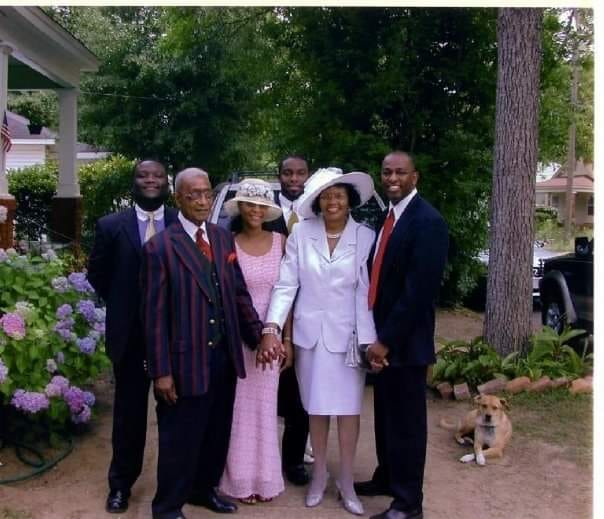
First Baptist Church was the center of family life for the Young family. Billy’s father served as deacon, trustee, and treasurer, and his mother, Alice, as deaconess, senior choir director, and president of the missionary society.
“All the time growing up, I’d only be in three places: home, church, or school,” Young said. Perfect attendance at school and church was expected. Choir was the center of their church life, as everyone in the family sang; later, even spouses and grandchildren joined in. Only one family member doesn’t sing, and that’s Billy’s sister Wanda Young Lowe, who plays the organ. She has been playing for services since she was 11. Each played an instrument, too: saxophone, clarinet, trombone, and trumpet.
As First Baptist prepares to celebrate its 175th anniversary this year, the Young family — the four adult children of the now-sainted Woodrow and Alice Young, and their spouses and children — will all be standing with the choir or seated on the organ bench as they celebrate their commitment to the church their father’s family started in 1845, while they were still slaves.

First Baptist’s Beginnings

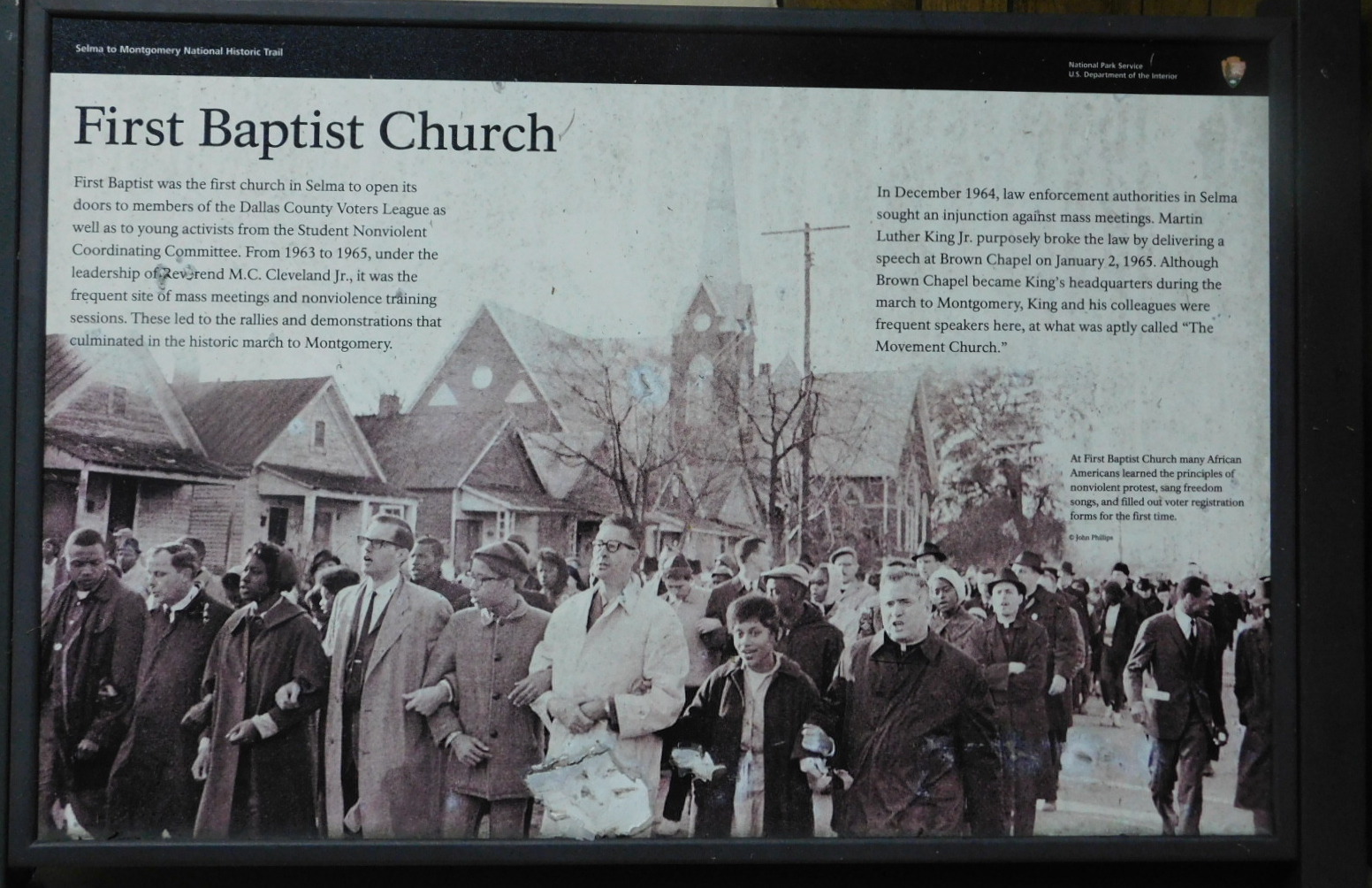
Established as First “Colored” Baptist Church, it is the oldest black church in Selma and one of the four oldest in Alabama. The church, renamed First Baptist in the 1880s, holds a prominent place both physically and historically in the Selma community. It is the mother church of black baptists in Selma, started the first public and private schools for newly freed slaves, and played a key role in the voting rights movement in Selma, beginning in 1920.
During the 1960s, the Student Nonviolent Coordinating Committee (SNCC), led by now-Rep. John Lewis, set up headquarters at First Baptist and held many nonviolent training sessions and youth mass meetings in its historic building. Lewis leads a congressional civil rights pilgrimage to Selma each March.
First Baptist has always had strong and dedicated members whose faith, tested and tried with slavery, Jim Crow segregation, intimidation, violence, and even a devastating tornado, triumphed over all. It began humbly in the basement of the white First Baptist Church in downtown Selma, where enslaved members organized in 1845 under Rev. Samuel Phillips, who was freed from slavery for his service in the Mexican War.
Selma First Baptist tornado
The church after a tornado ripped through.
The Young family’s roots are tied to the founding of the church. Great-Grandmother Amelia came to the United States from Haiti, following a Christian missionary family to their home in Chattanooga. She married a local man and died in childbirth. Her husband sent their daughter, Louise, born in 1893 to Selma to live with relatives and attend First Baptist. She later married Wilson Young, a railroad worker and church member, and their only son, Woodrow, was born March 21, 1916.

The Church’s Role in Selma’s Black History

After the Civil War, the congregation built its own church and housed the first public school for black children. In 1878, the congregation helped found and house the Alabama Baptist Normal and Theological School, now Selma University, for training black teachers and pastors. The institution had an African-American president beginning in 1881, a rarity as whites led most black colleges at the time. Most of the school’s presidents were also pastors at First Baptist.
First Baptist was mother to Second Baptist in 1869, Green Street Baptist in 1881, and Tabernacle Baptist in 1884. Churches and segregated schools played a key role as safe havens and centers of community and identity for African Americans in Selma.
The growing congregation needed a larger sanctuary, and in 1894, member David Benjamin West designed and built the Gothic Revival-style brick building, the church’s present home. The design was cruciform, with the Victorian-styled sanctuary and chancel raised 8 feet above the first floor fellowship room and housed beneath a steeply pitched cross gable roof. Listed on the National Register of Historic Places, it is considered “one of the most architecturally significant late-19th-century black churches in the state.” In 2018, it was one of four Selma structures named to the watch list of the World Monuments Fund, an organization committed to preserving global historic sites.
Commitment to the betterment of Selma’s black residents, First Baptist members took prominent roles in the community, and the church’s basement floor became a community center for the surrounding neighborhoods. Charles J. Adams, a trustee at the church and World War I veteran, worked on the railroad. Later, as a notary public, Adams served as a de facto attorney for the town’s black residents’ basic legal needs. He helped many black veterans apply for federal assistance often denied them by white bankers notwithstanding the veterans’ qualifications.
Adams was jailed several times, likely because of his advocacy on behalf of black Americans, but despite the obstacles and discrimination, he helped give black residents opportunities that were otherwise unavailable. With Adams’s support, for instance, the Chestnut brothers opened a grocery and meat business, Chestnut Brothers Market and Grocery, in 1936.
Earlier, in 1918, Adams helped found the first NAACP chapter in the state and began organizing for voting rights. Working with Samuel Boynton, who arrived from Tuskegee Institute as the African-American Dallas County extension agent, they founded the Dallas County Voters League in 1920. As late as 1960, even though blacks were 57 percent of the county population, only 1 percent were registered to vote. Boynton and his wife, Amelia, were members of First Baptist.
Selma voting march

Opens Doors for Community Outreach

Rev. Fred Shuttlesworth, one of the founding members of the Southern Christian Leadership Conference with Dr. Martin Luther King Jr., served as pastor of the church for two years in the 1950s.
In 1963, under the leadership of Rev. M. C. Cleveland, the church became the first in the city to open its doors for activities and meetings of the Dallas County Voters League. During the next two years, the church was a focal point of the mass meeting and nonviolent teaching sessions sponsored by the SNCC, which located its offices in the church basement. During the early months of 1965, King, Ralph Abernathy, and other leaders of the Southern Christian Leadership Conference spoke nightly to the youth at First Baptist Church.
After the marches, the church continued to serve as SNCC headquarters and a food and clothing distribution center for those who lost jobs while registering to vote.
In 1978, the congregation faced one of its most difficult trials when a tornado tore through the church, collapsing two main walls and stained glass windows. Church leaders, including Woodrow Young, determined to rebuild, despite a cost of over $1 million — one of the largest loans ever made in Selma at the time — all of which the church paid off in just a few years through Young’s leadership as treasurer.
Young, who participated in the teacher-led marches for voting rights alongside F.D. Reese, taught algebra, geometry, trigonometry, and calculus at the local black high school, one of the few in the state offering higher-level math classes. Young was also an adjunct at Selma University, the first black math teacher hired at the integrated Selma High School in 1970, and later taught at Wallace Community College. His teaching career spanned 52 years.

First Baptist Today

Today, three of the four Young family members worship at First Baptist (the oldest, Marcellus, lives in San Jose, California). Billy is chairman of the deacon board, a position his father once held, and he sings in the choir. Once a teacher in the local high school gifted program, Billy returned to law school — inspired and mentored by First Baptist member and attorney J.L. Chestnut — and today is assistant attorney general with Alabama’s Department of Revenue.
Young family
Billy Young’s love for church and for Selma is visible in all he does. He volunteers on several boards, including the Selma/Dallas County YMCA, the local Democratic committee, and his role as vice chairman of the Selma Redevelopment Authority. Committed to helping raise up a new generation of educated and dedicated, young, African-American men, Young is a mentor and leader of several initiatives based at his church.
Founding president of 100 Black Men of America-Selma, Young and his members mentor sixth- through ninth-grade young men in academics and careers, from learning to tie ties to preparing for the ACT. His fraternity, Alpha Phi Alpha, sponsors the Alpha Academy, a tutoring program that meets at First Baptist, and has awarded more than $100,000 in college scholarships to local students.
“The members of First Baptist Church are very concerned with the plight of young people in our community and believe it is the religious community’s responsibility to meet the needs of our youngest citizens,” Young said. “The religious community, and especially the men in our religious community, must do more for young men and must devote more time to interaction with the young men in Selma.”
As someone who grew up having “just a little talk with Jesus,” Young continues the family tradition of love for church and family. “God has been too good to me to not be active in church,” he said. “He has really blessed me, and it’s my responsibility to give back, to help someone like others at my church helped me.”
Christine Weerts, author of "Heroes of Faith: Rosa Young," directs the senior choir at Bethlehem Lutheran Church in Autauga County, Ala., founded in 1922 through the ministry of African American missionary Rosa J. Young. She has degrees in music (BA) and religion (MA) and is a freelance writer.

https://thefederalist.com/2020/02/26/selma-alabamas-first-black-church-is-still-going-strong-take-a-look-at-its-amazing-legacy/