Was it really worthwhile to fight a destructive war so that Poland might be the victim not of Hitler but of Stalin, so that there might be a Soviet empire, not a German empire, in Eastern Europe, so that we should face not Japan but Stalin’s henchman, Mao Tse-tung, in the Orient? War and postwar emotionalism have inhibited a frank facing of these questions. But the tragic factual record of what happened to Poland, set down in this chapter, surely suggests that there is a case for a negative answer.
—William Henry Chamberlin
If forced to briefly describe America’s Second Crusade, William Henry Chamberlin’s revisionist account of Allied leadership during the Second World War, two words come to mind: sober accounting. In nearly every chapter, the author holds the United States and Britain to the standards they themselves had set for what they hoped to accomplish by defeating the Axis. Did they meet these standards? Were their proclaimed goals achieved? Was the world in a better place after the war than it was before? Surely such questions deserve honest answers.
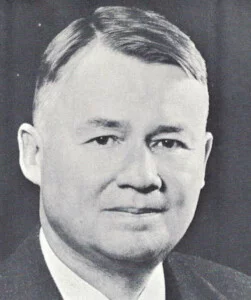 William Henry Chamberlin
Unfortunately, such questions were considered subversive when this book was first published in 1950, and many today still regard them as heretical. That’s why this dissident book failed to find a mainstream publisher, and why it has never been given the attention it deserves. The sidelining of this important work was part of a broader and largely successful effort to squash all voices that question the prevailing, “official” view of World War II. For any thoughtful and reasonably open-minded reader, this book makes a persuasive case for negative answers to the questions above.
The author begins by assessing how America’s first great “crusade” – in World War I – could have been avoided. It happened because this country’s elites were not honest with the people. In 1917, President Woodrow Wilson summoned Americans to war against Germany with idealistic and noble-sounding slogans and promises about making the world “safe for democracy.” That rhetoric disguised the very tangible goal of bailing out the beleaguered British and French, whose defeat would have meant defaulting on the massive debts they had run up to US banks and corporations.
In writing America’s Second Crusade, the author benefitted from other important revisionist works that had already appeared shortly after the end of World War II, including George Morgenstern’s Pearl Harbor: The Story of the Secret War (1946), and Charles Beard’s two in-depth studies of Roosevelt’s duplicity in the lead-up to America’s involvement — American Foreign Policy in the Making (1946), and President Roosevelt and the Coming of the War 1941 (1948). The bibliography of America’s Second Crusade is a useful guide to mid-century independent American historiography.
This book does not merely expose liars and hypocrites in the halls of power. It distinguishes itself by challenging the American public to consider that the death, destruction, and trauma of the Second World War may not have been “worth it” in the end. Chamberlin is no sympathizer of or apologist for Nazism. But he is not afraid to measure the stated goals of Franklin Roosevelt and Winston Churchill against the objective historical record by which the question he poses might be answered. The arguments for America’s entry into the war, he concludes, ultimately come up wanting.
Originally post at the Institute for Historical Review.
