Labels

Saturday, March 3, 2018

North Korea war could 'kill 10,000 US troops within days' - Nicola Smith


war with North Korea could result in about 10,000 American combat-related casualties in the first few days alone, according to US military planners.
A classified military exercise last week, attended by Army chief of staff General Mark Milley and head of Special Operations Command General Tony Thomas, tested hypothetical scenarios of how US troops would mobilise and strike if ordered to into a potential war, reported the New York Times.
The “tabletop exercise”, held over a few days in Hawaii, thrashed out the challenges that could hamper a US assault on North Korea’s sizeable military.
It determined that US casualties could be amplified by the Pentagon’s limited ability to evacuate injured troops daily, and by the possibility that Pyongyang could retaliate with chemical weapons.
Civilian casualties would far outweigh the initial toll on US troops, and could potentially reach hundreds of thousands, commanders were told.
While the US stations about 28,500 troops in South Korea, the capital, Seoul, a city of about 24 million, lies within range of the formidable firepower of North Korea’s artillery stationed along the border.
The potential human costs of any war were so high that, at one point in the exercise, General Milley remarked that “the brutality of this will be beyond the experience of any living soldier” said the Times.
Pentagon chiefs cautioned that the planning session did not mean that a decision has been made to go to war with the intention of curbing Pyongyang’s nuclear ambitions.
On the back of a diplomatic détente with South Korea during the Winter Olympics, Pyongyang indicated that it was willing to open up dialogue with Washington.
President Trump’s response that “we want to talk also” but “only under the right conditions” has created a glimmer of hope of a diplomatic solution. But America’s insistence that denuclearisation must be on the table remains an entrenched sticking point.
The unpredictable situation has sparked fears among US military leaders of a “ladder of escalation”, where a stray incident could cause a military crisis to spiral out of control.
Defence Secretary Jim Mattis has said a war with North Korea would be “catastrophic” but has reportedly ordered top Pentagon officials to be ready for any possible military action.
Among the plans discussed last week was the redeployment of a large numbers of surveillance aircraft from the Middle East and Africa to the Pacific to support ground troops.
Planners also looked at how American forces stationed in Japan and South Korea would be involved.

Friday, March 2, 2018

How To Play The Long Game With North Korea In America’s Interest - By Willis L. Krumholz

We should be wary of a military conflict that could incinerate millions of victims of totalitarianism, along with U.S. citizens, South Koreans, and others living in the region.
Vice President Mike Pence hinted at the prospect of talks with North Korea while in South Korea for the Winter Olympics. Speaking to the Washington Post, Pence said that while “no pressure comes off until they are actually doing something that the alliance believes represents a meaningful step toward denuclearization,” which means “the maximum pressure campaign is going to continue and intensify,” although talks with the North were still a possibility.
“If you want to talk, we’ll talk,” the vice president said. U.S. Secretary of State Rex Tillerson backed up Pence’s statement: “We’ve said for some time it’s really up to the North Koreans to decide when they’re ready to engage with us in a sincere way, a meaningful way … We’ll just have to wait and see.” With Tillerson and Pence seeming to condone a no-precondition summit, it is likely that President Trump is feeling talkative as well.
This is a potentially significant development. A war with the North would almost certainly result in the death of tens of thousands, even millions. North Korea has artillery positions spread across its side of the 38th parallel, and well within range of South Korea’s capitol Seoul, home to 10 million people. Those artillery positions would be almost impossible to destroy before South Korea was sufficiently shelled to bits. And this grim estimate assumes we can take out North Korea’s nukes before they can be used.
Those lobbying for a hard line on North Korea claim to care for the people in the North and justify their hope of regime change by highlighting this population’s plight. Indeed, the people in the North live under constant threat from Kim. But if we care about the people in the North, we should be wary of a military conflict that could incinerate millions of these victims of totalitarianism, along with U.S. citizens and military personnel, South Koreans, and others living in the region.
How Talks Can Be Productive Instead of Another Delay
Many would counter with saying that “talks” have been tried in the past. Indeed, there is voluminous history of the North coming to the table, obtaining generous aid, and continuing to develop its nuclear program. Won’t talks lead to the North yet again duping America and its allies?
Entering talks, America and its allies must give up the notion that the Kim regime will give up its nuclear program for any sort of aid package. The North’s nuke program has consumed a gargantuan portion of its meager resources, because the Kim regime sees the program as nothing less than its singular lifeline.
This is also why “maximum pressure,” no matter how harmful to the North Korean economy, is highly unlikely to spur the Kim regime into giving up the program. These sanctions may be having an effect, but cornering Kim could backfire. We want the cash-starved North Koreans to export cigarettes, not nuclear weapons technology.
What can talks accomplish? While the prospects of sanctions and threats of military action convincing North Korea to give up its weapons are slim-to-none, our primary interest of avoiding nuclear war can best be achieved through hard-nosed deterrence and diplomacy. In other words, America needs to play the long game. Despotic regimes like we see in North Korea always eventually collapse and die, or choose to moderate and reform. As the global hegemon, and as a strong and free society, we can more than afford to play this long game.
What Playing the Long Game Looks Like Now
If we do play the long game, what does immediate diplomacy have to offer? We can start by recognizing America and North Korea both want to avoid bloodshed. The United States doesn’t want a massive loss of innocent human life. From Kim’s perspective, any conflict would almost certainly lead to his own demise.
The North is also beginning to place a greater focus on prosperity and economic growth. Already, some market-based reforms have been enacted, such as allowing workers and managers to keep at least some of the fruits of their own labor. Pointing this out isn’t meant to applaud the brutal Kim regime, which still presides over a poverty-stricken command economy. But this is meant to say that, over time, greater wealth and reform could come from inside North Korea, which would reduce its permanent war footing. This would also directly benefit our ally South Korea.
Does all this mean that America sits idly by and does nothing to contain the North? Not at all. Deterrence means America continues to support our South Korean partners, including by prompting them to build up their own defense capabilities.
Next, America’s intelligence community needs to do a far better job of tracking North Korea’s illicit overseas revenue schemes, on which the country is still hugely dependent. For example, several Middle Eastern and African countries that are ostensibly allies of America have been turning a blind eye to North Korean slave labor on their soil. These ties need to be documented, so the United States can withhold foreign aid in the event that these ties do not cease.
The bottom line is that there is no good military solution in North Korea. Playing the long game of strong deterrence (peace through strength) and hard-nosed diplomacy is not only in America’s interest, but such an approach has consistently worked in the past for our free society. A preventive war will never be the answer.
Willis L. Krumholz is a fellow at Defense Priorities. He holds a JD and MBA degree from the University of St. Thomas, and works in the financial services industry. The views expressed are those of the author only. You can follow Willis on Twitter @WillKrumholz.

http://thefederalist.com/2018/02/28/play-long-game-north-korea-americas-interest/?utm_source=The+Federalist+List&utm_campaign=1f1d831a04-RSS_The_Federalist_Daily_Updates_w_Transom&utm_medium=email&utm_term=0_cfcb868ceb-1f1d831a04-83795033

What Civil Unrest Is Really Like: We Survived the Ferguson Riots - By Karen

When I mention the year 2014 do any events stand out in your mind?  Some of you may think of births of family members or special anniversaries or incredible vacations that you took.  You know the kind,  the ones you wish you could take every year because they were just that amazing?  Yeah, I love those too.
But when I think of 2014, two things come to mind. Let’s start with the second event.
We moved (usually a fun thing) in November of 2014.
But the reason we moved was because of another event that began in August of 2014 and continued through the end of 2014 and beyond.   The first thing that I will always think of when I hear, “the year 2014” are the images of destruction from my town of Ferguson, Missouri – images of the riots that we saw and experienced first hand while driving down streets where ruin ran rampant (say that five times fast).
Businesses were destroyed.  Personal property was demolished. It wasn’t even safe to leave your house depending on where in Ferguson you lived.
Some Background Details
We considered moving to Ferguson in the fall of 2001.  We were expecting twins and decided to buy a house in an affordable suburb of St. Louis.  We had friends who lived in the area, and they liked it.  What greater reference to the quality of the community than someone who already lives there, right?  We found a great starter house on the corner of two of Ferguson’s four main streets.
The house we chose to purchase had a small backyard, a decent sized front yard, and room for the two children we were expecting at the time to play.  We purchased the house in December of 2001 and lived there between 2001 and 2014.  We had our twins the following summer, and over the years, we added three more children to our family.  In August of 2014, our children’s ages were 12, 12, 8,7, and 3.
How It All Started
We pulled into our driveway on the afternoon of August 10, 2014, having just gotten back from a trip out of town.  After tucking the kids into bed, I got some things in order and started working on a project at my desk when a friend of mine messaged me asking if I was all right.  Okay, that was a rather odd question out of the blue.  I told her I was fine and asked her why she was asking.  She told me that there were riots going on in Ferguson.
That one sentence changed the course of my life – literally.
I knew my friend, and I trusted her.  But you know that feeling…the one that says, “It can’t be as bad as she’s making it out to be.”   Yeah, it’s real, and it’s called normalcy bias.  According to Wikipedia (which I’ve been told never to quote):
“Normalcy bias is a belief people hold when facing a disaster. It causes people to underestimate both the likelihood of a disaster and its possible effects, because people believe that things will always function the way things normally have functioned.” (source)
I didn’t know it at the time, but that was exactly what was going on in my head – it can’t be THAT bad because nothing like this had ever happened to me before.   BUT since I knew she wouldn’t lie to me, I opened a new tab on my browser and started looking up “Riots in Ferguson.”
One of the local news stations was running live coverage on their website.  I watched for a moment.  Then I called my husband over, and both of us watched, aghast at what we were seeing.  There was a wall of police and a mass of rioters.   As we watched and listened online we saw and heard screaming and yelling, threatening gestures, profanities being hurled. I saw one side moved forward and the other side moved back.  Then both groups shifted toward either the left or the right.  It was almost like watching a sinister dance.  But this was a dance that took a dark turn fast.
That night things got out of control.  Businesses were burned stores were looted, most of them were still about a mile away from us.  We watched and we were saddened, but there was no reason to believe that but the events were going to get closer to us.  We were safe, right?
Yeah, there was that normalcy bias again.
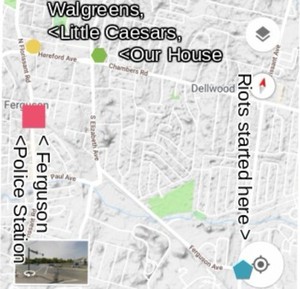
I’m putting a picture from Google maps in here to show you where things were happening and where we lived.
You’ll notice three main North/South streets, West Florissant (this is the street right off of which Michael Brown was shot and where the riots started), Elizabeth (the street we lived on) and N. Florissant (the west most of the main North/South streets).  The main East/West street that you see had several different names, Chambers and Hereford are two shown on the map.
Our house was on the corner of Chambers and Elizabeth.
Despite what happened during the night, during the next day, things felt rather normal.  The sun was shining, kids were walking to the school across the corner from our house, cars were driving by where we lived just like usual.  But it was an uneasy, eerie feeling.  It was like the calm that occurs when the eye of a hurricane passes over you and the sun comes out like life is happy and normal and there’s nothing to worry about until the second half of the hurricane hits you.
But of course, night follows day.   And with the next night, there was more unrest.  Again, thankfully, it was mostly contained about a mile from us.
The riots didn’t stop.
This cycle of fairly calm days and vicious nights continued the next few days.  By Wednesday, we had seen that this wasn’t going to go away quickly.  The protests seemed to be growing each evening – at least a little.  So Thursday, I packed several suitcases and put them in the back of the van – where they stayed.  Bug Out Bags are okay, but if you know there’s a good chance you’re going to have to leave for a few days (or permanently if our house was burned) it’s better to have three changes of clothes and night clothes for each person than to have just one.
The question started growing in our minds.  When do we leave?  We knew our family needed to be protected, but how close to our house is too close?  I’ve read articles where people talk about ‘buggin out’ like there is that one right moment to bug out.  Anything before that is just worry.  Anything after that is foolishness.
There is no cut and dried “perfect time to leave” while you are living in a dangerous situation.  The struggle is a real.  You don’t want to leave too soon and foolishly waste resources or overtake friend’s houses unnecessarily.  On the other hand, you don’t want to get caught in the middle of the turmoil and not be able to make it out with your family.  The truth is there is no way to know when it is the exact right time to leave until after that moment happens.
We waited, wondered if we should leave, and watched.  Friday night though, we had a lot more to watch.  That night the riots broke out in the area of Ferguson in which they had previously been contained.  Rioting, looting, and burning spread all the way from the area in which it started north almost two miles to the highway.
It also spread across the city over to New Florissant road.  Our Walgreens, Little Caesars, and Shop & Save (our grocery store) were all on different corners of the intersection of West Florissant and Chambers/Hereford.  They were only about one quarter to one half a mile from our house.  All of them were looted.
Again, we felt that torn feeling.  Do we stay or do we leave at 1 am? Do we wake up the kids and wake up our friends?  My parents also lived in Ferguson, so it’s not like we could go to their house for a few nights to escape the turmoil.  We hated to be a burden on friends outside the area.  I know it sounds silly.  Our friends would have been happy to put us up, but that really does weigh on your decision.  Going to a hotel wasn’t really an option.  That cost a lot of money that at the time we didn’t have.
We stayed that night and didn’t sleep much.  As the next day dawned though, we witnessed the destruction.
Then everything changed.
There was something else that was evident the next morning too.  Now that the riots had turned more violent and moved to the other side of our house, I had lost my sense of security.  That might sound like a “DUH,” moment, but until something like this happens, it’s hard to realize just how deep your sense of security had been and just how much is now gone.  It was that ‘normalcy bias’ that I talked about earlier.  It was then that I realized things weren’t going to get better quickly.
With our sense of security gone, practical things changed for us. we could no longer sit out on our porch swing.  Our children weren’t allowed outside.  The blinds were kept pulled all day long.  We didn’t leave the house unless we absolutely had to.  At night we could literally smell the tear gas that was being hurled at people.
On the night of Monday, August 18th, everything exploded again.  Hundreds of protesters gathered in Ferguson.  Rioters threw bottles at police before the group charged the officers.  Almost 100 people were arrested that night.  The next morning, we called our friends, loaded our children into the car and decided that it was time for us to leave for a few days.
We spent three days with friends about thirty minutes from Ferguson as things continued. After three nights of being away, when Governor Nixon recalled the national guard from Ferguson, we found that our house was still standing and there was no physical damage to the property. We decided we really needed to return home.
Things would never be the same.
Upon our return, our attitude changed further.  It’s amazing the things you take for granted like the stores at which you shop.  I stopped shopping at my usual stores because I didn’t want to shop in the area.  I would travel five to eight miles out of town to go to a store when it had a counterpart less than a mile from me.
We found a park near my husband’s work and ate lunch with him and to let the kids play because they weren’t going to play outside at home.  We did what we could to give the kids a sense of normalcy since we were living in this nightmare for months on end.
The atmosphere during the following days continued to change as well.  Gunshots in the streets became more frequent.  We had heard them on occasion over the previous thirteen years that we had lived there, but NEVER like we heard after August 9th. There were fewer kids walking to school.  Police sirens were heard crossing our corner almost hourly.
It was about this time that my husband and I began to talk about relocating.  We had been casually talking about the possibility of a job with a company located in central Illinois.  We decided that this was the time to get more pointed and committed to the discussion with them.  We didn’t know how we were going to sell a house in the middle of a zone torn by riots, but we knew we couldn’t continue living this way with five children.
The unrest went on far longer than most people realized.
What might surprise many readers is that the riots really lasted a LONG time for us.  There was unrest almost every night for months.
One night, I had to be out teaching a class.  When I came home, the kids all told me about how the protesters had walked from the Memorial on West Florissant north to Chambers/Hereford where they turned west, and then when they reached North (New) Florissant, they turned south and went to the police station.  This took them right by our front yard.  As a matter of fact, the crowd was so big that there were some who overflowed into our yard.  The police had a helicopter with its searchlight/spotlight pointed into our front yard to watch the protesters at one point.  It was a sensational event for a couple of my children, but it really frightened several of my children.
Some of our children started to exhibit signs of emotional trauma.  Incidents of bed-wetting increased, and our youngest child even refused to sleep in a bed by himself.  We had children that were frightened to go out to the car if it wasn’t in the garage.
Between August and October, when we were home, we lived exclusively indoors.  We continued to take multiple trips each week to parks near my husband’s work.  The kids would play, and my husband would join us for lunch.  We had a library that we loved to go to where the kids didn’t have to worry about whispering.  We went there at least once a week.  It was hard helping the kids find a sense of normal in the midst of daily turmoil.  They had seen some very frightening events first hand.
But time continued on.  Despite the fact that there was still unrest almost every night, television stations stopped broadcasting about the riots.  Everyone was tired of hearing of hearing about them, so all of a sudden, in the media, it was like the riots didn’t exist
But they did for us.
By this time our house was on the market (of course without a prospect on the horizon).  We were getting close to a job deal with the company in central Illinois.  Moving was starting to look like a real possibility.
Once we reached October, there was a whole month of activities planned by activists called, “Ferguson, October.”  Fortunately, the events of “Ferguson October” were listed online.  When we were checking it out, we saw that there was going to be a big event in Ferguson in for an entire weekend.  Again, we were torn, but we didn’t need our children to be subjected to any more of the violence, so we decided to pack up and leave the town for the weekend.  We stayed with some friends in Illinois.   Not much came of that weekend, though.
We finally relocated.
Eventually, despite my husband’s well-paying, secure job in St. Peters, Missouri, we moved from Ferguson to a small city in central Illinois in November.  November actually ended up having the worst violence of our whole time in Ferguson.
We planned on leaving Ferguson on November 20th, but on November 17th, Governor Nixon declared a state of emergency in anticipation of the verdict in the case of the police officer who shot Michael Brown.  No matter what the outcome, violence was anticipated.
When we heard that, we left.  We packed up our belongings on November 18th and drove to a friend’s house in central Illinois.  We wouldn’t be taking possession of our rental house until November 20th, but all indications were that things were going to get out of hand.  Yeah.  That was the understatement of the year – and considering the year we had, that says something!
The verdict of not guilty came out of November 24th and carnage ensued.
Shops that had been looted before were now burned.  Shops we had used for years on end were gone never to be rebuilt – or at least not rebuilt as the businesses they were in the past.  There had been an attempt at a deal between the city of Ferguson to bring in a CVS drug store. With everything that happened, CVS refused to move into the neighborhood.  Other stores which hadn’t been destroyed pulled out as well.
We still had to come back to finish cleaning out our house in the hopes of selling it.  We saw the devastation first hand again.
This event affected us permanently.
While we missed our house and our neighborhood, we would have missed it even if we had stayed.  I have friends who still live in Ferguson and they’ve told me that there is still violence from time to time and that it doesn’t have the same atmosphere as before the riots.
When we moved, our salary was greatly diminished and our expenses were higher, but our children were able to play outside again.  It took years for our house to sell and we took an enormous loss. They were able to climb trees in our own yard again.  We rarely heard sirens anymore.  In many ways, my children were able to bounce back.  It was worth every bit the cost of moving and more.
Even now though, four years later, from time to time I still notice residual actions or insecurities that I believe were brought on by what we lived through in Ferguson.  Those events changed each of us.  They made us a little more streetwise.  They brought us a little more sense of awareness around us.
What we learned
So if I could leave you with a few takeaways, they would be these:
  • Don’t think it could NEVER happen to you.  We lived in a small town surrounded by wonderful people.  I would never have dreamed in my wildest nightmares that we’d be enveloped in civil unrest of any magnitude, let alone that magnitude.
  • Being ready for the unexpected is a MUST! I have a friend who asked me why in the world she should keep items together (like a BOB or Grab-and-GO bag) in case they had to evacuate.  Sure she lives on the Florida peninsula, but they always have some notice before a hurricane, right?  This is why.  You never know when you literally have five minutes to be out of the house before unrest of one sort or another reaches you.
  • Learn to use social media to your advantage. During the whole situation, Twitter was our best friend.  We would stalk Twitter and more specifically #Ferguson on Twitter.  What we saw either could keep us in our house or evacuate us at a moment’s notice.  If we needed to leave the house, we always checked #Ferguson on Twitter.  We would be able to see where the protests were and which was the safest way out of the city.
  • Having items that you keep in your car all the time is VERY helpful in case you ever need to leave quickly. We keep various tools, foods, drinks, first aid kits and more in our family vehicle.  You never know when having them in your car is the difference between you having something and you having nothing.
  • Watch for the effects that stressful situations may be having on your children. Learn to notice the differences and do what you can to mitigate what they are going through.  If you can’t actually stop what they are going through, then do what you can to help them have a sense of normalcy in the midst of it.  For us, routines helped.  It was also helpful to learn where we could go that was safe so that our children could get out their energy.  Extra time with parents and extra snuggle time with those children who need it is also vital.
I want to leave you with one final thought.
Earlier I mentioned normalcy bias.  Ya know what?  You most likely have that, even if you’re a prepper.  By the time the Ferguson Riots hit, I was a prepper – maybe not a very good one – but a prepper nonetheless.  Yeah, I was prepping for some unnamed event out in the future that MIGHT happen to me, but when it did happen to me, in many ways it still didn’t seem real.
There’s another part of Wikipedia’s definition I didn’t mention before,
“This [normalcy bias] may result in situations where people fail to adequately prepare themselves for disasters.”  (source)
Don’t be that person.  Don’t be that person who doesn’t prepare for anything because they think that everything is just going to be the same as it always was.  Don’t be the person who lives in denial of a terrible event ever happening to them.
It can happen to you, and it might happen to you.
I never dreamed that my family would have to face having our home severely damaged by a tornado, or that we’d live through the Ferguson riots, or even that we’d be attacked by a knife-wielding teenager bent on killing everyone at our chess club.  We didn’t plan for any of that to happen to us, but it did.
Learn, practice, and prepare yourselves mentally as well as physically, so that if a life-altering event happens to you, you can face it and come through the other side more wise and capable than when you went in.
Reprinted with permission from The Organic Prepper.
Copyright © 2018 The Organic Prepper

https://www.lewrockwell.com/2018/03/no_author/what-civil-unrest-is-really-like-we-survived-the-ferguson-riots/

Putin’s State of the Union - PaulCraigRoberts.org


Putin has given a remarkable address to the Federal Assembly, the Russian People, and the peoples of the world. http://en.kremlin.ru/events/president/news/56957
In his speech Putin revealed the existence of new Russian nuclear weapons that make it indisputably clear that Russia has vast nuclear superiority over the United States and its pathetic NATO vassal states.
In view of the Russian capabilities, it is not clear that the US any longer qualifies as a superpower.
There is little doubt in my mind that if the crazed neoconservatives and military/security complex in Washington had these weapons and Russia did not, Washington would launch an attack on Russia.
Putin, however, declared that Russia has no territorial ambitions, no hegemonic ambitions, and no intention to attack any other country. Putin described the weapons as the necessary response to the West’s firm refusal year after year to accept peace and cooperation with Russia, instead surrounding Russia with military bases and ABM systems.
Putin said: “We are interested in normal constructive interaction with the United States and the European Union and are expecting that common sense will prevail and our partners will choose fair and equal cooperation. . . . Our policy will never be based on aspirations for exceptionalism, we are defending our interests and respect the interests of other countries.”
Putin told Washington that its efforts to isolate Russia with sanctions and propaganda and to prevent Russian capability to respond to the growing military encirclement from the West has failed. Russia’s new weapons have made the entire US/NATO approach “ineffective from a military point of view.” “The sanctions to constrain Russia’s development, including in the military sphere… they did not work out.” They have not been been able to contain Russia. They need to realize this… Stop rocking the boat in which we all sit.”
So, what is to be done? Will the West come to its senses? Or will the West, drowning in debt and loaded to the gills with bloated and ineffective military industries, intensify the Cold War that Washington has resurrected?
I do not think the West has any senses to come to. Washington is totally absorbed in “American exceptionalism.” The extreme hubris of the “indispensable country” afflicts all. The Europeans are bought and paid for by Washington. I am confident that Putin was hopeful that European leaders would understand the futility of trying to intimidate Russia and cease to endorse Washington’s Russiaphobia that is leading to nuclear war. No doubt Putin was disappointed in the idiotic response of the UK defense minister Gavin Williamson who accused Russia of “choosing a path of escalation and provocation.”
My guess is that the neoconservatives will play down Russia’s capability, because the neoconservatives do not want to accept that there are any constraints on Washington’s unilateralism. On the other hand, the military/security complex will hype the Russian superiority in order to demand a larger budget to protect us from “the Russian threat.”
The Russian government concluded from years of frustrating experience with Washington’s refusal to consider Russia’s interests and to work together in a cooperative manner that the reason was Washington’s belief that American power could compel Russia to accept American leadership. To shatter this Washington illusion is the reason for Putin’s forceful announcement of the new Russian capabilities.
In his address, he says, “no one wanted to speak with us. No one wanted to listen to us. Listen to us now.” Putin stressed that Russia’s nuclear weapons are reserved for retaliation, not for offense, but that any attack on Russia or Russia’s allies will receive an immediate response “with all the attendant consequences.”
Having made it clear that the Western policy of hegemony and intimidation is dead in the water, Putin again held out the olive branch: let us work together to solve the world’s problems.
I hope that Russian diplomacy succeeds in bringing an end to the rising tensions fomented by Washington. However, Russian diplomacy faces two perhaps insurmountable obstacles. One is the need for the bloated US military/security complex to have a major enemy as a justification for its $1,000 billion annual budget and the power that goes with it. The other obstacle is the neoconservative ideology of US world hegemony.
The military/security complex is institutionalized in every US state. It is an employer and a source of major political campaign contributions, which makes it almost impossible for a senator or representative to go against its interests. In US foreign policy circles there is yet to appear countervailing power to the crazed neoconservatives. The Russiaphobia that the neoconservatives have created now affects ordinary Americans. These two obstacles have proved sufficiently powerful to prevent President Trump from normalizing relations with Russia.
Perhaps in his next speech, Putin should address the Europeans directly and ask them how European interests are served by enabling Washington’s hostilities toward Russia. If push comes to shove, how can any country hosting US ABMs, US nuclear weapons, and US military bases expect to escape destruction?
Without NATO and the forward bases it provides, Washington cannot drive the world to war. The basic fact of the matter is that NATO is an obstacle to peace.


Vox Popoli: The younger religion (More of Judeo-Christian)


There has been a similar debate at Steve Sailer's over the propagandistic term "Judeo-Christian". There were four things in particular that I noted from the comments:

1) The great American intellectual Harold Bloom reached a similar conclusion about the myth of the "Judeo-Christian tradition".

There is no such thing as a Judeo-Christian tradition. That is absolutely ridiculous. And fascinatingly enough there are two things that I’ve said throughout my life when I’ve addressed Jewish audiences, say at the Jewish Theological Seminary or such places, and they always get furious at me. But they’re both true. One is that nowhere in the whole of the Tanakh does it say that a whole people can make themselves holy through study of texts. That’s a purely Platonic idea, and comes out of Plato’s Laws. That simply shows how thoroughly Platonized the rabbis of the second century were. The other one, which I say in this book and it has already given some offense, is that in fact not only is Judaism, which is a product of the second century of the common era—and it’s worked out by people like you know Akiba and his friends and opponents like Ishmael and Tarphon and the others, is a younger religion than Christianity is. Christianity in some form exists in the first century of the common era. What we now call Judaism comes along in the second century of the common era. Christianity is actually the older religion, though it infuriates Jews when you say that to them.

2) Christianity has considerably more in common with Islam than with Judaism. The Muslims regard Jesus Christ as a divinely inspired prophet. The Jews regard him as at best a fraud, and at worst, an evil sorcerer who is in Hell boiling in excrement. The Jews are also awaiting the Antichrist and will worship him. The Muslims are not.

Unlike Islam, Judaism does not accept Jesus as a prophet or as having performed any miracles. The rabbi’s best guess was that Jesus was the illegitimate offspring of a Roman soldier and that Mary made up the “virgin” thing as an excuse. Nowadays they would go on Maury Povich and get a paternity test. They most certainly do not believe that Jesus came back to life after his crucifixion and then flew up to heaven. 

3) Oliver Cromwell never allowed the Jews to legally return to England. The celebration of the "informal resettlement" is pure historical revisionism meant to hide the fact that they were illegal infiltrators there for hundreds of years, until 1858. And it was the same sort of evangelical ecumenites as today's churchian cuckservatives who were responsible for the legal emancipation of the Catholics and the Jews. Less than a century later, England found itself enmeshed in global wars, lost its empire, then its sovereignty, and was invaded by third world savages. Sound familiar?

4) This exchange was both informative and hilarious. The amusing thing is the way in which that David Goldberg's semi-autistic fan actually thinks he's being conciliatory rather than infuriating.

As a Jew, I have nothing against Jesus. At best, “Jesus” is a fairy tale creation, akin to Santa or the Easter Bunny. At worst, Jesus was a dangerous cult leader/sorcerer/terrorist, but who cares cause he’s dead. The real issue is political reality. And the fact is, Israel needs evangelical support.
- SpenglerFan

Really? Why is that? Why not use your awe-inspiring 115 IQs to take care of yourselves for once? I’d also like to let you know how much I enjoyed hearing the rationalist, “fairy tale” explanation of Jesus, juxtaposed with the suggestion that he might really have been an evil sorcerer. You don’t get that combination very often.
- Anon


Thursday, March 1, 2018

Vox Popoli: It's a start, anyhow


Kurt Schlichter appears to have correctly concluded that more dire warnings will not suffice to deter the Left:
They hate you. And we must act accordingly.

 The first step is the political battle. Wake up – the midterms are coming and we need to ensure that these people do not gain the power to undercut our rights. At CPAC, President Trump demonstrated that his competitive nature is in full effect – he intends on winning. We need to do the same. Volunteer. Donate. Activate. Yeah, it’s a hassle. We’d all like a pause to this constant cold warfare. That is not happening.

The second step is the cultural battle. The left is intent on mobilizing the corporations that form the infrastructure of society against us. We need to respond with our own political power, and that means casting off the tired shackles of an ideology that assumes we are in a pure free market scenario. “Free market solutions” don’t apply where companies instead act based on political ideology when choosing to exercise political power; how, exactly, do we respond to a company that acts against us but decides it doesn’t care about the market consequences? Well, we can’t – unless we use our own political power. Georgia refusing to give Delta a tax break – which it should not have gotten in the first place – is the template. If they want to declare a cultural war on us, let’s give them one. It’s not how you or I want it to be, but it is how it is. Maybe pain will motivate them to re-adopt the old rules. Surrender sure won’t.

The third step is to create deterrent facts on the ground. Demonstrate your commitment to your rights by joining the NRA and, further, by buying guns and ammunition. Tyranny is not out of the question – hey, aren’t they always calling Trump Hitler? Tens, even hundreds of millions of armed American Normals provide a deterrent to the kind of insanity we’ve seen the left hinting at. Be prepared to protect the Constitution, and the chances of them getting violent will diminish exponentially. Remember, they don’t want to fight; they prefer we give up under a barrage of hectoring from CNN and vicious tweets about how we hate children.

Yes, it’s ugly. Yes, perhaps it’s even frightening. But it is how it is, with leftists who makes no bones about what they think of you. They hate you. And you need to act accordingly.

It's something. It's a start. But it's still very far from sufficient. If you're still hoping that "pain will motivate them to re-adopt the old rules", then you're still failing to understand and accept the current situation. And sure, it could be somewhat demoralizing to see how many so-called conservatives, and how much of the so-called Right, simply refuses to support the only people willing to stand up and defend America, Christianity, and the West.

But so what? We don't need those cowardly, lukewarm ninnies more concerned about appeasing the enemy than they are about defending their nation, their faith, and their families any more than Gideon needed the mouthdrinkers, George Washington needed the Tories, or Jesus Christ needed the masses he fed with the bread and fish. Alt
Hero has 2,160 backers. After only one video, Voxiversity already has 261. And all our Lord and Savior needed was 12.

We can win. And we will win. All we have to do is find the courage to show up and fight. Support those who openly stand up for the good, the right, and the true. Ignore those who won't, and oppose those who attack them.


Vox Popoli: Denying Jesus and America


The relentlessly dishonest Ben Shapiro was quick to publicly deny both Jesus Christ and the Christian heritage of America while taking speedy exception to a rabbi telling Christians the truth about her religion. Shut it down! Unfortunately for the Littlest Chickenhawk, Twitter was well-informed and having none of it. Do not be deceived. Shapiro is a lying, parasitical snake; he is a Fake Right Fake American who has been artificially propped up in the media for nearly two decades in order to lead Christians and conservatives astray.
Rabbi Danya Ruttenberg@TheRaDR
This might be a good time to note that “Judeo-Christian” is not a thing and we Jews would like you to stop conflating our tradition with your American Christianity.

Ben Shapiro@benshapiro
This is nonsense.

Ben Shapiro@benshapiro

Judaism and Christianity are deeply intertwined. American Christianity has generally had a deeper love for the Old Testament than European Christianity. And the vast majority of religious American Christians see the Jews as the root of the tree of Christ.

Ben Shapiro
@benshapiro
The fact that America is Judeo-Christian and not merely Christian is a reflection of those facts.

Crew@CarborundumCrew
Ben, there is no Judeo-Christ!

Heather Anne@cler_morgaine
Judaism and Christianity are both *Abrahamic* faiths. The term 'judeo-christian' is used to to fake religious pluralism while excluding Islam, which arguably has more in common with both than they do each other.

Dr. Ramone, Esq.@melvinramone
Judaism rejects the core premise of Christianity. You're making up facts.

Cornelius Rye@CorneliusRye2
It's literally not. It's a very recent invention by YOUR PEOPLE. Jews have very little to do with America pre-WWII.

JOHNMEYER@JOHNMEY28401489
You represent Talmudism. Different thing.

#BroniesForTrump@GWSSDelta
White evangelical Christians' rate Jews 69 out of 100, but Jews rate evangelical Christians 34 out of 100. I look forward to the day when Christians wake up from the "Judeo-Christian" "greatest ally" con and realize that Jews hate them.

Emprah'sFinest@SamHydeShooter
Please tell me which of the Founders was a Jew.

Deplorable Unum
🇮🇹@deplorable_unum
Wrong. America predates the 20th Century, when the "Judeo-Christan"  term first appeared. Stop trying to rewrite America history, little Benny.

The Forgotten Man@_ForgottenMan
As many of the presidents of the past have said, "This is a Christian nation." The Judeo-Christian makes no sense, Judaism and Christianity are two very different religions.
And then, of course, there is the absolute, conclusive proof that America was never "Judeo-Christian" in any sense, as the term in its current form didn't even exist prior to WWII.

However, the rabbi is not entirely correct. It isn't so much "American Christianity" that attempts to falsely conflate Christianity and the post-Temple rabbinical talmudism that presently passes for Judaism. It is self-serving diasporans resident in the US like Ben Shapiro who have done so, in a moderately successful post-WWII propaganda campaign fueled by a poem and a play to deceive Americans about their own Christian heritage and the central importance of Christianity to both America and the West.

If you don't get why I bother to make these historical clarifications, if you don't realize the importance of the understanding the truth of this matter for Christians, I encourage you to contemplate the warnings from the Book of Revelation about the deception of the saints. From what nation will the Lawless One come? From what tribe will the False Messiah hail? In what city will he rule? What group of people are most central to the ongoing attempts to legally restrict the ability of badthinkers and thought criminals to make a living, to ensure that no one can buy or sell who does not have their mark of approval? On behalf of what nation have laws been passed to eliminate the right of Americans and others across the West to freely express their opinions about history and trade? What group of people and what religion relentlessly preach the New Babel and oppose nationalism in almost every nation around the world? Precisely how is the world to be "healed" and what would this healed world look like?

Make no mistake about this: Judeo Christ is another name for pseudokhristos and an ecumenical satanism that includes this anti-Christian, ahistorical, explicitly anti-Biblical "Judeochristianity" is his religion. But you need not take my word for the mythical nature of Judeo-Christianity. Even the early neocons were more honest, as Arthur Cohen attested in his 1969 Commentary article entitled "The Myth of the Judeo-Christian tradition".
It is an apparent truism that the concept of the Judeo-Christian tradition has particular currency and significance in the United States. It is not a commonplace in Europe as it is here; rather, Europeans since the war have become habituated to speak of Jewish-Christian amity, to define the foundations and frontiers of community, to describe and, in describing, to put to rest, historic canards and libels. In Europe they are not addicted as we are here to proclaiming a tradition in which distinctions are fudged, diversities reconciled, differences overwhelmed by sloppy and sentimental approaches to falling in love after centuries of misunderstanding and estrangement. I need not speak at length here of the religion of American secularism, that uncritical Jacobinism which is neither fish nor fowl, and certainly neither Christian nor Jewish. Suffice it to say that such secular religiosity is correctly perceived by both communities to be dangerous; it is the common quicksand of Jews and Christians. And it is here that we can identify the myth. Jews and Christians have conspired together to promote a tradition of common experience and common belief, whereas in fact they have joined together to reinforce themselves in the face of a common disaster. Inundated institutions have made common cause before a world that regards them as hopelessly irrelevant, and meaningless. The myth, then, is a projection of the will to endure of both Jews and Christians, an identification of common enemies, an abandonment of millennial antagonisms in the face of threats which do not discriminate between Judaism and Christianity; and these threats, the whole of the Triple Revolution—automation, the population explosion, nuclear warfare—these are the threats which evoke the formation of the myth.

The threats are real and desperate, but patching-over will not, in the long run, help. Patching-over can only deteriorate further what it seeks to protect. The Judeo-Christian tradition is an eschatological myth for the Christian who no longer can deal with actual history and a historical myth for Jews who can no longer deal with the radical negations of eschatology.
Or, alternatively, take the word of Dr. Jacob Klatzkin, the late editor of the Encyclopedia Judaica:
We are not hyphenated Jews; we are Jews with no qualifications or reservations. We are simply aliens; we are a foreign people in your midst, and we emphasize, we wish to stay that way. There is a wide gap between you and us, so wide that no bridge can be laid across it. Your spirit is alien to us; your myths, legends, habits, customs, traditions and national heritage, your religious and national shrines, your Sundays and holidays... They are all alien to us.
And if Marco Rubio, of all people, is selling the "Judea-Christian heritage" concept, that alone should be more than enough to confirm that it is false.
The debate after #Parkland reminds us We The People don’t really like each other very much. We smear those who refuse to agree with us. We claim a Judea-Christian heritage but celebrate arrogance & boasting. & worst of all we have infected the next generation with the same disease 
The point is that We are not The People, we are now multiple peoples, multiple nations, and multiple religions, all caught up in conflict over who will wield the imperial power over whom. More importantly, there is no "Judeo-Christianity". There is no "Judeo-Christian tradition" and there are no "Judeo-Christian values". You cannot follow both Jesus Christ and Judeo Christ.