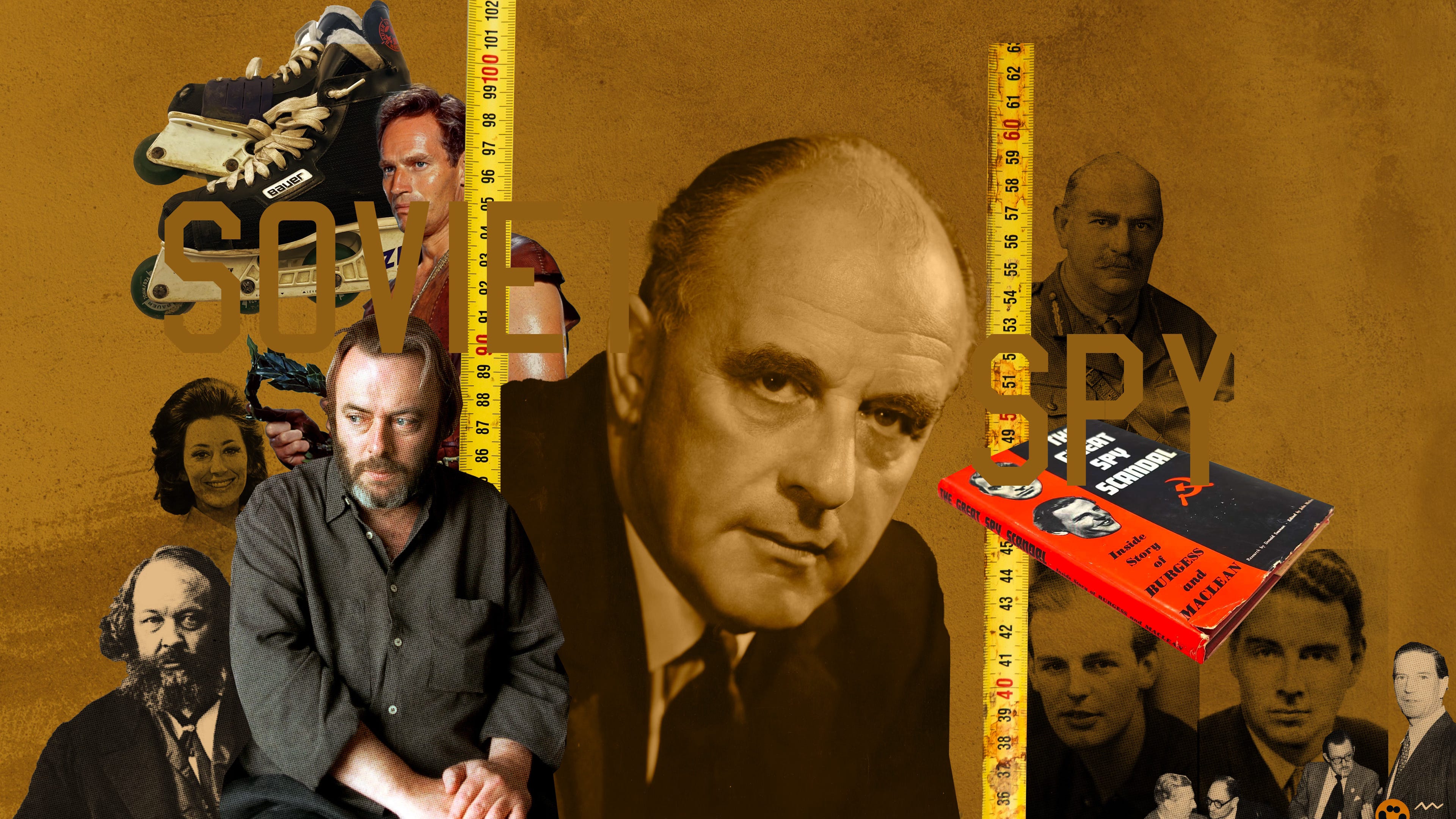
Lord (Victor) Rothschild - father of Jacob Rothschild, grandfather of Nat Rothschild - was a KGB spy. I don’t know about you but I think this is a pretty big deal. A British peer of the realm, supposedly working for the British intelligence services, was in fact a traitor and a double agent - or, indeed, a triple agent because he was also, inevitably, spying for Mossad.
But though reams have been written on the three most infamous double agents in 20th century British intelligence history - Philby, Burgess and Maclean - the treachery of Lord Rothschild remains largely unknown, despite the fact that Rothschild likely did more damage and betrayed more secrets than the other three spies put together. So how come he has been let off the hook?
This was one of the questions I was keen to ask this week’s Delingpod guest Roland Perry. Perry is the Australian professor and author who unmasked Rothschild in his painstakingly-researched book The Fifth Man. It was published thirty years ago and given the explosive nature of his material, you might have thought it would have sold in the millions - as did far less revelatory books like Peter Wright’s Spycatcher, which erroneously fingered MI5 head Roger Hollis as the Fifth Man. Instead, I was surprised to hear from Perry - who said I was just about the only interviewer in the last thirty years to take his research seriously - that the book’s sales scarcely exceeded five figures.
Really, though, I shouldn’t have been surprised at all. You only have to read Christopher Hitchens’s 1995 hatchet job in the impeccably left-liberal Establishment The London Review of Books to see where Perry came unstuck.
Roland Perry – who actually opens one of his chapters with the words ‘A shot rang out’ – would not know the difference between Bukharin and Bakunin, and makes the case that Victor Rothschild was a spy because he was a Jew. ‘He was never so committed to his country of birth and its established order. In fact, more than once when confronted with a conflict between race and country, he chose race.’ Well, why not come right out and say what’s on your mind?
I’m suspicious of any thesis that depends on such rhetorical fallacies as the argumentum ad indignationem and the appeal to ridicule; as I also am of one that the focuses on the style rather than the content. Hitchens deploys all three forms of trickery in this one paragraph, something I probably wouldn’t have noticed as a younger man in thrall to the cult of ‘the Hitch’, but which now strikes me as entirely characteristic of the man’s essential bogusness.....
A bit like Daniel Deronda, Hitchens was thrilled in later life to discover - at the age of 38, he claimed - that his mother was of Jewish heritage. This meant, of course, that he himself could lay claim to being a Jew - something which is unlikely to have done him much harm in the literary/political circles he frequented first in the UK and subsequently in America. But even if he hadn’t been a “Jew”, Hitchens would likely have been no less assiduous in witchfinding examples of antisemitism, even when, as in Perry’s book, they were purely imaginary. That’s because, contrary to popular myth, the curse of the British intellectual classes is not that they are routinely antisemitic. It’s that they are routinely, glibly and self-deceptively anti-anti-semitic.
To appreciate this point does not require you to think ill of the Jews.
