Labels

Saturday, December 5, 2015

What to Do in an Active Shooter Situation

Maintain Situational Awareness Wherever You Go
Besides having a general idea of what you’d do in an active shooter situation, another thing you must do to increase your chances of surviving is constantly maintaining situational awareness.
We’ve written in detail about situational awareness before, so rather than getting into the nitty gritty here, let’s review a few important principles as they apply to shootings:
Stay in condition yellow. Condition Yellow is best described as “relaxed alert.” There’s no specific threat situation, but you have your head up and you’re taking in your surroundings with all your senses. Most people associate situational awareness with just visual stimulation, but you can also learn a lot about a particular scenario from sounds. This is especially true for active shootings. If you hear gunshots — or something that sounds an awful lot like gunshots — that should be a sign that you need to start immediately preparing to take action. 
Though your senses are slightly heightened in Condition Yellow, it’s also important to stay relaxed. Staying relaxed ensures that you maintain an open focus, which allows you to take in more information about what’s going on around you. Research shows that when we get nervous or stressed, our attention narrows, causing us to concentrate on just a few things at a time. A narrow focus can therefore cause us to miss important details in our environment.
Bottom line: Don’t have your nose constantly in your smartphone and don’t zone out; rather, you should open your eyes, ears, and nose, and calmly and constantly scan your environment to take in what’s going on…………
Conclusion

While active shootings are increasing, they’re still rare. We shouldn’t be cowered in our homes in fear. But there’s no downside to being prepared. Sometimes there’s nothing you can do to survive a shooting; you’re in the wrong place, at the wrong time, and you’re killed without warning. But you may get a chance to act, and will only have seconds to figure out what to do. Your stress will be through the roof and the situation will be utter chaos. If you hope in that moment to be able to protect your life and the lives of others, ready yourself now and have a plan of action wherever you go.

A vision of paradise restored, looking forward to 2016

Monday - a book I want to read!

Monday
Somehow, between Red Eagle, Mike Cernovich, Red Meat, Automatthew, myself, Castalia House's star proofreader, and the self-appointed religious conscience of the blog, we have managed to complete Cuckservative in time to ensure its Amazon release on Monday. I also just received the second of the two bonus books; it is a complete riot, so if you haven't signed up for the New Release mailing list, please note that this is your last chance to do so before the Cuckservative mailing goes out on Monday morning. You can sign up on the left sidebar. <===== Look over there.

As one of the authors, my opinion is too close to have any perspective at all, for better or for worse, but two of the early reviewers have used some form of the phrase "hits it out of the park". Red Eagle himself said after going over the completed manuscript, "this is a powerful book".

It is going to be considerably more controversial than SJWAL was. I would be absolutely astonished if it was not vilified as being heartless and unapologetically racist, and I will be astounded if the words "vicious", "hateful", and "Nazi" do not appear in almost every critical review. It should have a real shot at the record for the most one-star reviews on Amazon. I wonder what the record is?

In the book's defense, all I can say is that it is remorselessly true. We didn't bother with footnotes or a lot of citations because we know how that game is played; this is not a dialectical book, it is weaponized rhetoric backed by solid dialectic. And, as we know, the best rhetoric always stands on a foundation of truth.

There will be many things about the book that will make you uncomfortable, things you will not like. Some of you will even be offended. But we cannot, and we will not, apologize for writing about the truth as best we see it. Reality is what it is. The facts are what they are. The future will be what it will be. I don't like many aspects of what appears to be the most likely scenario any better than any other sane individual, but then, no one ever asked me to arrange matters.

A few people have questioned whether Red Eagle exists or if I invented him in order to deflect some of the inevitable criticism. All I can say is that a) he wrote more of it than I did, b) he's a more engaging writer than I am, and, c) if you genuinely believe I wrote both SJWAL and Cuckservative by myself since June, you're insane. Also, there will be no deflecting any criticism. The open borders crowd is going to view Cuckservative as something between the hateful bastard of The Bell Curve and Mein Kampf, and a set of blueprints for making a working nuclear bomb out of Legos printed on the back of a Cheerios box.

Translation: I don't think SJWAL's reign as "the most dangerous book in America" is going to last beyond Monday. The goal is to hit 1k on Monday.

Populism Is a Path to Liberty - Rothbard and Ron Paul are right, says Jeff Deist.

Libertarian strategy has always been a vexing topic. Presidential election years, filled with statist campaign rhetoric, tend to cause existential pain and a reexamination of the fundamental question before us: What must be done to reduce the size and scope of the state? How can we realistically create a more libertarian society here and now, given the resources available and the range of tactical options? Is our primary task intellectual, with the goal of converting academic, financial, and political elites to our point of view? Or is a bottom-up strategy superior, one that focuses on populist messages and grassroots political activism?
Is our fight intellectual or populist?
Murray Rothbard addressed both of these approaches in a decidedly un-PC essay written in 1992, an election year that presented libertarians with many of the same issues faced today. He discusses the goal of influencing elite thinkers, a process he termed “Hayekian conversion,” and contrasts it with the goal of reaching the masses through populist messaging.
Typically for Rothbard, he saw no inherent conflict between seeking popularity for libertarian ideas and sticking to first principles. As for appealing to elites or appealing to the masses, he suggests both. But the real subject of the article is populism, a topic Murray approaches unabashedly: libertarians should openly embrace right wing populism as the quickest means to generate opposition to the state and its lackeys, specifically the “technocrats, ‘social scientists,’ and media intellectuals… who apologize for the State system and staff in the ranks of its bureaucracy.”
Almost 25 years later, Murray’s analysis sounds quite prescient:
Libertarians have often seen the problem plainly, but as strategists for social change they have badly missed the boat. In what we might call “the Hayek model,” they have called for spreading correct ideas, and thereby converting the intellectual elites to liberty, beginning with top philosophers and then slowly trickling on down through the decades to converting journalists and other media opinion-molders. And of course, ideas are the key, and spreading correct doctrine is a necessary part of any libertarian strategy. It might be said that the process takes too long, but a long-range strategy is important, and contrasts to the tragic futility of official conservatism which is interested only in the lesser-of-two-evils for the current election and therefore loses in the medium, let along the long, run. But the real error is not so much the emphasis on the long run, but on ignoring the fundamental fact that the problem is not just intellectual error. The problem is that the intellectual elites benefit from the current system; in a crucial sense, they are part of the ruling class. The process of Hayekian conversion assumes that everyone, or at least all intellectuals, is interested solely in the truth, and that economic self-interest never gets in the way. Anyone at all acquainted with intellectuals or academics should be disabused of this notion, and fast. Any libertarian strategy must recognize that intellectuals and opinion-molders are part of the fundamental problem, not just because of error, but because their own self-interest is tied into the ruling system.
Why then did communism implode? Because in the end the system was working so badly that even the nomenklatura got fed up and threw in the towel. The Marxists have correctly pointed out that a social system collapses when the ruling class becomes demoralized and loses its will to power; manifest failure of the communist system brought about that demoralization. But doing nothing, or relying only on educating the elites in correct ideas, will mean that our own statist system will not end until our entire society, like that of the Soviet Union, has been reduced to rubble. Surely, we must not sit still for that. A strategy for liberty must be far more active and aggressive.
Hence the importance, for libertarians or for minimal government conservatives, of having a one-two punch in their armor: not simply of spreading correct ideas, but also of exposing the corrupt ruling elites and how they benefit from the existing system, more specifically how they are ripping us off. Ripping the mask off elites is “negative campaigning” at its finest and most fundamental.
This two-pronged strategy is (a) to build up a cadre of our own libertarians, minimal-government opinion-molders, based on correct ideas; and (b) to tap the masses directly, to short-circuit the dominant media and intellectual elites, to rouse the masses of people against the elites that are looting them, and confusing them, and oppressing them, both socially and economically. But this strategy must fuse the abstract and the concrete; it must not simply attack elites in the abstract, but must focus specifically on the existing statist system, on those who right now constitute the ruling classes.
Libertarians have long been puzzled about whom, about which groups, to reach out to. The simple answer: everyone, is not enough, because to be relevant politically, we must concentrate strategically on those groups who are most oppressed and who also have the most social leverage.
Rothbard makes two important points here, both are which are deceptively simple and thus often overlooked:
  • First: elites are not motivated by intellectual ideas, good intentions, or the betterment of society. They are motivated by self-interest, like everyone else. Therefore the question is not whether we can convince elites that libertarian ideas are better, but whether they would be better off in a more libertarian world. For many state-connected elites, the answer is decidedly no. This explains why Hayekian conversion frequently fails. Rothbard understood the immense power of self-interested elites working against the libertarian message. The state and its clients—central bankers, academia, crony corporations, defense contractors, federal workers, politicians, and the whole political class—are aligned against us. But as Rothbard posits, we cannot simply give up on identifying potential allies among those elites. Organizations like the Volker Fund, IHS, and the Mises Institute have had success in winning converts and placing libertarians in academia, and surely we can’t simply cede higher education entirely to progressives. We also should seek alliances with elite libertarians in the business and investment worlds wherever possible, people like Peter Thiel and Mark Spitznagel.
  • Second: any successful libertarian strategy must contain a healthy dose of populism. Austrian economics and libertarian theory often don’t lend themselves to easy sound bites and simplistic memes. But intellectual arguments alone won’t carry the day. Effective populist messages contain an implicit answer to the question of “What’s in it for me” that satisfies the average Joe or Jane. It’s easy for Bernie Sanders simply to say, “I want to make college free so that all young people have an equal chance at success.” It’s not so easy to hand someone 900 pages of Human Action and say, “Read this, you’ll understand” (but try it anyway).
Many Americans are too busy keeping their head above water and raising families to spend any free time reading economics or libertarian theory. At most, the average person might pay some slight attention to the campaign season and vote in the majority of elections. Therefore a winning populist message must be easy to understand, easy to sell, and obviously beneficial to middle class and working class constituencies. A populist message by definition is not one that requires a great deal of work to find or adopt.
Case in point: Ron Paul managed to enlist thousands of new libertarians during his 2008 and 2012 presidential campaigns by successfully applying two populist messages: “End the Fed” and “Get out of the Middle East.” Both messages appealed across ideological lines, and both messages captured the prevailing mood of the country.
After the Crash of ’08, many Americans increasingly were wary of Wall Street and its cozy connections with both the Fed and the Treasury Department. Wall Street got bailed out, Main Street did not. The public’s understanding of what the Fed does and how exactly it creates an elite banking class may have been fuzzy, but so what? The Fed is a great example of an issue where the average person’s reflexive viewpoint just so happens to be correct and libertarian at the same time. Ron Paul was able to tap into visceral anti-Fed sentiment in the same way that progressives do on a host of other issues.Dr. Paul similarly exploited weariness with our Middle East entanglements by using another simple and appealing populist message: get out of Iraq and Afghanistan. In doing so, he correctly sensed that the interventionist sentiment following the events of 9/11 had passed. By 2008, and certainly by 2012, a majority of Americans had come to the conclusion– however vague– that these two lengthy wars were producing nothing except casualties, debt, and blowback. So Paul’s principled antiwar position dovetailed with the national mood, even if most people might not have articulated a libertarian rationale for that mood.
Libertarian populism, like any form of populism, can be a double-edged sword. Support for any candidate or message that is not based on some degree of thought and deliberation can turn on a dime. But note that many of those initially drawn to Dr. Paul’s campaigns by its populist themes went on to read books he had recommended, becoming more fully liberty-minded as a result. And as Rothbard points out, libertarians ignore populism at our own peril. Just as every left wing populist has not read Marx or Howard Zinn, we should not apply intellectual litmus tests to potential libertarian converts. When it comes to libertarian populism, reflexive antipathy for the state—and an instinctive recognition of its malevolence—can be enough.

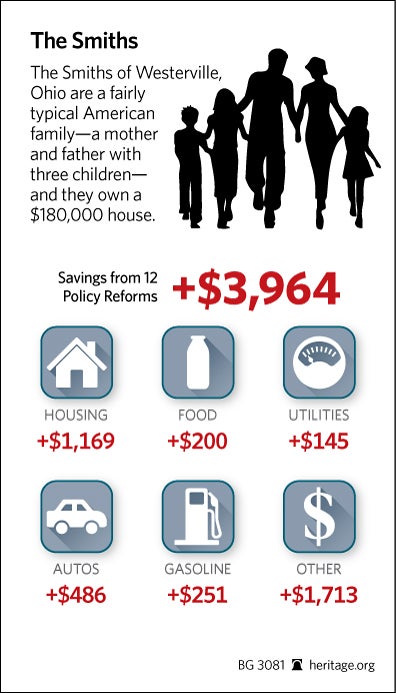
These 12 Policy Reforms Could Save An Average Household $4,440 a Year

Economic freedom is a matter of principle, but it’s also a boon to family budgets.
Just 12 economic policy reforms would save the average household $4,440 a year. Opening up markets to more competition, treating outsiders and insiders equally, and squeezing out bureaucratic delays could push prices down enough to give American families some budgetary breathing room.
>>> Read the full report: How Bad Policies Raise the Cost of Living
Nor do Americans need to wait for Washington: States and municipalities can implement some of the biggest cost-saving reforms.
Dozens of studies have looked at specific ways that prices are driven up by policy mistakes. I collected the evidence on 12 policy mistakes and found that the combined effect of free-market reforms would be a huge benefit to consumers: $546 billion a year, more than all the rent paid by Americans in a year. The 12 policy mistakes—and paths to reform—are detailed below……….

smithgraphic

Federal reforms
The characteristic vice of the federal government is cronyism. Lots of well-connected insiders have figured out that if you take a few dollars from everyone in America, you will be very rich, and the victims might not notice. Below are just a few of Washington’s reverse Robin Hood schemes.
Corporate Average Fuel Efficiency (CAFE) standards are the way that Rube Goldberg would have regulated fuel efficiency. When the Obama administration rewrote the CAFE standards in 2009, engineers and economists predicted that consumers would lose at least $3,800 per new car. Six years later, the price of cars is $4,500 above its previous trend. Repealing the CAFE standards would save the average household $448 per year.
The ethanol mandate requires that refiners use corn for gasoline. Corn isn’t very good at being gasoline. Just letting corn be itself would lower the price of gas by 19 cents per gallon and lower food prices by about one percent, for an annual household savings of $255.
Corporate tax complexity forces corporations large and small to employ armies of accountants and lawyers just to comply with the tax code (and to seek out its many loopholes). Commonsense corporate tax reform would lower their costs. Even if only half the gains were passed on to consumers, the average household could save $230 per year.
Repealing the crude oil export restriction would also lower the price of gas by 12 cents per gallon. That’s just a minor side benefit of repeal, which would also create jobs and increase incomes as well. But the average household will welcome an extra $227 per year.
The Sugar Program and Federal Milk Marketing Orders transfer money from consumers to wealthy landowners by raising the prices of staple foods. A gallon of milk would be 49 cents cheaper with a competitive milk market, and a pound of sugar would be 28 cents cheaper. Consumers would save 16 cents a pound on butter and four cents on a box of breakfast cereal. Each reform would save the average household $29 per year.
Cement production regulation is just one example of the many ways that the Environmental Protection Agency imposes high costs on consumers. Regulation has made it much more expensive to build a cement factory, allowing the existing plants to behave like monopolies. They pass on the costs of regulation to consumers and then some. Going back to the 1990 level of regulation in the cement industry would save the average household $14 a year. The broader lesson is that environmental regulations should be subjected to rigorous cost-benefit analysis.
Conclusion
Twelve steps toward economic freedom and away from cronyism and overregulation would save the average American household $4,440. Congress can make a difference, but so can state capitols and town halls around the country.
There are benefits to economic freedom that are not discussed in this op-ed: more jobs, higher wages, and less volatility in the housing market, for instance. More deeply, economic freedom is a civic virtue in itself—lower prices and greater prosperity are the fruit of individual liberty, not its justification.

Friday, December 4, 2015

The Government Is Powerless To Stop Terrorism - It’s lying about “security,” says Fred Reed.

A few cheering thoughts on terrorism. This column specializes in cheering thoughts.
Terrorism by Moslems in America and Europe cannot be stopped. If attacks do not occur, it will be because nobody tried very hard. Stopping them would require excluding Moslems, deporting them, or controlling them by totalitarian methods. Or, improbably, minding our own business in the Middle East.
What you think of the foregoing approaches doesn’t matter, since none of them will be used. In France the result would be a civil war. America is too divided to do anything about anything.
The notion that the government can prevent terrorism suggests studied inattention to the obvious.  To begin, the intelligence agencies have proved useless. NSA did not prevent the first attack on the Twin Towers in 1993, nor the successful one. French intelligence did not prevent the recant attacks in Paris, nor Russian intelligence the downing of the airliner over Syria. On and on………..

What goes on at airports is not security. It is Security Theater. When the government’s own agents try to smuggle “weapons” aboard airliners to test the system, they succeed ninety-five percent of the time......

It is interesting to remember that terrorism is not bad for everybody. For the Pentagon, Nine-Eleven was a windfall, providing wars and new drones; for NSA, a massive expansion in its powers; for Israel and AIPAC, the destruction of Israel’s arch-enemy, Iraq; for the arms manufacturers, hundreds of billions; for the federal government in general, near-dictatorship and, for jihadists, the involvement of the US in crippling and endless wars. Which is what they wanted. Everybody profited except the American public.
The future? Hard to say. As I write, President B. Hussein Obama is endeavoring to import tens of thousands of Moslems. It will be impossible to screen them, presumably making the importation a free ride into the US for terrorists if they so choose. It is not politically incorrect to note that the countless Moslem terrorists in recent years have been countless Moslem terrorists. It is, however, true. The greatest question about terrorists is not whether they can, but why they haven’t.


Thursday, December 3, 2015

The Logic of Islamic Intolerance

A sermon delivered by popular Saudi Sheikh Muhammad Salih al-Munajjid clearly demonstrates why Western secular relativists and multiculturalists -- who currently dominate media, academia, and politics -- are incapable of understanding, much less responding to, the logic of Islamic intolerance……………….

The net result of all this? On the one hand, Muslims, who believe in truth -- that is, in the teachings of Islam -- will continue attacking the “false,” that is, everything and everyone un-Islamic.  And no matter how violent, Islamic jihad -- terrorism -- will always be exonerated in Muslim eyes as fundamentally “altruistic.” On the other hand, Western secularists and multiculturalists, who believe in nothing and deem all cultures and religions equal, will continue to respect Islam and empower Muslims, convinced that terrorism is an un-Islamic aberration destined to go away -- that is, they will continue disbelieving their own eyes.  Such is the offspring of that unholy union between Islamic logic and Western fallacy.

Read more: http://www.americanthinker.com/articles/2015/12/the_logic_of_islamic_intolerance.html#ixzz3tJlS9cXZ